
Berkshire Hathaway Annual Meeting 2026 Transcript


How did Greg Abel open the 2026 meeting?
TL;DR: Greg Abel welcomed the owners to Omaha and laid out three sessions. Berkshire retired Warren Buffett’s number 60 jersey next to Charlie Munger’s number 45.
[00:00:00]
Thank you. And then the director who’s always done the movies again did this video and we’ll do our company videos. That I’ll touch on shortly. Brad Underwood. Thank you, Brad. Now, we have a great day planned and it’s really all around our owners. It’s our culture, but most importantly, this is our owners day, our owners weekend. We have an exceptional group of owners, and we’re just passionate to be here. Will communicate a variety of things around Berkshire and our insurance, our operating subsidiaries and the in Berkshire as a whole, but what we really treasure is the engagement with our again our owners, our shareholders and the questions that come. So, thank you. Really appreciate it.
Now to touch on this morning, we have three sessions that we’ll cover over the morning early afternoon. The first session, there’ll be some pleasantries here and then we’ll move into a business update. That’ll be the first session. As we move into the second session, I’ll have Ajit join us here on stage. We’ll obviously take any questions. So, it’ll be a question and answer period. We’ll do the traditional rotating between our shareholders and Becky. Becky, thank you for being here. And we’ll do the traditional Q&A and then that session will wrap and then we’ll move to a third session that will have Katie Farmer. Katie is a been the CEO of BNSF railway for the past five years.
And then we’ll also be joined by Adam Johnson who is a 10-year CEO 10-year CEO of NetJets but also took on an incremental role recently and we announced that in December. Adam took on the consumer products group, services and retailing group. So we’ll have them join us for the third session. Again, the traditional question and answer period. The only thing that I would say this is also a little bit incremental or different from past meetings. Throughout this morning, we’ll have three different videos associated with operating companies. The first one will be from GEICO, Nancy Pierce, who’s the CEO of GEICO, long-term veteran and wealth of experience with GEICO. She’s over in the manager section. She’ll narrate a video on GEICO.
And then we’ll also have a video on NetJets narrated by Adam and a video narrated by Katie on BNSF the railway. So that’ll be incremental. Now the fundamental purpose of both having the ma some incremental managers join us on the stage and the videos. We have an exceptional team at Berkshire. The depth of management is very deep. Obviously, we have a number of subsidiaries, but the depth of our team is great. And this is an opportunity through the videos or having incremental leaders on stage. It’s an incre it’s an opportunity for you as our owners to both learn more about those businesses, but also about the leaders that lead them. And that will be a format that as we go forward, we’ll build on.
I.e., we can introduce you to other leaders either on stage or through the videos. So let’s move to the formalities. Now I’m going to introduce our directors. I’m going to do it alphabetically. So if they could just acknowledge with a wave or however they would like to acknowledge our shareholders, our owners. Start with Howard Buffett. Susie Buffett, our chairman Warren Buffett. Warren, we have a little surprise there for you. If you look up to the right, you’ll see a jersey and a number. We are we’re retiring. Worn appropriately. It’s number 60 for 60 years as our CEO of Berkshire. Equally, it’s being it’s placed beside Charlie’s jersey, number 45. Charlie was with Berkshire for 45 years, obviously our vice chairman and a treasured partner of Warren and it’s just reflective of a great partnership.

Thank you, Warren. I’m happy to report both those jerseys will remain in the rafters for the years to come. So, Great. Now we’ll continue with our directors. Steve Burke, Ken Chenault, Chris Davis, our lead director. And I’ll just add a point here because this it’s Sue’s 20th year as a director of Berkshire. Thank you for being our lead director and all you do. Sue Decker, Charlotte Guyman, Ajit Jain, I would just add for relative to Ajit obviously been our vice chairman for of insurance for nine years. I had many years to be his co-chairman. But one thing I just want to touch on, Ajit joined Berkshire in 1986. So not only is he a director, just been really the architect of our insurance business.
So again, thank you. Ajit Tom Murphy Jr. Wally Weitz, Meryl Witmer. Now I can start to I think my eyes have adjusted a bit to the lights and everyone out there. And I have to tell a little bit of a story here because when Warren announced the transition last year and I was sitting here and couldn’t been more proud, but I don’t mind sharing. The first thing that flashed through my mind was, geez, we’ve already booked this arena and I know the directors would be here and I knew I would have some family here, but it’s wonderful to all have you here. So, thank you. Thank you. Now, back to a great tradition. I’m going to throw the mic over to Warren.
Warren, thank you.
What did Warren Buffett say about Apple and Tim Cook?
TL;DR: Warren Buffett said Berkshire’s Apple investment of about $35 billion has turned into $185 billion pre-tax. He thanked Tim Cook.
[00:10:23]
We turned it over to another person who was not that well known at the time. And we did that by spending roughly $35 billion buying stock in Apple Corp. And we were going to have that under the management. We’re turning that money over to the management essentially of Apple to make Berkshire look good and without any work by us, which is our preferred way of operating. And I would like to report that 10 years later several things are happening. One is the 35 billion counting dividends realized appreciation unrealized appreciation. But that has turned into 185 billion tax and I didn’t have to do a damn thing. I mean, so it’s, you know, we’re very big around here on having other people do the work and collecting the money, but that has been a success and we do look at marketable securities as being businesses.
Berkshire’s $35 billion Apple investment turned into $185 billion pre-tax
Counting dividends, realized and unrealized gains, as Warren Buffett described it in May 2026.
That doesn’t mean we hold all of them forever, but we still our largest holding is Apple. And Apple has a very interesting history that some of you may be familiar with. But one item is they’re observing an anniversary themselves. I think just within the last week or so. They celebrated their 50th anniversary and you know 50 years is seems like a long time but Apple seems like a very new company and when Tim Cook went into the top position at Apple he’s he succeeded allegedly And you know that Steve Jobs was everybody in America knew his name and not many people knew Tim’s name. And Apple had this roller coaster experience where the two Steves had started in a garage or something 50 years earlier and then I’m not sure how many of you know but Steve was thrown out for a while.
He came back in. He did these marvelous things in terms of developing products. And then he had an untimely death and everybody said who’s going to manage Apple when Steve Jobs isn’t around and probably just a very few percentage points of American investors had even heard of Tim Cook and we in effect Tim took over about 14 years ago when Steve died but when we made our investment and turned over 10% of the resources of Berkshire we were turning it over to Tim and as I say, he has turned that into 185 billion or something pre-tax, which we won’t bother to compare to our record with. And but Tim has announced that he’s retiring as well.
That’s an announcement that’s just been made in the last couple of years. And so I think it’s appropriate if Tim would take a bow and our shareholders would say thanks to him. That’s Tim is right by me. How would you like to step into the shoes of Steve and come through with his record? I mean, it’s one of the miracles of American business management. And so anyway, thank you, Tim. And I’m going to turn things back to Greg
[00:17:59]
Why does Greg Abel call the Salomon testimony Berkshire’s anthem?
TL;DR: Greg Abel said Berkshire’s culture and values will not change. Every year he reminds 400,000 employees of Buffett’s 1991 newspaper test.
[00:18:36]
It’s the bedrock of Berkshire that culture and values. Now one of the values we’ve often touched on here is integrity. There’s no better example of Warren’s remarkable demonstration of that when he testified before Congress in 1991 as the chairman and CEO of Salomon Brothers. I like to call it Berkshire’s Anthem, but I wanted to make sure we had that opportunity to see the video today. Berkshire’s Anthem.
[00:20:20]
To help do this, I promise to you, Mr. Chairman and to the American people Salomon’s wholehearted cooperation with all authorities. These authorities have the power of subpoena, the ability to immunize witnesses, and the power to prosecute for perjury. Our internal investigation has not had these tools. We welcome their use. As to the future, the submission to this subcommittee details actions that I believe will make Salomon the leader within the financial services industry in controls and compliance procedures. But in the end, a spirit about compliance is as important or more so than words about compliance. I want the right words and I want the full range of internal controls. But I also have asked every Salomon employee to be his or her own compliance officer.
After they first obey all rules, I then want employees to ask themselves whether they are willing to have any contemplated act appear the next day on the front page of their local paper to be read by their spouses, children, and friends with the reporting done by an informed and critical reporter. If they follow this test, they need not fear my other message to them. Lose money for the firm and I will be understanding. Lose a shred of reputation for the firm and I will be ruthless. I welcome your questions.
[00:22:51]
How did insurance and GEICO perform in Q1 2026?
TL;DR: Primary insurance and reinsurance ran combined ratios of 89.6% and 87.0% in Q1 2026. GEICO grew policies in force by 2%, Progressive by 11%.
[00:23:24]
So, love we treasure the exhibit hall and what a great experience and I’ll just add it’s open till 4:00 today and feel free to spend a little money. Now truly moving to the more formal aspects of the business update. We issued our 10Q this morning and had the related press release. You can see the results and I’ll touch on those. I’ll start with Berkshire just as a whole. Obviously we have our insurance as I’ve referenced as our heart of Berkshire was our foundation. But as we move to the non-insurance businesses, we’re really fortunate to have a number of businesses in there, but in their aggregate, they’re fundamental and really central to American businesses and American industry and to the American consumer.

And when I combine those, it’s really the unique opportunity we have to excel across those businesses. And that will continue. It’s been our focus and it’ll very much continue to be our focus. If I start by looking at these results, I’ll start with the insurance, total insurance. And I’m starting there because there’s a couple really important points to make. You can see in 2026, the first quarter, we’re actually up quarter on quarter. And yet in the letter that I sent out just in February highlighted the fact that we unlikely to see stronger results in 2026. But there are some important points here. In 2025, we have an $860 million after tax charge associated with California wildfires that we insured.
The adjustment’s not so important. It’s just to highlight that the 2026 results and what we’re feeling in the insurance industry right now, there’s two things. One, our 2026 results do not reflect any catastrophic events. It was a pretty benign period. There were some storms in the northeast part of the United States, but relative to 2025 and past years, very benign. And that highlights again that the insurance, our insurance businesses, but the industry as a whole, the pricing, we’ve talked about that hardening, I.e., can you get the proper premium for risk? It’s becoming a more challenging market. What’s driving that over when you see a benign environment and I’ll touch on further results another layer but you start to see competition coming into the industry.
They bring a v a variety of products and forms but it’s really they’re bringing capital into the industry. So just wanted to really highlight we still see that as a softening market and I’ll expand on that.
Now when we discuss insurance we all we have two core objectives at Berkshire we want to underwrite at a profit so create a profit for our ultimately for our shareholders but truly underwrite at a combined ratio I’ll come back to it because there’s a lot of insurance jargon here and there’s a lot of numbers so I’ll come back to it and then the second core objective is to increase our float now the insurance jargon and the numbers on here. Go to the combined ratio on the left and go way over to the right. The 10-year average 93%. I’ll give you a little bit of color here. If we have a $100 premium that comes in associated with a policy, the 93% represents the costs incurred associated with that premium.
It can be the cost of writing the premium, the commissions, or the loss reserve we set up. The 7% I.e., $7 on $100 is our profit, our operating profit on that premium. And then if I go back to the $93, just roughly $23 of that would be the expenses, the administration of running the business. And that’s just an average. It varies across our businesses. It across it varies across the industry. The other $70 and this is very important. That’s actually what goes down into float. So when I you see our float growing, we take that $70, it goes into our float and we’ll incur premiums against it over the years to come. And when the premium shows up, we pay out against that 70.
But if you take a simple small commercial business or personal insurance, that $70 effectively gets paid out likely over a 3 to four-year period. That premium sits there as float. We earn on it and Warren’s referenced it many times. It’s a valued part of Berkshire and it’s really the opportunity to continue to create value for you as our owners and shareholders. You can see on the float we’ve going back to 2015. It’s effectively doubled through 2025. There’s a small increase in the current quarter but I wouldn’t I wanted you to all see it, but I it’s not the fact it increased, it could have decreased because it’s just subject to the payment cycle we’re in.
The really core and important objective is that we grow it over the long run. And we’ll continue to provide those type of updates to you as our owners. Now, if I go back up to the underwriting results and you see the combined ratio again, but we’ll focus on 2026. Primary and reinsurance, they’re both 87% 89.6%. The amazing thing there is that there’s an eight in that number. You can, again, our 10-year average is in the 93%. So we’re actually realizing more operating insurance income profit there. Again, what’s driving that? A very benign environment when you think of the catastrophic environment we insure into. The last time there was a hurricane that hit landfall in the US was 19 months ago.
So our quarterly results, our results last year do not reflect those type of outcomes. Again, that means we have more capital coming into that industry. Yes, we like those results. But the reality is as that business as our insurance business softens and we cannot realize the value we should for the related risk Ajit and our insurance team across the businesses, we start writing less premium. We still want to write it at an underwriting profit because we’ll there’s still opportunities there and there’s a number of risks we’ll insure, but we’ll be much more cautious and specifically across the primary and reinsurance businesses. Now, let’s move to GEICO. As I highlighted, we have a new CEO. We’re fortunate to have Nancy leading that team.
They even have a better combined ratio 87.3%. That means associated with that business 12% plus operating income coming off of each dollar of premium we write there exceptional result. What’s driven that is that four or five years ago we the GEICO team stepped back and said that they felt they weren’t relative to the risk getting the proper premium the proper price for risk and over the last four years we’ve seen a bet we have worked hard the GEICO team worked hard to get the proper balance across that meant our premiums went up for our customers across certain classes of drivers. We they worked hard to segment that customer. And by the way, that happened across the auto industry.
Generally speaking, you saw an increase in the overall premium as they manage that underlying risk. Again, what’s that mean to the industry? What’s that mean to GEICO? Well, one, there’s a lot of folks out there pursuing those customers. Anytime you increase a customer’s insurance premium and especially over a period of time and this is I’m talking about both GEICO and our competitors. Listen, people start evaluating and shopping and we’ve seen unprecedented shopping activity across the auto space and you see the advertising that’s out there. They’re pursuing customers and they’re pursuing the GEICO customers. So yes, we there’s a an important balance I want to highlight to all of you is that and this is what our GEICO team’s working on.
Yes, we have to get the price to risk right, but there’s two other important things we really need to balance. The second piece is we really do want to retain our customers. There’s no more valued customer than our GEICO customers. Many of you as shareholders and owners of Berkshire are GEICO customers. We want to retain all of you. We want to retain every GEICO customer. So, as we found that right price to risk, the next challenge is making sure we retain our customers. And Nancy and her team have that as a clear objective and they’re working hard on that. And then the third piece of that balance is to grow GEICO. How do we measure growth in that industry?
It’s policies in force. And if I touch on what we’ve experienced as growth in GEICO, if we go back to last quarter 2025 versus this quarter ending March of this year, our policies in force grew by 2%. Now compare that to a com the number one competitor in our industry, Progressive. They just announced their first quarter results. They grew by 11%. And our team at GEICO fully acknowledge, as I said, that balance that they have to find across those the three metrics, including growth. It’s not going to be easy to just restart the growth engine. We acknowledge that. But they understand the objective and as we go through 26 and into 2027, two important objectives as I said they have is that okay, let’s retain our customers and let’s start growing GEICO.
Again the last thing I’ll just touch on the insurance business and it’s Tokio Marine. I’m not going to expand a lot but other than we announced the transaction in the fourth quarter of I mean in the fourth week of March a great transaction by Ajit and his team and it’s a strategic transaction in that and I’m highlighting that because yes there’s a financial aspect of it and we’re thrilled with that but it is a long-term strategic partnership and when Ajit’s on stage I’ll have him I’ll have him expand on that. So well done Ajit. Thank you to you and your team. A great transaction for Berkshire.
How are BNSF and narrow AI changing Berkshire’s operations?
TL;DR: BNSF moved from fifth to fourth of six Class 1 railroads in Q1 2026. Berkshire uses narrow AI under three rules.
Segment Review: BNSF Railway Operational Improvement
[00:36:53]

Technology Transformation and Narrow AI Framework
And we’re doing a very good job on the customer service side, but we’ve recognized we’ve got to get better operationally. Our team’s also very been very focused on what resources do we have? Do we have too many locomotives because actually too many locomotives it sounds counterintuitive but can be a problem. You’re just not as one you’re not as efficient but the congestion and everything comes with. So our team’s been very focused on that and then how do we best use our employees? Well, that’s something our team’s working hard on, but and we’re working hard to become more efficient and more effective. But we also have to very much recognize where we are versus our industry peers.
This is the six class one railroads that operate in the US. And we’re one of them. And you can see that last year we were fifth out of six. And that’s a reality of where we are. But we’re also getting better and we are going to get better. We recognize that this performance is we’ve our as I’ve said our teams have worked hard but there’s a lot of room for improvement. Now the good news is if I look at it in 2025 and what we have here is our operating margin. So the 34.5% you see for Berkshire that’s the operating profit that came back to BNSF associated with its underlying operations that operating margin improved by 2.5% 250 basis points that’s a very positive outcome obviously and by the way in fairness to our team that’s the work they’ve been putting in that was that on a nominal basis that was the largest improvement across the our five peers.
So, we’re pleased with that, but we know there’s a lot of work to be done. If you look at our first quarter results, happy to report that, okay, we went from fifth to fourth, but our team would be the first to say there’s a lot more to be done. And if you look at our overall operating margin there, very consistent with the result last year and the efficiency we’ve delivered is being maintained and improved versus the quarter vers over the quarter of 2025. So again, we see a lot of opportunity here to continue to get better, but to achieve where say Union Pacific is as a leader at with an operating margin of 39.5%. We know that’s going to require a step change both as how we’re operating, but even how we approach our operations.
An important step that we’ve or something we’ve identified. We like to identify the gaps and where we can get better is technology and we’re doing a lot at BNSF and I’ll touch on our other businesses here when I go through technology but that’s where we see a step change or potentially where our a few of our peers have gapped out versus where how we’re using technology. I’m going to back up to GEICO and then I’ll come back to BNSF because it was approximately four years ago. I was in a GEICO meeting with our management team there and they were discussing this price to risk and segmenting customers and we had our operational team from GEICO.
They had the commercial team but they had the tech team there and they’re often there and you’re looking for some help. But what I heard in that discussion was a clear technology transformation that was happening at GEICO. It was obvious that the technology was going to be a big part of the solution as GEICO tackled their certain challenges. And as that meeting wrapped up, I very much wanted to spend more time with the technology team to understand what was driving this and they were calling it a technology transformation because I could see that it was so applicable to what we were going to do, what we needed to do and what we would pursue across our non-insurance businesses.
- Human Involvement: We maintain strict human-in-the-loop governance. Our senior managers, operators, and employees are directly involved in reviewing and implementing any recommendations generated by the technology architecture. Human judgment is never abdicated.
- The Safeguard Constraint: We enforce a constraint on our data sets. If we ask an AI application for an operational recommendation now, and then ask it the exact same question 30 minutes later, it must deliver the exact same logical outcome. If it does, we know the safeguard is working and the underlying data set is strictly constrained. When the next day’s operational data updates the system, the answer will update marginally, but if we tell the system to ignore today’s data and look only at yesterday, it must return the identical answer.
- Additive Commercial Value: We do not execute AI for the sake of AI. You can spend an immense amount of money in this area. We insist on knowing exactly what operational challenge we are trying to achieve and whether there is a clear, additive value proposition for the business.
So what is this technology transformation that they described at GEICO? I’ll summarize it in a few different ways, but first and foremost, we recognized we were going to become a builder of technology rather than just a buyer of technology. And that meant that instead of we had a number of systems and we often bought the related applications or software that came with it. And yes, it’s a valued application, but it was disconnected from all our systems. Obviously, we didn’t have that ability to then use the information, get to the data. And what they started to talk about is simplifying the infrastructure, making sure we would build what we needed ourselves and deliver solutions back to our customers and we would have clear access to the data.
All things that make a lot of sense, but a massive challenge and it doesn’t happen overnight. And we’re still on that journey at GEICO in year five. There’s no question, but quickly recognized that this could be used across our other businesses. Very fortunate that at GEICO they had put their leadership team in place to drive forward this transformation. And the most senior leader then came from GEICO joined our non-insurance operations took on a senior leadership role the leadership role helping us with the technology transformation at Berkshire Hathaway Energy and then also as a senior technology officer at BNSF. So we started down that journey and one of the first things you have to do is say okay we need a different resource base.
So now we’re hiring engineers we hire developers in our technology group that help us start to build the solutions we need for these businesses and it’s going beyond GEICO now. And we still have our valued employees there and they may be retraining or transitioning to other roles, but the reality is we need less people managing the applications and the software and more people building outcomes that our businesses need. Now, when I asked our team, well, how does AI fit into this artificial intelligence? What’s actually a big piece of this because it’s effectively what goes on top of a lot of our systems and that’s what they’re building. They’re using AI to build applications and that’s all great but we also know there’s certain risks around humanity.
There’s risks and there’s the broader risk for globally and for the and for our country but there’s also risk within our businesses. And as I just start heading down this path I said well okay how should we think about this? How are we how should we all be comfortable we’re approaching this correctly and they said well we don’t really like to call it artificial intelligence they call it narrow artificial intelligence and they have three really important principles associated with it and the first one was that yes we’re using it and we’ll use it with these engineers we have and these highly skilled individuals we brought in but how are we going to manage it? Well, the first thing was that we still have our employees, our senior management team involved in implementing the recommendations that we then receive associated with the architecture or the framework they put in place.
There may be and there may be things that still occur and should occur just like they did within our systems or within that. But as it moves up and the important decisions are being made, there’s human involvement. Our managers, our employees are involved and that’s part of the governance that’s effectively in place. The second piece is what they call the safeguard. And the safeguard is very intriguing because right away, of course, we all want good governance. We want that in place. But what’s that mean? And our team said, “Okay, here’s how I would describe it. If we ask for an outcome, we want a recommendation or an action and we ask it now and then half hour later we ask do we get the exact do we get the exact same outcome?
If we can receive that same outcome, we’re it’s effectively the safeguard. We know we’re utilizing that application properly. And importantly, it means we’ve got a defined data set that we’re comfortable with. And I like to call it the constraint. We know we’re constraining our data. We know what data we’re using and we know what data is coming in. Now when you talk about all the operations that we’re focused on, yes, the next day of operations come in and it updates that data set and we may get a different if we ask the question the day later, we’ll get a marginally different answer. It’s got new information. But if we ask it, well, if you ignore today’s information and just focused on yesterday, do we get the same answer?
Yes. So we call that our safeguard. And then the third thing on technology and associated with this narrow AI is it has to be additive to our businesses. We’re not going to do AI for the sake of AI. You can spend a lot of money in this area and we need to know what we’re trying to achieve and do we see a valued proposition for the businesses. So that’s what we call narrow AI. And if you see how it’s starting to be applied at BNSF, it’s incredible. So, if I think of BNSF, we have, the expansive network I touched on. We have a variety of trains leaving from a variety of points every day. I’ve touched on it can be the intermodal trains of 150 to 200 on our tracks a day which are moving very quickly and often leaving LA to deliver product in Chicago 48 hours later or it can be in the last quarter we had more than 750 trains a day moving across that system there’s weather or there’s equipment failures we share our tracks we allow Amtrak to use them they can be running on time or they can be running behind schedule.
We have to adjust all to that. And the reality is Katie and her team been they have a system that’s been running for 177 years, but we were not there in how we could use technology to operate that better. And that’s what we’re using or we’ve just started down the path of that’s how we know we’ll see that step change in our operating performance. Now to summarize it all that, but I want to let you know it’s all around operational excellence. We are going to get better at rail, but we’re going to use that framework across all of our businesses. They very much will create the framework and then our teams can embrace it if they so choose and we’ll help them see the value of it.
But there is an opportunity there. And I’ll break it down with one last comment around technology. When you think of a artificial intelligence, everybody talks about the large language models and okay they’re learning models and there’s a lot more to it than I just highlighted. But I summarize it as one thing and this is why there’s an opportunity across all our businesses. Those large language models, I really communicate them and I communicate them to our teams or at least it helps me understand it. They’re large logic models. We’re at this point in time we’re using it to solve logical challenges in our business and what we’re trying to do it is in a more efficient fashion I.e., do it more quickly and get to a better answer.
So that was a lot in technology but it touches the whole franchise of Berkshire.
What are the opportunities and risks at Berkshire Hathaway Energy?
TL;DR: Data centers make up 8% of peak load in Iowa. An appeals court reversed a PacifiCorp wildfire verdict in April 2026.
[00:51:05]
If you look at the number of data centers and hyperscalers in that state, it’s very significant. And we have four very large hyperscalers, data centers there or builders of them and ultimately the their customers using it. But if I look at our peak load, I.e., the amount of energy being used from those data centers, it’s at 8% of their peak load. And the only reason I highlight that 8% is when I hear people in the industry and all the utilities around us, a lot of states, they’re talking about this great opportunity and geez, hopefully in the next 5 years they’ll be from a relatively starting point. They want to get to the 5 to 10%.
And we’re already at eight and we see opportunities to grow that by 50% over the next 5 years or potentially more. But we’ll do it in a way and you’re starting to hear more and more of this across the US. We’ll do it in a way where we’re not going to impact the costs of our other customers. These users of the I.e., those the hyperscalers, the data centers and the users of the energy they have to bear their full cost. We can’t transfer that burden across all our other customers. And that’s a principle we’ve applied across all our utilities and from the very early goings when we’re building these data centers and I would highlight I think our team’s doing an exceptional job of that if again go back to MidAmerican if you look at their with all the data centers and hyperscalers and then and the infrastructure they put in place their rates are still 45% below the national average that’s just unheard of it’s an exceptional outcome come and it just highlights they’re doing the right things when they build this infrastructure or it’s a part of it and we would highlight we have similar positive outcomes across the rest of our utilities now and I would note one other thing our gas network or our infrastructure there our large pipeline company we have there as they build out all this infrastructure not just in our utilities but across the US our pipeline footprint will grow a lot of it’s being built by natural gas and we’ll meet that challenge.
But here’s an interesting point. 15% of the gas consumed in thei natural gas consumed in the United States is touched by our pipeline network or one of our core assets there. So again, that’s the opportunity on the energy side. But it’s not without its challenges and we’ve talked about this the past few years. And when I think of en the Berkshire Hathaway Energy Group, what’s the challenge? It’s what I call the regulatory compact. We leave your capital, our owner’s capital, Berkshire’s capital in these businesses and often a portion of the earnings that they generate, we may reinvest back into those businesses. And for that, we get a very specific set of return. And it’s a fair it’s over the long run it’s been a very balanced and fair return but how do you measure that it’s versus the risks we take on in that business and that’s the compact okay you’re going to pay us x% return and what risks are you asking us to take and that model has worked very good for a number of years and for centuries but the problem is it’s becoming more stressed if you think of inflation If you think of the data center challenges, but I strongly believe we’re managing that separately and then you move to assets that are 60 to 100 years old that are starting to retire and we bring those into the network.
The challenge is every day to get more efficient, more effective from the operational side, but as a regulator, as a governor, you’re very focused on I don’t want my rates to go up. I don’t want to take on more risk. They want to transfer that back to us and that’s the regulatory compact. And unless that exists, we do not if we don’t see that bounce, we don’t deploy our capital back into those businesses or into those utilities and we work hard to maintain it. But there’s been a very important challenge we’ve had within that we’ve touched on in the past two and that’s wildfires. Wildfires in the west very prevalent the last 15 plus years in California.
We experienced a very significant wildfire in Oregon in 2020 or a number of wildfires across Oregon but we being the state but also the company. So there were a number of wildfires across the state. We had certain equipment, certain high winds, we had certain failures with our equipment that contributed to those fires. And associated with that, we fully acknowledged where we there was causation and where we were responsible for it. But there was also associated with some of the fires and specifically one fire, a class action lawsuit that was had very large claims against our utility there, PacifiCorp. And we had to approach it such that we’d resolve all the other matters, but that was a class action.
And there was specifically one fire that we strongly felt we weren’t responsible for. There was zero causation. There was an Oregon Forestry Department report that said though that PacifiCorp did not contribute nor cause the fire. We took a very strong position there that one, we were not going to put more capital in to fund the entity and these type of risks and these type of obligations and secondly, we would challenge that liability verdict. And we challenged it. It’s been a long process, but as owners and shareholders, and this was a very significant event that occurred in this past quarter or occurred in April. We’re very fortunate that it was up to the appellate court. They red they reversed and remanded that liability verdict and said back to ground zero.
Start over again. And what they were really saying was that class of customers and who did we actually affect and where was the causation that’s been that will be revisited and then the related damages. Some positive things associated with it. We recover a billion dollars of security we’ve already posted. The people the law firms that pursued it are responsible for our costs associated that period of time. Not our litigation costs, but the costs we incurred in posting the bonds or posting that security that’s $10 million or approaching likely $10 million. So, but the most important thing is we’ve reset the stage there and that’s very important because we’re working hard to get that regulatory compact balanced and getting the right outcome and we do want to see these utilities move forward and we want to be a very good operator and steward of those assets for our customers.
So, the last thing I’ll just touch on wildfires. So when you think of PacifiCorp, yes, we’ve addressed that challenge, but to get the right compact, we’ve worked with Wyoming, Idaho, I’ve touched on Utah on this stage to say it requires a judicial system that supports the legislature, the laws in place, but more importantly, we all or as importantly, we need good legislation that then sets that balance. We’ve had it across those states and we’ll continue to work hardly work hard across our other states. So, an exceptional outcome and wanted to make sure you know there’s still a lot to be done there because the we’re back to the very first back to first base on the legal proceedings.
How are manufacturing, OxyChem and Clayton Homes doing?
TL;DR: Aerospace demand drives PCC and IMC. Berkshire closed OxyChem for $9.5 billion in January 2026. A finished CrossMod home with lot costs $249,000.
[01:00:30]

And even when I think of the industrial group, I like to break it down into a couple other groups, but it’s a good way to think of our businesses. And that’s why I want to share it. Within the industrial group, we have a metals group that is very strong. There’s three businesses. We have Precision Castparts. It’s a business we acquired 10 years ago in 2016. It’s run by Mark Donegan who was the CEO when we acquired the business and he continues to run it today. And as owners and shareholders, we’re very fortunate to have Mark in that position. He understands Precision Castparts inside and out. He understands the industry and very much works towards delivering solutions for our customers.
The second important part of a metals group is a business called IMC and there are international you can hear the management team over there little international metalworking company and it’s really interesting to see that company what one they make the tools that removes that remove steel. So they’ll take a cylinder steel, they create the tools and then that gets utilized in a variety of other industries. It can be the aerospace like a Precision Castparts and I’ll touch on that or it can be another industry like the auto. If you think of what’s happening in the aerospace industry and this is why Precision Castparts and IMC has such a significant backlog or I’m highlighting a backlog.
If we look at what Boeing just announced last quarter or this quarter, but just recently, their number of planes that they delivered went up by 11% quarteron quarter. That’s phenomenal. And they’re talking about even doing more. Very similar results at Airbus and that’s who Precision Castparts serves and also often IMC serves that industry. And that’s remarkable. But if you hear of the backlog in this space, it’s 10 years. And I did ask our team the simple question. I go, well, is that many more people really flying? Like I get it. We’re postco and it’s building up. And I sort of obviously knew part of the answer, but it’s really remarkable why there that is that demand.
And a lot of us know this, but the reality is to see what’s driving it is the efficiency of those planes and engines is so great now that it’s better to buy the new plane and retire the own the old plane. And what you have is this 10-year backlog that we’re seeing a very similar backlog across our metal businesses when you touch on a Precision Castparts or IMC. Now the third piece of the metal groups and by the way I should just touch on this. We acquired IMC 10 basic basically 10 years before Precision Castparts. So you go back to a 2006 timeline. We acquired 80% of it. And again, we’re very fortunate to have the senior leader there, Jacob Harpaz, who was at the business, the senior leader running it back then and still runs it today.
If I look at what how Precision Castparts and IMC works together, Precision Castparts is now if not but very likely IMC’s number one customer. We have them working on joint solutions. Now move to that third group. In 2022, we acquired Alleghany and we’re fortunate to have that in the family now and a been a very good addition. But along came also with it came three non-insurance businesses. There were a variety of other ones that are tucked into the appropriate place in other businesses, but one of them that is standing that stood alone was W&W|AFCO Steel. And it’s a it was a family-founded company. It had transitioned to Rick Cooper. He’s here over in the manager section.
He’s the CEO. And it’s a remarkable business. They create basically they contribute steel into a variety of core infrastructures. It can be bridges, it can be stadiums, it can be arenas. Their most famous one is the Las Vegas sphere. And here we bought an insurance company and Warren has touched on this. We sort of had these nice add-ons that I’m not sure we spent a lot of time valuing that side of it, but incredible additions to the Berkshire family and that really comprises the metals group. Now, if we move to the second group is the chemical group we have within the industrial sector. We have three of those. We have Lubrizol going back to 2011.
We’ve touched on that business many times. We then acquired OxyChem last year. Associated with OxyChem. We announced the acquisition. We closed it on January 2nd. Very nice addition. I would say they provide they produce two core commodities. So it’s more a commodity chemical business and they’re valued commodities in the again industrial sector. But their plants can’t be replicated. That would not be easy. So, we’ve got valuable assets. And then the third piece of the chemical group is a company called LSPI. And I’m just highlighting because it’s a it’s a it’s a real gem for our owner shareholders. What that does is it creates a drag reduction agent that allows oil to move through the through a pipeline.
And you can imagine in the environment we’re in right now with the fundamental supply and demi demand imbalance on oil, the more oil that can be moved through those pipelines and you can’t quite double it, but you can get darn close. They have an amazing product and obviously in very high demand. Now, the last thing I’ll just touch on with the industrial group is we have Marmon. Excellent business. And the reason I’m touching on it at the end, it’s really amazing because it’s the catchall. It touches our rail industry or the industry. It touches the energy industry. It touches the metal industry. It touches the chemical industry. It touches in all the core industries in the US.
And again, a remarkable asset that we have and will continue to create strong value for our owners and shareholders. Now, the second piece of the manufacturing group is our building products group. I’m not going to go through all the businesses in there because we have one that is the bell weather and it tells you how the rest of them are doing. That’s Clayton Homes. The other businesses will their results follow very much very closely that because with Clayton Homes we’re building manufactured homes or site build homes and there’s a lot that goes into it and our other companies provide both products to them and across that space. So it could be the insulation, paint, carpet, a variety of other things.
You look at Clayton’s results, if you go to the manufactured side of the business, our results are down on true homes manufactured and sold down approximately 10%. A little better than the industry average, but that gives you a feel for it. And if you go to the site build, I.e., homes we were home builder, they’re down around 5%. And the numbers I’ve been seeing for the last quarter are probably more like 7% across the industry. And that’s obviously driven by where interest rates are and certain other challenges for the consumer. But where’s the opportunity and I’ll touch on the challenge. Where’s the opportunity in these businesses and how is Clayton tackling it? It’s very much around pursuing the American dream and can we help deliver that?
And what I have is a going to have our team bring up a video a slide that highlights this is actually a what we call a crossmod home. We have it in the exhibit hall. It got moved in. Had to cut the back off a little bit. So, it’s not quite the full size if you’re if you’re comparing it to this. But the reality is this is where the opportunity is within Clayton. We want to deliver on an affordable home to the American consumer. This home you’re looking at, we thank you and thank you to our Clayton team. Including the lot price, assuming it’s in the 40,000 range, and there’s a lot of place in America where it’s well below that.
We recognize some others. It may be greater, but we can deliver this home on-site built two-bedroom, family home, living space, very beautiful living space for $249,000 delivered, including the lot. That’s absolutely incredible. That’s delivering affordability to the consumer. Now, the cross mod, how can we get it to that price? 70% of that home is built in our manufacturing side of our facilities. So those manufacturing homes we produce, we now use it. The last 30% is built by our site builders. They bring the street appeal and all the features that as a homeowner they may want. So it’s a exceptional product. Now we don’t stop there. We still have a very strong culture around the manufactured homes and how can we go, you know, what’s the extreme on that?
Well, if we deliver a single and this is a thousand square feet. If we take it to the manufacturing home and think of a traditional manufactured home, and our team probably won’t like it, but it’s more the box square box, but it but what it does create is a home. It can be a two-bedroom with a again, very nice living space, very well done. Now has a 30 year plus life on these assets just like this one. And they can get a 30-year mortgage on the cross mod or on a manufactured home now. So, that’s the quality we’re building it to. And we can now do a single manufactured home for just under $35,000. We can deliver it.
They still have to get their lot or rent one, but the reality is we’re creating homes that people can afford, and that’s really where the opportunity is within Clayton. So very proud of what our team’s doing there. Now lastly, I’m going to move to the service and retailing business. I’m not going to dive into it in our consumer products business. Again, we’ll have Adam here, but when I think of those businesses and Adam’s been in that role, as I said, so in since December, very much learning the businesses, getting to know the management team like myself and how we’ve always done it very will be very focused on capital allocation and the risk and but also very focused on helping the team achieve operational excellence across those businesses.
Business. Now, if you think of those businesses across those 32 businesses, we have a wide spectrum of where they are in their life cycle. We have some that are still growing and growing very quickly. We have some that are growing at a much smaller pace but still growing. And then we have some that I would call in the more mature cycle, but still creating a valued product to the consumer customer and deploying and creating capital, producing cash flows that often within those businesses will redeploy across our other businesses and we’ll have that chance to discuss that with Adam.
What does Berkshire’s balance sheet look like after Q1 2026?
TL;DR: Net cash and short-term US Treasury bills stood at $380.0 billion. Berkshire bought back $235 million of its stock in Q1 2026.
[01:14:08]
We purchased $235 million of Berkshire stock. You can see that reflected on the slide. And we’ve talked about this often, but when do we purchase stock? It’s when our intrinsic value, again, conservatively determined, exceeds the current price of our share. And we do that literally. Warren and I will be discussing this on a daily basis and how do we feel around the overall value. It’s not daily, but it we think about it daily. And the reality is there’s a lot of different ways to calculate intrinsic value. It can be a simple premium over book value. You can take book value because we have everything at a historical cost basis and try to adjust our various companies at a BNSF is recorded on the books at the original price we bought it at versus what’s it valued at today.


You can go through that exercise. Or if I think of it more as how we would think of businesses when we buy a stock or a full company, we think of it as we have our balance sheet. We know what our cash is. We know what our US treasuries are. We know what our inve equity investments are. They’re marked to market. And then we have our operating companies in place. And that’s where we have to think about what are the long-term econ economic prospects of those businesses 5 years 10 years from now. And then the other important part of that equation is how do we redeploy that capital that comes off of it. And that’s really the approach we take to the intrinsic value.
Now let’s move to our balance sheet. The very specific numbers. There’s a lot of numbers here. Again, I’ll touch on a few captions. If you look at our cash and US Treasury bills, there’s a risk that people use the 397.4 billion as the headline number because that is our cash and US Treasury sitting there at the end of March. However, and we don’t like these type of adjustments, but it is important to communicate it. There is 17.2 billion of payables associated with the treasuries that are in that total. How does that happen? We bought the treasuries right before the end of March and the payable I.e., the fact we use our cash to purchase those treasuries that occurred right after the end of March.
So we’ve got the treasuries up in the 397 and we’re still holding the cash. Accordingly, our cash in U US Treasury bills net is 380 billion. And yes, it grew by that 7 billion you can see on the slide. The other important thing to focus on is our cash and investments at the bottom, the 705.8 billion versus the 708 uh7 billion at the end of the year. So we’re down just under three billion. Now what drives that or what’s the underlying numbers behind that? We produced a little more than u well close to 10 half billion dollars of income and related cash flows in the first quarter. We also would have incurred certain capital expenditures against our businesses.
We incur those to either ma reduce risk in the businesses to manage those businesses on a sustainable basis or to pu pursue growth. That was like I said just under five billion. Again we are involved in our management teams as they decide to deploy that capital and very comfortable with that. And then the other piece of the equation in the first quarter was we closed on the oxy transaction. $9.5 billion dollars flowed out associated with that. Very pleased with that. Now, we did have two transactions last year that we announced. OxyChem, we announced it and closed on it in this year. Last year, we announced Bell Labs, a smaller transaction. We’re fortunate to have it join our company, Steve Levy, and his team.
A great group there. It’s our Warren likes to say we finally delivered on Charlie’s objective around we have a rat poison company that we value highly, but it’s an exceptional business. But the reality is that’s not in that number. We had the oxy transaction resulted in a little more than a $3 billion decrease in our results. So with that, a very wholesome business update. So, I appreciate the opportunity to share where our businesses are and where they’re going. So, thank you. Now, I’m very excited to I’m going very shortly have Ajit join us on stage and we’ll move to the Q&A. But as we transition to that session, we’ll have the GEICO video narrated by Nancy.
Thank you.
[01:20:09] Nancy Pierce (GEICO video): GEICO started out 90 years ago by trying to make things simple and giving a great price and service to customers. And when you think about it, today is exactly the same thing. We’re just continuing to try and perfect that and make it a little better every day, a little faster, a little easier. I’m Nancy Pierce and I became CEO of GEICO in December of 2025. Prior to that, I was the chief operating officer, but I’ve just had my 40th anniversary with GEICO. I started as a claims associate in 1986 right out of college and I’ve just had the pleasure over many years of working in I think just about every department or every sector that GEICO has.
So while I started in claims, I’ve been in pricing, I’ve been in product management, I’ve been in underwriting, I’ve had an opportunity to run operations in different parts of the country. But what really has kept me all these years and what has inspired me and I think inspires all 30,000 people at GEICO is every day we’re delivering for customers and we’re doing something for them. We’re saving them money on a product that you know everybody has to have but maybe you don’t. Necessarily want to use it. But when you do need to use it, that’s really the moment of truth. And for us to be able to do that and to do it in a way that saves people money and gives that outstanding customer service, that’s what excites me every day.
And the reason that we have customers and will continue to grow is just keeping that as our northstar. And if we do that, I think GEICO will be very successful over the next 20 years. GEICO was founded in 1936 by Leo and Lillian Goodwin and their idea was to come direct to consumers and to cut out the middleman and to have much better cost and much better service for those customers. So in 1951 Benjamin Graham took an investment in GEICO and of course one of his students was Warren Buffett and that’s when Warren really started to think about GEICO and to deeply try and figure out what we were doing and met with the leadership of GEICO and that was one of his first very big investments his personal investments and then later he started investing Berkshire Hathaway shares and by 1996 he owned all of GEICO.
From that beginning, we now ensure millions of cars, trucks, RVs, campers, etc. We’re in all 50 states. And we try and be there wherever the customer needs us. That’s always been sort of number one. I think from the first time I met Warren or Greg or they always start by talking about integrity and reputation and making sure that you’re doing the right thing for customers. So, it’s something we live and breathe every day at GEICO and u it’s just it’s absolutely a big part of our culture. Obviously, Berkshire Hathaway was founded in some ways on insurance and being wholly owned has just been terrific for GEICO and terrific for our customers over the years because it really allows us to invest in our business and to make long-term decisions, not quarterly or annual decisions on what’s best for growing our business.
And you know obviously Berkshire has many other insurance companies besides GEICO and we do work together with them. GEICO sells many of their products you know today and we continue to look and bring more of them onto the GEICO platform. There always cycles in insurance. Sometimes there’s bad weather. Is just making sure that the company’s prepared for all of those things and to deliver on that promise that we make to customers when they buy that policy to be there in their hour of need. So, we take that very seriously. If you’re involved in a in an auto accident, the last thing you want is to go weeks and weeks before you get paid and before the whole thing is resolved.
So, we really strive to do that now in minutes where possible as opposed to in days or hours. Nobody really wants to spend a lot of time with their insurance company, but when they do, we want to make sure that they’re getting the very best service as fast as they possibly can. So, when I think about innovation, it’s really about things that are going to allow us to handle claims faster than anybody else in the industry. What I’m really focused on is our customer loyalty and retention. So, we want to improve those. It’s a very competitive market right now. You know everybody has come out of sort of a an unusual period out of co in regards to frequency and severity.
So I think everybody now all of our competitors are in the mode to try and grow and the best way for us to grow is to retain you know every one of our customers. I think that what I’d like to communicate is just that every day 30,000 people at GEICO go to work in support of millions and millions of customers. And I want you to know that’s what the GEICO team is delivering for Berkshire day in and day out. Is a reputation of doing the right thing. Saving customers money and just giving outstanding service.
How did Ajit Jain structure the Tokio Marine deal?
TL;DR: Berkshire paid $1.8 billion for a 2.5% stake, took a quota share of Tokio Marine’s business and signed a long-term strategic agreement (2026).
[01:25:29]
[01:26:00] Ajit Jain: Sure thank you Tokio Marine and fire is the largest non-life insurance excuse me, insurance company in Japan. They’ve been doing business for more than 100 odd years and are clearly regarded as a blue chip company in the international arena altogether. They’re clearly number one in Japan. Every insurance company would like to be associated with them. They have a very high reputation in Japan and globally as well. We being in the insurance business for the last god knows how many years we’ve tried year after year to try and get a relationship going with Tokio Marine and Fire. It has not been easy because one of the things we bring to the business is a capital partner and Tokio Marine were cash-rich and they really never needed capital in a big way.
- First, we made a simple equity investment, writing a check for $1.8 billion USD to acquire a 2.5% equity stake in Tokio Marine.
- Second, they possess a highly profitable property-casualty book of business. We structured a quota-share reinsurance agreement where Berkshire takes a direct slice of that business, compensating them for their origination and administrative efforts, securing a highly profitable stream of business for several years down the road.
- Third, we established a long-term strategic agreement. It is not spelled out in exhaustive detail, and normally I am highly concerned about open-ended agreements. But Tokio Marine is a first-class company. They remind me of that famous phrase J.P. Morgan used decades ago: ‘Doing first-class business in a first-class way.’ That is Tokio Marine. We have a general commitment to coordinate globally, find international insurance opportunities, and optimize operational structures. I expect this will serve as a powerful springboard to move both companies to the next plateau.
They have been expanding in Japan. Now given the limited growth in Japan, they’ve looked overseas and over these last 8 10 years they’ve really got most of the low-hanging fruit overseas that they would like to get. Nevertheless, they are keen and they are hungry for business elsewhere outside Japan. And last year we got a chance to spend some time with them and talk to them in very general terms about what the two of us could be doing and should be doing with each other. After that initial conversation which probably took place nearly a year ago, things moved fairly quickly. So to sort of get to the bottom line in March we finally announced a transaction with them.
That transaction has three legs to it. I’ll describe to you each one of them and that’ll give you an idea of what the relationship is right now and we’ve got a long way to go of course. Firstly we bought some stock in the company just a simple transaction we wrote a check for 1.8 billion US and we got 2.5% of the stock of Tokio Marine and Fire. That was one part of the transaction. Secondly, they have a good and profitable book of business in terms of what they write in Japan and elsewhere. We took a piece of the business just that property casualty business that they write and you know we compensated them for their efforts in getting the business originating the business and running the business but we get a slice of their business god know for several years down the road and the third piece was a sort of strategic agreement between the two of us.
It is not spelt out in a lot of detail and normally I would be very concerned about having open-ended strategic transactions but Tokio Marine they are a quality company in fact they remind me of the a phrase that JP Morgan used I don’t know how many years ago doing business in doing first class business in a first class way and that is Tokio Marine in the insurance industry. We have a general statement that we’ll work with each other. We’ll coordinate when it comes to finding opportunities elsewhere, running businesses operationally. And that is something that will evolve over time in terms of who’s going to bring what to the party. And I certainly hope this serves as a springboard for both of us to move on to the next plateau.
[01:30:12]
It reminds me of our five other Japanese companies that we’ve made investments in. Yes, we like the financial investment, but we also see long-term strategic relationships that can develop across one or all five of them. So fully support and excited by everything you just described. Thank you.
What did shareholders ask Greg Abel and Ajit Jain?
TL;DR: A deepfake of Warren Buffett asked why to hold Berkshire. Ajit Jain explained why Berkshire stays careful with cyber insurance and AI, and why underwriters must say no.
[01:30:47]
Why should owners hold Berkshire for the long term?
[01:31:02] Warren from Omaha (deepfake video): Hi my name is Warren. Warren from Omaha. I’ve recently undergone a let’s call it a significant change in role and I have well let’s just say a not insignificant portion of my net worth tied up in Berkshire stock now Greg I’ve been watching this company for a while long time a very long time and I’ve been telling people that I have no intention of selling a single share not one. So, my question is a simple one. I’m 95 years old. I’ve got nothing but time and cherry coke and I want to know just so I have something to tell my fellow shareholders, why should they hold their Berkshire shares for the long term? Anyway, Greg, take it from here.
[01:32:10]
We have our equity investments as we know and we also have a very important asset. We have our cash in US treasuries and it serves a couple purposes. One, and you’ve heard Warren Charlie say this before, I’ve said it. We do not intend to be beholden to anyone. We start with that position. Thank you. And it’s how we manage Berkshire and we’ll continue to manage Berkshire. Now that asset the cash and treasuries also creates a unique opportunity. It creates the opportunity to deploy it across these different groups. It can be and it will be dependent upon the opportunity I.e., Is there is it a strong value proposition? But if it presents itself, we’ll be prepared to act decisively and with significant capital.
That’s what that’s what it’s there for. And we have will we will and do have opportunities on the within the equity investments that we currently have and beyond that we have our operating businesses as I said and our and there it can be deploying capital back into those businesses as I touched on the capital expenditure side or it can be the incremental opportunity to acquire 100% of a business and Then there’s the opportunities that Ajit’s already alluded to on the insurance side. But what’s the other unique thing is yes Berkshire is a conglomerate and we recognize that but we are unique conglomerate in that we can move our capital very efficiently and that’s the value of the conglomerate is we can move our capital very efficiently across each of those groups.
We can move it from insurance to non-insurance into equities or if we so choose to hold it in cash or back across those in a very efficient way in a very tax-efficient way. I would also add to the fact that how are we unique as a conglomerate? We live by the fact that we hate bureaucracy. Ajit’s the biggest fan. He reminds me constantly. I love it. I treasure it. But no, we’ve heard many times the ABCs, the arrogance, bureaucracy, complacency that can creep into a company will kill a company. And we intend to never allow that to happen. So we have this unique opportunity to both take the businesses we have today, take that foundation and build upon it.
We also have that capital to be deployed back into them. How will personally myself and the team define success? We’ll define success is can we ensure that Berkshire endures in its current form. That means we do business as we do today consistent with the cultures, values, business principles we have with the both the long-term objective and with great purpose and intent create long-term value for our shareholders. That will define success.
[01:37:08] Warren from Omaha (deepfake video): Anyway, Greg, I’ll let you take it from here. I’ve got a few things on my plate. Actually, excuse me. I need to take this. Someone may want to sell me their business. I hope it’s an elephant.
[01:37:26]
I touched on the technology side. We’re constantly using technology to protect our businesses. And then we’re also trying to use technology to identify it. We’ve all a lot of us have heard about Mythos and what’s going on there. We’re very focused on those risks. But Ajit, before we move truly to our first question and you’ve touched on this many times, when you when we think of cyber risk and we insure it, what’s our current approach across our insurance businesses and your thoughts there?
Underwriting cyber risk: ‘How bad can bad be?’
[01:38:47] Ajit Jain: Okay. So cyber is something we worry about in the insurance operation at two levels. Firstly there is a huge demand by people in business all over the world who are interested in buying protection against some kind of a cyber incident. We have been slow in terms of consciously we have been slow in terms of entering that class of business as an underwriter. The reason for that is firstly on cyber I find it very difficult to have some meaningful method to assess and model the aggregation. People will tell you we’ve got it under control and they’ll show you all kinds of models but nothing that I can really hang my hat on in terms of we really have a good feeling for what the aggregate exposure is because any risk we take on the first question we ask ourselves how bad can bad be and I’m not sure we can answer that question as well as we should so the second reason is cyber has been a very popular fashion able product in these last several years.
We have not played in it. Now, as it turns out, there haven’t been very many cyber losses. So, people who’ve taken on cyber risk have actually made profits and as a result of which the premiums that cyber insurance commands has been coming down over time. So, we’d hate entering a line of business where prices are coming down. So we sort of sitting on the sidelines and I’m not sure when but I’m pretty certain that the day will come when we will have a fairly significant role to play in cyber. Secondly, you know, we being a large company are exposed to cyber perils ourselves. We try and do the best we can. We I think are as good as anyone else.
Now, cyber insurance is very highly regulated by the regulators and we’ve been consistently above what the regulations call for. So, I think we’re doing the best we can, but I cannot be categorical about it.
[01:41:14]
Where does human judgment still give Berkshire an edge?
[01:41:32]
[01:42:07] Ajit Jain: Yeah. So AI also is very fashionable right now. People are jumping into it in the from the insurance space and from the non-insurance space. And clearly if AI becomes reality as it’s being projected then there’s no question about it. It’ll be a huge game changer. Right now what we are seeing is AI being used as a productivity tool as a mechanism for reducing labor cost and doing re routine repetitive things. I do not think AI will reach a point where you can make a tradeoff on things like pricing, settling a claim. That is still years away and you know I tend to be skeptical. I’ll be surprised if AI can solve that problem for you.
So if you’re counting on AI telling you which stock to buy and which one to sell, I don’t think that’s going to happen.
[01:43:12]
Yes, we focus on those, but we’ll get a very quick view on another using technology. We’ll probably look at those other 15 risks and have a strong view on it. Is that fair?
[01:44:31] Ajit Jain: Yep. That’s exactly. So using it within the businesses but well aware it’s evolving I think is a fair way.
[01:44:31]
How do you balance patience and action?
[01:44:47] Livia, Irvine, California: Hi everyone. My name is Livia and I’m from Irvine California. Born in Qing China. And I really want to say it’s my honor to see both Mr. Buffett and Mr. Abel today. I really want to say Mr. Buffett, your speech has helped me get through many dark moments in my life and stand back up not only in investment. I really appreciate you. Okay. My question is, as a young investor navigating both uncertainty and rapid technology change, I often struggle to balance patience with action. How would you personally distinguish between the two, please?
[01:45:37]
When do we see those? We’ve outlined our investment philosophies which is one we very much have to understand what we’re investing in. So we want to have a strong it can be you touched on technology and the things you’re seeing there and the evolution and how fast it’s all changing. I always start with and I know we always have at Berkshire. Do we understand this business? Do we understand the opportunity and more importantly do we understand the risks? Then we want to have a very understandable view of what the economic prospects look like for the next five ten years. Not yes the next year matters but we’re not in that investment for a year. It has to be a long-term view of where that opportunity will go.
We take it one piece one step further. We’re going to be in these investments forever. So we think that way and we need to we like to have a strong view on the management team that they’re capable and operate with high integrity and if we can get to that position but the most important one being then at the end the value has to work for us to deploy our capital. We’re not anxious to just deploy capital into subpar opportunities. We want to know it meets our principles and then we’ll as I said earlier we’ll act decisively both quickly and with significant capital. Anything you’d like to add?
[01:48:05] Ajit Jain: No.
[01:48:05]
Does an operator’s lens change how Berkshire invests?
[01:48:20]
[01:48:54]
So the first group when I highlighted it was just under 200 billion and remains at that we have and closer to say 85 billion right now. You then add in associated with be it the other investments you have a BofA, a Chevron a Google companies like that there’s another $70 billion of investments and what that highlights is a very significant portion of our total investments are highly concentrated and sit across a limited portfolio that the active management of that is really limited is really what I’m what I’m highlighting. We know those businesses well. We know the management teams. Those are the things that Warren and I would still be absolutely collaborating on and discussing. We don’t have to discuss them every day, but if there’s something going on across those businesses, we’d be discussing it that week or that month.
And maybe it’s where they’re going or what we’ve learned. The Japanese companies just announced their results in the last 48 hours and that was a an active conversation and I that Warren and I had just around their results and the businesses and what we’re seeing there yesterday morning. So that’s those are core but it doesn’t mean we just set them aside or they’re concentrated investments. We’re constantly aware of them and evaluating them. Ted oper Ted manages another 20 billion or just under 20 billion of our capital and his responsibilities go far beyond that. He obviously helps us across a variety of our other opportunities or helping us assess risk or capital deployment in our businesses.
So we’re fortunate to have that. But it’s a it’s a portfolio that’s very manageable when you think of the management around it and the and what’s required of it. The as we’ve touched already is the opportunity to deploy that cash in US treasuries at the right time is a very significant opportunity including equities including what we may see on our within the operating businesses and including the insurance side but so when it comes to allocating the time yes there’s a certain amount of time spent on operations and we’ll prioritize that because we see a huge opportunity to continue to improve and close those gaps and operational excellence. We see opportunities within our existing portfolio, but that’s that is either adding to them or rightsizing it and then constantly evaluating what other opportunities are out there either in whole totality acquiring a company that’s private or public.
Equally looking at what are the incremental opportunities if we’re going to own a piece of a company and those are evaluated in the same fashion I.e., We look at as I said the economics and really tied to the last answer. Ajit any thoughts there?
[01:55:05] Ajit Jain: Yeah. I really think capital allocation and operating businesses are two sides of the same coin. And a comment that Warren had made several years ago I think goes a long way when he made the comment saying that a good capital allocator will make a good operating manager and vice versa.
[01:55:41]
Let’s move to station two.
How should long-term investors allocate capital when cash earns something again?
[01:56:33] Jackie Han, Toronto, Canada: My name is Jackie Han from China currently working in Toronto, Canada. This is my ninth Berkshire meetings. So I guess I’m officially a repeat customer and like the most shareholders I plan to stick around for the long term. Over the years, Mr. Buffetts has often said that capital allocation is Berkshire’s most important responsibility. Today we are in a very different environment. Interest rates are higher. Cash actually earns something again. And competition for quality assets has increased globally. The station lady actually read my mind a little bit. Actually my question is how should long-term investor think about their capital allocation approach today when patience has a real opportunity cost and also for Mr. Abel as you step further into this role how do you personally balance patience versus action especially when standards are shaped by decades of Mr.
Buffett’s track record. Thank you.
[01:57:20]
And I would add it’s not that we don’t see exceptional companies out there today that we’d love to own a and I’ll be careful because I wouldn’t want to say we long term we’d be happy to own those companies because there’s excellent companies that have excellent management teams that we evaluate and I would say when you think of the world it doesn’t mean there’s multiple handfuls of those type of companies but they’re there but the price relative to the opportunity, the economic prospects of that company and the related risks. We’re
Not interested in acquiring those companies at that price. And that can be a piece of them or all of them. That doesn’t mean that opportunity won’t be there in the future. It’s what we spend our time preparing for. I.e., one being disciplined, but two being aware of some core opportunities we would treasure or value at the right price. And that really ties back to the discipline. And I you asked me personally my plan for patience over, maybe, quote, action. Again, it aligns to I took this role and am so fortunate to be in it and work with Ajit and others, but we do it because we love and believe in Berkshire. Warren brought this great commitment to Berkshire, a great understanding of Berkshire and passion and with that he wanted to create something that was very long-term including the opportunities it would create.
Personally and I know all of us we bring that same passion and we fully intend to do it consistent with how we’ve how we’ve done it in the past. So thank you.
[02:00:55] Ajit Jain: You know, insurance much like investing is a game that requires patience and it is very difficult to get people to sit back and do nothing. When I recruit people, my modus operandi, I tell them right up front, I said I tell them your job is to say no. You will get bombarded with deals day in and day out, but your base case is just say no. I said, every now and then you will come across a deal that’ll hit you with a 2×4 and it’ll be screaming money. That’s when you come to me and we’ll make a decision whether to do it or not. Yeah, you know, all kidding aside, it is very difficult to sit there and do nothing while everyone else is being wined and dined by brokers and taken to London.
So I think the real test of being successful certainly in insurance and therefore investing as well is the ability to say no.
[02:02:01]
And it and trust me, we understand that a lot of people have this urgency to act, but you described it incredibly well. Thank you. Let’s go back to Becky.
How do Greg Abel and Ajit Jain think about risk and succession?
TL;DR: Ajit Jain would insure ships in the Strait of Hormuz only at the right price. Berkshire’s board has a succession plan for both Greg Abel and Ajit Jain.
When would Berkshire insure ships in the Strait of Hormuz?
[02:03:15]
[02:03:31] Ajit Jain: I mean the short answer is depends on the price.
[02:03:50]
[02:03:50] Ajit Jain: Yeah, there’s a lot of chatter, there’s a lot of need. Fortunately there’s enough capacity in the insurance world today that would like to write that risk for no other reason but people are sitting on excess capital and they’d like to find a way to deploy that excess capital. We ourselves have taken a small participation in a program that’s put in being put in place so as to write insurance for the ships in the Strait of Hormuz. We haven’t written any deals as yet. It’s still being fine-tuned, but if we can get our terms in terms of the underwriting decisions and the fact that the US Navy will escort these ships, we have put a price on which we will be comfortable underwriting that risk, but nothing’s happened as yet.
[02:04:54]
How will Greg Abel manage the portfolio Warren Buffett built?
[02:04:54] Josh, China: Good morning, Mr. Abel. My name is Josh and I’m from China. So my question is about the key investing principle staying within your circle of competence. I imagine you and Mr. Buffett each have a somewhat different circle of competence. So how do you plan to manage the portfolio by established by Warren Buffett? Thank you.
[02:05:25]
He saw what the product was and how much the individual consumer valued it. And it’s a remarkable perspective, but it would be very much a similar perspective that I think many of us would apply. Would, you know, maybe electricity I know a lot and I know how to make sure something gets generated and how we’re going to transfer and all that. But am I really that interested in how they make the Apple phone? I’ll be intrigued by where they make it and some of the risks and challenges around that. But I do fully and our team, you know, when we talk about it on a more broad basis. Listen, we’re looking and saying, do we understand the value and what why that product has value?
And it’s really that value to the consumer. I think the unique opportunity we have and so fortunate is that Warren comes into the office each day. It’s fortunate that we get to discuss potential other opportunities that may be out there bringing a different set of skill sets. But in the end, we’re going to narrow pretty quickly down to what’s the opportunity? Why is it valued? Why does the consumer whoever is using it the whatever industry is it is what’s why will that company and that product endure and then associated with that where are the risks associated with that and that pretty much is how Warren approached it how I approach it so the when it comes to our existing portfolio yes we’ll always be well aware of what we’ve invested in, but as far as understanding those the opportunities and risks within them, very comfortable that have a strong view in that and we’re comfortable where we’re at.
Thank you. Anything there?
[02:08:43] Ajit Jain: No.
What is the succession plan for Ajit Jain and Greg Abel?
[02:08:59]
[02:09:32]
Let’s talk let’s discuss the culture and it was a remarkable opportunity for me to one expand my knowledge base on the insurance side and I obviously been working with Ajit for a number of years and had other board opportunities where I had a wide understanding of it but then to spend time with Ajit and our team and have Warren’s perspectives it was great and that was literally the first action Warren took and what I could see within that group was a very deep group that of management experience, insurance experience and they absolutely had the same values and culture that Ajit has highlighted. Now I think when it comes to culture Ajit touched on it already which is it is challenging to keep a culture where you maintain that discipline.
Because as he said in action and telling people, you know, take a few months off when they’re used to being active is not easy if they’re if they’re that type of underwriter or selling product. So, that’s the delicate balance. But when it comes to we’re fortunate he’s got an exceptional group that works with them and then also operates a number of our critical subsidiaries. They’re deep in both knowledge and talent. I would then also highlight our board takes the succession issues very sincere seriously both with Ajit and myself. We have a plan they have a plan in place and they discuss it. So if Ajit were unable to perform in his role today or I was unable to perform, our board knows what action they would take.
Ajit.
[02:12:36] Ajit Jain: Yeah. So in terms of the culture and the underwriting orientation which is so critical, there are a few simple rules that I’ve followed over the years and it’s come at a cost but I think net is still a positive. Let me just lay it out in terms of how I think about this issue. Firstly, we have a very small number of people who actually get involved in the decision-making. My top three lieutenants in the operation, forgetting about companies that we acquire, we have been together for 35 plus years now and we’ve become friends. We and the other thing to minimize any kind of competition among these people and stepping on each other’s toes. We have a compensation plan that gives fixed salaries, fixed compensation to the individuals as opposed to having some complex formula that results in they get the upside and Berkshire gets the downside.
I try and stay away from that as much as possible. Usually really a problem with all the compensation plans I’ve seen. Then the other thing that is important is people need to have experienced going through a tough time and the fact that it doesn’t penalize them. We insulate them from the ups and downs of the marketplace so that they feel secure and they do the right thing and yeah so those are the elements that I think allow us to have a long-term orientation and not get sucked into the latest fashion of the year day and just do stuff for the sake of doing…
[02:14:49]
[02:14:49] Ajit Jain: Yeah. Yeah. The compensation thing. Having seen all these programs over the years, I remember having mentioned to Warren at some point in time. I said, Warren, you give me a compensation plan, I’ll game it. You’ll not be able to figure it out for years down the road. And that’s the problem together with the fact that if the employees lose, they want to go back and renegotiate the plan, and if they win, they’re happy to walk away with everything. So that’s the big challenge.
[02:15:21]
When will Berkshire’s utilities retire fossil fuels?
[02:15:38] Kansas Lohmeier, Omaha, Nebraska: Hello, Mr. Abel. My name is Kansas, and I attend Elkhorn South High School in West Omaha. Mr. Abel, you may remember me from last year and I’m here to question your company’s business model again. It is compromising my future and the planet’s future. Mr. Abel, in your first letter to shareholders, you wrote, “Berkshire Hathaway avoids businesses that undermine the fabric of society, but Berkshire’s electric utilities continue to invest in fossil fuels that are driving the climate crisis. Can you tell me and my graduating class when Berkshire Hathaway’s Utilities will retire their fossil fuels, transition to renewable alternatives, and stop causing irreparable damage to the environment and my generation’s future? Thank you.
[02:16:33]
So we know what those parameters are and as we see federal law and state law across our many states but the federal law there are things they do and there are things implemented to reduce the impact on the environment. We’re very sensitive to that and our teams are absolutely committed to both complying and absolutely doing it right. I would then add that if we’re discussing our facilities, for example, across the river in Iowa, we have plans on resources and when we’ll retire our coal units potentially and our gas units. That’s very much driven by state policy. It’s the state will decide, I.e., through their policy legislature and through our regulatory processes how we’ll operate what ass how long we operate these assets because in the end it’s that those customers that both bear the cost and bear the risk and very much we’re we are very respectful of that and as I said we’re stewards of that do we provide input into that process absolutely so for example I know I touched on this last year.
But if I look at our Iowa utility, this is this changes every year because of the load growth we’ve discussed. But if we look at on a 12 month 365 day period, 93, it’ll be very close on this. Approximately 93% of our energy came from renewable energy. That’s remarkable. They absolutely lead the nation and we’ve done that in a way where we could do it in an affordable way. But yes, we still have our carbon resources there. We still operate our coal plants. We need them to deliver as I would call protection to the system. I it stabilizes it and there’s peak times we need it. But do we use them less? Absolutely. But that’s a policy our state made many years ago and we provided a lot of input as I said and we’ve deployed the capital to ensure that could be delivered.
But the reality is state by state they’ll decide what resources we’ll deploy to serve the customers and they’ll and they’ll also very much provide us input on when we’ll retire our units. The real challenge going forward and it’s well beyond Iowa because I think Iowa we and our other utilities we approach it in a very prudent way and we’ve got one I.e., prudently. We’re doing it consistent with our state policy, but want to do it in a call it a frugal way. We’re trying to we’re not we’re not building for just sake of building. We’re trying to do things that are that we feel are best for our states. But the challenge is when you talk about the hyperscalers and the data centers there’s that’s putting a lot of pressure on the system and there’ll be a you know if you look at the amount of gas units purchased there’ll be an incremental amount of carbon units used as we go forward if that’s going to be a valued if artificial intelligence and the consumers want that and that’s a valued product.
It’s going to put a lot of pressure on the systems and on the type of assets we use and the industry uses anything on the insurance side because I know you’ve gone on the insurance side as far as how what do we insure how do we approach it?
[02:21:31] Ajit Jain: Yeah. So right now in the insurance sphere the supply is greater than the demand and that makes it very difficult to be able to carve out a deal that rationally is good for the buyer and the seller. When supply is greater than demand then it’s the seller that loses. So because of that we haven’t been active in getting involved in writing insurance for these new facilities, the data centers, But clearly there is a surge in demand and as long as supply doesn’t go crazy, we will get a few days in the sun sometime in the next few years.
[02:22:34]
So, we’re approaching 11:00. As we transition, we’ll move to a NetJets video. Again, just give you some more knowledge on NetJets and Adam Johnson. We’ll then take a break, but this is the exciting part, and we’re very fortunate Warren agreed to this. At 11:45, Becky and Warren will do an interview backstage. So, basically in 45 minutes, if you take a break and then reconvene, we’ll have Warren on the large screen. Becky is will interview him. As we take the break, there’ll be a couple other activities. One, you’ll get a three-minute warning before the 11:45. So, if you’d like to rejoin us, but you’ll be able to see it throughout the arena, but it’ll be a again an interview from Warren.
And then, also during the break, we often did commercials during the movies and we could have incorporated into the video. We’ll have those at the 15-minute mark. Basically, at 11:30, the videos will the commercials will play. That’ll be a 12-minute se reel of our various commercials from our different companies. Be a three minute warning and then we have the interview with Warren and then we’ll recommence the third session. As we recommence that session, we’ll have a video from Katie on BNSF that allow our team to get settled in here. So, please enjoy your break as we go to it. And Becky and Warren, we look forward to your interview. Thank you.
What did Warren Buffett tell Becky Quick during the break?
TL;DR: Buffett said Berkshire will pick its spots and compared the market to a church with a casino attached. His message to shareholders: follow the golden rule.
During the break, CNBC aired Becky Quick’s interview with Warren Buffett. Timestamps in this chapter link to CNBC’s video of the interview. The NetJets video and the commercials were not broadcast.
[00:00:00]
[00:00:16]
[00:01:05]
[00:01:20]
[00:01:20]
[00:01:54]
[00:02:43]
[00:03:00]
[00:03:34]
[00:03:51]
So we’ve never had people in a more gambling mood than now. But that doesn’t mean that investing is terrible. That it does mean that prices for an awful lot of things will look very silly. I mean they, you know, they had a squeeze and then in Avis of all things, well, Avis has been around for 50 years, but just this past week. And we have lots more regulation and everything now, but people spend their time figuring out how to get around the rules rather than follow the rules. That’s just a challenge.
[00:03:51]
[00:05:42]
It’s where the money is. And there’s and there’s more money around than ever. And it you know,
[00:06:47]
[00:06:47]
[00:07:37]
[00:07:53]
[00:08:10]
[00:08:10]
I mean because you know whether it does you a lot of good to worry about that. I don’t think it does do any good to worry about it. I think it’s good to be cognizant of it, but the worrying about it is terrible. And I don’t like to I don’t like to even cause that belief with people. I don’t like to go around.
[00:09:30]
[00:09:45]
[00:10:33]
[00:10:49]
And I you know I’ve always hope that you know US never does it but we are not immune from it happening. We have a lot of control over whether rates may go up a half a point or down a half a point, but we may have less control over whether they go up 50 points.
[00:12:27]
[00:12:27]
[00:12:27]
[00:12:43]
But it’s what you don’t think of that does all the damage.
[00:13:50]
[00:14:07]
[00:14:07]
[00:14:39]
[00:15:25]
[00:15:41]
[00:15:41]
[00:15:41]
[00:16:29]
[00:16:29]
[00:16:29]
[00:16:29]
[00:17:01]
[00:17:16]
[00:17:48]
[00:17:48]
[00:18:20]
[00:18:20]
[00:18:20]
[00:18:36]
It’s really interesting and where else does that happen in the world? I mean what people you know that America is special and it’s a miracle what America’s accomplished. I mean, it’s just an absolute miracle. And yet the miracle, the division of the of the output and everything is about as inequitable as it you could come up with. While at the same time, it’s got these great attractions. There is some secret sauce. Never been able to define it precisely, but that when you run a country for 200 and some years and people want to come here every year, I mean there’s really something about it. And what Greg Abel is very, you know, is looking forward to becoming an American citizen, that means something to him.
And you can’t buy that at any place or package it or, you know, won’t work for a Madison Avenue approach, you know, you know, be an American or something like that. But that feeling just goes in my 95 years. I’ve seen it, you know, it’s time after time. So I felt good when I Greg just volunteered that in the last day or two to me that he was up there for his final exams here pretty soon, becoming a citizen.
[00:21:15]
[00:21:15]
[00:21:32]
[00:21:48]
But it’s work the extremes to which it works don’t seem to belong to that kind of a society. I mean if you were drawing up dreams for the ideal society and you would have this kind of GDP per capita and everything you wouldn’t design you wouldn’t design the you wouldn’t design the inheritance laws. You wouldn’t that mean you just do all kinds of things differently but somehow it’s worked but that doesn’t mean that we can’t do better I mean at all
[00:23:27]
[00:23:43]
[00:24:39]
[00:24:39]
[00:25:10]
How are Katie Farmer and Adam Johnson improving BNSF and NetJets?
TL;DR: Afternoon session. BNSF handled more freight with 260 fewer locomotives in Q1 2026. Adam Johnson paid back NetJets’ debt by focusing on safety and service.
After the break, Berkshire showed the BNSF video narrated by Katie Farmer. The timestamp links to CNBC’s live stream.
[03:58:37]
We got our start as a six-mile railroad in the state of Illinois, a little railroad called the Aurora Branch. And over time, that railroad grew into the Chicago, Burlington, and Quincy railroads. And then we continued to stitch smaller railroads together to have a route from the Midwest all the way to the Pacific Northwest. We are made up of 390 predecessor railroads. And some of those railroads actually connected with the Pony Express and our trains were used to sort mail as the train moved across the tracks. That then grew into the present-day BNSF Railway. We operate in 28 states and three Canadian provinces. Every year we move somewhere between 9 and 10 million loads. And we move everything from coal to agricultural commodities to building products, construction products, chemicals.
And our largest business segment is our intermodal business. And our intermodal business is the movement of trucks from the highway lifted on a container or trailer onto our railroad. Then we haul it the long portion of the route and then lift it off again from the train to over the road. And to give you some perspective of the scope of what we move, of those 9 to 10 million units, over 5 million are intermodal. So we’re the industry leader in intermodal. And we lift a container on or off our trains every 4 seconds, 24×7, 365 days a year. So that just tells you a little bit about the scope of what we do and how we touch literally every part of the economy.
Everything’s foundational around safety for us. We’re going to lead the industry in service. We’re going to continue to be productive and efficient. But one of the things I’m excited about is the next 177 years. And so we’re at a point now where we’re looking at how do we build that spirit of building and innovation to our technology and our innovation efforts. And so we created BNSF Tech, which is a new division of BNSF. And it’s really focused on taking that moving from looking for commercial solutions and buying technology and speeding that process up and building internally. And so we hired a gentleman by the name of Hari Govind who many of you know came from GEICO and has a long track record of going in and transforming and innovating.
And it’s not about technology for technologies sake. It’s about outcomes. And so, how do we use technology to best position us for the future, to make us a safer railroad, to give the customers a better service product, to drive productivity and efficiency? And so, I’m excited about the opportunities we’re going to have going forward to really bring that spirit of building to our technology efforts. So I go back to one of Warren’s annual letters to the shareholders and I remember he said that he believed that BNSF would not only be an asset for Berkshire but an asset for our country 100 years from now. And we take that responsibility very seriously. But we also really appreciate that aligns well with the way that we have to think about our business.
We make investments that are very long-term investments and so thinking about that in that longer time frame is really important. Warren always challenges us to think about the businesses that we lead as if it were our own family’s company. And you know, I’ve worked for BNSF since I was 20 years old. So thinking about BNSF as it as if it’s my family’s company is not a big stretch for me. And I love that perspective of thinking about how do I make sure that I’m passing this company on so as if it were a family company for the next hundred years to those who will come after us. And with Greg, it’s great to help focus on execution and making sure that every day you’re making that business your family’s business.
You’re making it better. So, we are very honored to be a part of the Berkshire Hathaway family. We understand the responsibility that we have, which is to operate every single day with the highest ethical standards and deliver value for the shareholder. And I want the shareholders to know that we have 35,000 proud railroaders who come to work every single day and focus on those two things.
[02:25:18]
But the one thing I didn’t really touch on is I started talking about the getting to that next level. But as you touched on, you have 35,000 employees and to move the organization to look externally and recognize where do we go? How do you take on that challenge?
Katie Farmer on BNSF efficiency turnaround
[02:26:45]
[02:27:34]
[02:28:24]
And what they never told me was what happens after you get on that elevator. And I just want to point out as the CEO for the last 10 years, there’s been many times I’ve had to make calls on things. We run a big business and I simply want to say that what happens after that is you have the most unconditional support and I echo all the CEOs that are in this portfolio. So I just want to say thank you for that because it’s not easy delivering sometimes good or bad news but it’s been phenomenal support. As it relates to the actual the other 31 CEOs in our bucket, I have to sort of start with conversation with NetJets because people have been asking me a lot in the last 5 months.
So, you’re still CEO of NetJets, but how are you going to take on this other role and I think the journey starts with the team at NetJets? So, many of them are here and they’re incredible. I spent a lot of time over the last 10 plus years with them. I sat up in that stage in the arena in May of 2010 and it was a hard thing to hear but it was the truth and Warren talked about NetJets and stated that it was his toughest mistake that year and but for the backing of Berkshire that we would have been bankrupt and I don’t like repeating those words and probably shouldn’t do it in front of an entire room but it’s an important pause because then you have two choices what are you going to go do and so the team that’s sitting with me today and many people back home.
I do think we have a wonderful company as Warren talked about with Charlie in 2023 and I just want to say to them, thank you because it’s been a rough road to do that and we’ve accomplished a lot which gets me in to answer your question and I, you know, I be honest with you. So, thank God I have NetJets because I was able to fly around and see a lot of these companies. Unfortunately, all 31 companies are not based out of Columbus, Ohio. So, I’ve been on our airplanes a lot. And if I’m honest, I was a little concerned about it. Many of the CEOs had reported directly to Warren. All of them reported to Berkshire and then here comes this guy, you know, that they’re now going to be working with.
And I will tell you, one of the things that struck me is how wise the CEOs are. They have the energy, intelligence, integrity that Warren always talks about. But I say wise because of my concerns were quickly allayed when I started talking to them in the sense that they’ve been listening. I know many in this room don’t know the names of those 31 other CEOs, but they know you and they’ve been listening. They absolutely understand the playbook that is the ownership manual. By the way, this is the almost today the 30th anniversary. Warren wrote the owner’s manual and in that was sort of our business bible on what we needed to do and I was really pleased.
Every one of our CEOs understands that they’ve been living that and that’s going to make the interaction much easier for me. So I feel really good. I feel really good about the form of the CEOs that we have and I know that they have ingrained in them the culture part of the culture certainly is the ownership thinking but the stewardship that is talked about we feel a massive and deep responsibility to carry on the stewardship and the legacy of Charlie and Warren and work really hard for Greg and his team. So I feel good about it.
[02:32:42]
How has the conflict in the Middle East hit Berkshire’s businesses?
[02:33:14]
[02:33:32]
And we never tried to use that as a reason we couldn’t do something or get to the right place. And what I’ve seen associated with the obviously the war in Iran and the various conflicts in the Middle East is again a team that is very much taking the approach that’s the situation we’re in. We can manage our business and we very much quickly move to what’s the best solution for our customers. How can we deliver and continue to deliver what we’ve done to them and what’s their expectations around that and our teams will work incredibly hard to come up with solutions. I touched on LSPI, the drag reduction agent on the pipeline company. They don’t usually sell a lot of product into the Middle East as far as moving.
It’s more a domestic based product for Canada and the US. When you think of a drag reduction agent on pipelines, literally being cargo planes of that chemical being moved in the Middle East to help free up supply and I.e., remove that some of that constraint. So there’s so many things that go on when they start trying to figure out how to solve the challenge. Now what I would say is it doesn’t mean there’s not immediate impacts to our businesses. If you think of companies in America around the globe, petroleum is and ga natural gas matter is such a fundamental in input to so many products. And the reality is if you think I touched on our chemical group their input is generally a petroleum product and the output is the various products they produce.
Obviously that are byproducts of that, but their input costs have effectively doubled in a very short period of time. But again, we’ll manage through that and that’s the beauty of being part of Berkshire. They know first we’ll take care of our customer. We’ll find the right answer. We’ll manage the challenges and the value creation will be there in the end. So there’s some short-term pressure on our chemical businesses. If you looked at their first quarter profits individually, they would be down because or flat to down because they’ve got some challenges. For example, on the input side, but they’re delivering what the customer needs and that rebalances over a period of time where our prices will move up pursuant to our contracts.
We’ll be treated fairly in the end in that they’ll reset and then may unwind a little bit slower. But the point is unfortunate situation and we’ve got you know men of service and women of service over there and putting themselves at risk and that in itself is scary because a lot of our employees are have family involved. But you know as far as running our businesses, it’s really heads down. We’ll get through this and we’ll keep operating everything for the long run. And again, it includes how we’ll operate our assets. We’re not going to put the asset at risk to try to get to a short-term outcome because a petroleum prices higher or petrol petroleum prices are higher.
It’s very much continuing to take that long-term perspective. Katie, obviously it can impact demand and what’s being brought in on the coast. Are you seeing that or what else are your observations?
[02:37:48]
In addition to that, you know, we see commodities like aggregates and steel, things like that are favorable and we’re seeing an increase in those. But then some of the commodity areas that use energy in the manufacturing of those commodities are certainly being impacted by the increasing fuel prices. The largest segment of our business, as I mentioned, is intermodal. And so as fuel prices increase, our intermodal business becomes more competitive. And so we’re seeing an increase there relative to what’s happening in the Middle East. I would say in general though as we think about it if fuel prices stay too high for too long it has an impact on consumer demand and when that happens that cuts across all of our businesses.
[02:39:26]
[02:39:41]
[02:40:13]
[02:40:13]
So, we’re feeling it. It’s, you know, it’s not the first time we’ve had to deal with this. You know, we’re prepared to deal with those things and make adjustments where we need to, but it certainly is affecting, I would say, some of the retail businesses and some of the consumer product businesses.
[02:41:17]
How will Berkshire handle underperformers, and how will BNSF compete with autonomous trucks?
[02:41:33] Shareholder: Good afternoon, [name unclear] from Mountain House, California. Warren has spoken very highly of both you, Greg and Katie. So, I’m grateful to have you both leading our company. And I’d like to ask each of you a question. Greg, as you know, the Berkshire system relies on decentralization. Each manager runs their own subsidiary. As CEO, which operating units do you think need more oversight and how will you handle a manager who underperforms? And Katie, as Greg highlighted, BNSF’s profitability lags its competitors. With eventual technology advancements and autonomous driving, trucking costs will continue to drop. How will B and NSF maintain its competitive advantage from competitors and new technology?
[02:42:40]
They understand what needs to be done and if they think like an owner we get very good outcomes across the group of companies. I would highlight though that with a decentralized model we do not take responsibility and I was one of those I ran BHE it’s a great set of responsibilities where Berkshire Hathaway Energy shouldn’t be abbreviating sorry but when I ran it that autonomy meant you embraced it and there was a great amount of accountability that came with it and sheer pride that you wanted to do things right. We’ve got a clear set of when we talk about integrity and how I started it, we have a lot of expectations and that’s where both on the integrity how they approach managing their business and servicing their customers and I’ve said there’s a lot of external factors we can observe but our primary engagement is with their are they managing the risk and foremost do they see themselves as that chief risk officer you’ve heard us discuss many times are they good allocators of capital with the capital they have there because even capital you have to manage your operating expense as well I view everything you know that when we’re spending money on a it may be a capital expenditure it can be an operating expenditure you’re deploying our shareholders capital are we doing that well and we focus on that so that’s part of that equation of allocation Apple.
And the reality is if we’re seeing a situation where we’re underperforming or we’re or we’re seeing some potentially poor decisions, that’s where we engage and have a discussion. And usually it’s relative, and I touched a bit on this with Katie, it’s relative to what we see externally and just really trying to understand where our performance gaps are and then it quickly moves to how and we have we don’t have the people at corporate to go in and quote help. So, it’s not like we send in an army, but there’s generally some people within our subsidiaries or maybe someone we know that could help them with that performance gap because we do treasure continuous improvement and strongly, as you’ve heard, believe in operational excellence and there’s, as I’ve said, there’s room for us to get better and that’s how we would approach the situations where we see the gap and need to close it.
Katie, maybe you can probably touch on both.
[02:46:16]
We run our intermodal network. We run our agricultural and our coal network, our bulk networks. And then the balance of it is what we call our carload network or our single car network. And that’s where we have non-unit train. It takes a lot of operational focus. It takes a lot of work effort and it consumes a lot of resources. And so anything you do to improve that single car network is good for all of your customers. It frees up resources. It creates capacity. It allows you to handle the same amount of volume if not more with fewer assets. And that translates through then to the improvement that you’re seeing in the profitability. An example of that is in the first quarter of this year, we handled more volume than we did in the first quarter of last year, but we did it with 260 fewer locomotives.
That translates into a more consistent service product for our customers and it also translates into better financial results, which is what you saw in the first quarter of 2026. So we’re spending a lot of time ensuring that we have operational excellence not in all not in just all those other networks but in the network that frees up resources and drives improvement and operational excellence for all of our customers. The second area and you heard Greg talk about this earlier was around our technological transformation. We really believe that in addition to driving that operational discipline that you saw in 2025 and into 2026 that working with the new BNSF tech organization to drive that next step level of improvement.
And so you saw units dwell in our terminals less time that translated through to the financial results that I talked about. You saw velocity improve as well. And so how do we leverage technology then to take the next step level improvement? So I’m excited about what we’re doing there. We’re literally attracting data scientists, operations research folks, and we’re putting them alongside of our operators in our network operations center. We’re looking at things like digital twins, which gives us the opportunity to model how we run the railroad before we actually run the railroad. We’re looking at opportunities to do predictive ETAs for our customers, which allows our customers to have a better product. It allows us to turn the assets faster.
And then last, what I would say is that we’re just it’s good old-fashioned going to work on attacking the largest structural cost buckets. We had a record for the first quarter in our fuel efficiency. That’s the kind of thing we want to do because it makes us competitive with trucks. It is good for the environment and it’s good for our financials. So those are the things we’re doing to close the gap relative to profitability. Now your question about competing with trucks. I would say a couple of things with that. First of all, we have the largest intermodal franchise of all of the railroads. We have a unique relationship with JB Hunt and we have been extremely successful in converting over the road freight.
We’ve done more of that than anybody. So, we know how to compete with trucks. But your question about technology is a good one. And I would say that we in the past have invested in a system called positive train control, which is a safety overlay that allows us to operate the railroad efficiently. As you know, we operate in a closed circuit. And so we have the ability to your point ultimately to run the train with fewer people than we operate with today. And in fact if you go way back in time we used to operate the trains with five people on the train. Now we’re down to two people on most of our trains. So the technology will continue just like most industries will continue to evolve and we’re continuing to look at that as well.
The last point I would say with that though is that we also have to be allowed to innovate and so we need regulation that supports the ability for railroads to be able to compete with trucks. As you said, we know that there are trucks out there running today in our state in Texas along I-45. We just there was just a pilot with autonomous trucks. What we have to be able to do is to be able to compete with that and to be able to innovate. And so we’re going to need regulations that allow the railroads to be able to do that. So that’s how I think about competing, ensuring that we’re closing the gap as well as maintaining our competitive advantage with trucks.
Adam Johnson on reversing subsidiary underperformance
[02:51:55]
[02:53:00]
I remember my first board meeting prep and I was excited and we were starting to kind of move and I was talking about growth and we’re going to get this right. We’re going to grow and Greg pulled me aside in a very kind way and he said, “Why don’t you pay $1 back to Warren and work on getting your debt down?” That was a teaching lesson. I took that to heart. I heard it clearly and I actually already knew that. And so we just started really putting our blinders on and we said safety and service, safety and service. Warren bought NetJets after becoming customer in 1995. Bought NetJets in 1998 and he did a video for us that we still use and he said I want safety and I want service and we’ve been really focused on making sure everybody stays in that alleyway.
That in large part plus a lot of hard work is why we’re able to pay our debt back. We’re able to pay cash back to Berkshire Hathaway and move our way, as I said in the video, out of the other comm and be first in the service business and I’m proud of that.
[02:55:09]
Will Berkshire seek tariff refunds?
[02:55:09]
[02:55:45]
We’ll figure out how we’re going to continue to serve the customer. We’ll work through on delivering what they need. And there has to be some reasonable expectations on the other side that we’d recover those tariffs from our from through the either through a direct contract with them or through the product we’re creating and that was a good approach in that we just held our course and wanted to continue to service them. So they yes there is financial impacts but our team did a really remarkable job of addressing it and really minimizing the impact any of our businesses as far as recovering it. That would definitely be at our operating level they would be making such a decision.
But overall right now our perspective has been there’s a there’s a lot to sort out when it comes to refunds. What we’re eligible for and so at this point in time, we’re very much taking an approach that if it’s appropriate, our teams will evaluate it and again, it’ll be a discussion with our customers and in with a number of them. So, it’s an operating subsidiary decision, but we’re not naive to it and that we’re encouraging them. It’s there’s a lot to be sorted out at this moment in time and we’re not pursuing them. That doesn’t mean we may not have a subsidiary and I’ll look to our team on stage here that may be pursuing one or seeking one.
Katie, anything on that?
[02:57:56]
With that said, it does cause some uncertainty and I think where we see that really showing up is, you know, it’s very difficult for our customers from a planning perspective and I think it’s keeping some capital on the sidelines as far as investment in manufacturing facilities and it’s just really the uncertainty of the tariffs that really is what we’re seeing reflected with our customers.
[02:59:16]
[02:59:16]
And the 32 companies in the portfolio, consumer product services and retail, it’s a stat that I love. They’ve been actually been around on average 88 years and only 0.5% of American businesses have been around more than 80 years. Our average in that sector from a founding standpoint is 88 years. And several of the five of the companies specifically companies that were founded in the 1800s. And when I called those CEOs, they said we’ve been dealing with tariffs for a hundred years, you know, kind of thing. And so not being dismissive at all of tariffs. The point is I look at the whole tariff conversation as you’re always going to have a curveball. If I think of the CEOs in the last, you know, seven, eight years, we’ve had to deal with a global pandemic, the highest inflation 40 years, and now this thing, you know, the bouncing ball of tariffs.
The businesses have done an excellent job of managing through that. I wouldn’t put it in the fun department of the things we have to deal with, but we’re learning it and, I think we’re in a pretty decent spot. Moving forward.
[03:00:52]
Does the Tokio Marine deal signal more active partnerships abroad?
[03:01:08] Amir Rahani, Vancouver, Canada: Good afternoon. My name is Amir Rahani from Vancouver, Canada. Thank you for hosting us and thanks to everyone at headquarters that makes this weekend possible. Berkshire’s investments in the five Japanese trading houses was passive. Good businesses at good prices financed by cheap yen. Your Tokio Marine deal is fundamentally different. A 10-year joint M&A and reinsurance partnership. That’s a level of operational integration Berkshire has never done internationally. What does that look like in practice? And does it signal a broader shift toward active international partnerships under your leadership? And to put you on the spot, Greg, Canada versus USA and hockey. Who are you cheering for? Sorry. Sorry.
[03:01:56]
Now and that’s again part of the financial transaction but there’s also great deal of faith there. We as Ajit said and really Ajit says and I take his word for that but it’s you know it’s an exceptional company and their performance has been remarkable. So we’re thrilled to have them. And then the third thing that was touched on was the partnership highlighted a variety of things we how we would like the relationship to develop and that’s not defined yet. So we’ll continue to let that take its proper form. They’re the type of partner that has the same culture, same values as us. So there’s little question it’s going to be exceptional for many years to come.
But as far as pursuing an absolute acquisition in insurance or something like that’ll evolve with time and that would be obviously the discussions Ajit and the senior team at Tokio Marine would be having and if such an opportunity materializes we’d be thrilled with it. Now to the really tough question, Canada versus US in hockey. Hm I did find a way and it’s it can cause a lot of angst in my own family. So, I remember waking up that morning and Canada was playing the men, but I’d already decided a little bit earlier that, when it came to the Canadian men versus the US men, Connor McDavid plays for Edmonton. And, therefore, I was going to cheer because being from Edmonton, I would cheer for the Canadian men’s team.
And I’ve always followed the US women and I love what a program the US hockey and I love USA hockey and how they approach the coaching and the development of the youth and I think they’ve done a great job there. So I chose to cheer for the US women and it was the perfect outcome for me and so little selfish in finding that type of outcome.
[03:05:14]
[03:05:31]
What would make Berkshire sell a business?
TL;DR: Greg Abel named three cases, such as the announced sale of PacifiCorp’s Washington business. Breaking up Berkshire: absolutely not.
[03:05:46]
[03:06:04]
I would then take it a little bit further. I touched on a couple things or one other thing before I jump to that would be we’ve often talked that if we have a business that is unsustainable it and no longer generating operating cash for our shareholders, we have to make some serious decisions around that. If there’s someone else who could operate it and make it be more successful both for the customer and for our employees then we have to consider that otherwise that business is unfortunately in a place where we can’t just fund it and experience losses. We would wind it down over a period of time but we’d look for a better solution for our customers employees.
So that’s always been the ca well that at least from my perspective has always been the case and how we’ll continue to do it. I would say we’re taking it we take the obligation and in making sure capital’s properly deployed obviously very seriously. I touched on the regulatory compact in energy and that has to exist and we have to be if we have capital deployed there we have to get a fair return. We have a situation where we’ve actually announced we’re selling a portion of PacifiCorp, our Washington state utility. And that’s really a function of the fact that we have a multi-state process in PacifiCorp. There’s six different states and each customer is impacted in different ways.
And I’ve already said there’s we very much focus on what’s the needs of our each state and how can we best service them. And unfortunately we were in a situation in Washington where they clearly had policy that they wanted from PacifiCorp. And it was having a significant impact on the costs of our other states. And as much as we would have liked to seen what we call a multi-state compact, I.e., how do they balance all that? It wasn’t occurring and our other states were bearing costs that they felt were not theirs that were being imposed by another state. So we consciously said this isn’t working for the six states and the one state who had very specific policies and wanted them implemented we chose to exit.
We found a very good purchaser who very much supported and could implement what was required at that state. So there we have evolved and it’s a situation where it just didn’t make sense for Berkshire to be an owner of that asset or our owners to be an owner of that asset and it’ll be I believe a better outcome for the state and for their customers. So there are those situations where we would divest and we will always approach things that when we buy something it’s forever. When we acquire a utility we tell the regulators it’s forever. But it has to be a relationship that works and if it’s broken we’ll find a better path both for the company, the employees, customers and obviously for Berkshire.
[03:10:23]
[03:10:38]
We he’s got folks in NetJets and they always step up and take more responsibility including when I was in that role or in the vice chairman role. So we but the one thing we don’t do is create layers of bureaucracy or other decision trees around it and I think so many conglomerates end up with layers and layers of costs that don’t add value in to the overall corporation. I’m even careful when I talk about our metals group and our chemicals group because they’re a group in call it maybe in my vision I.e., they I see similar opportunities. I want them to work together but they don’t have a corporate group on top of them or anybody directing them on what to do.
They find ways to work together because they have a lot of the can have the same challenges can have the same customers. So we see our conglomerate structure working without the bureaucracy and bloated costs. We see a great opportunity to continue to move capital across those different groups in a very tax-efficient way. Other people can’t say I want to move capital BNSF’s a great example. Yes they have a strong operating results and they generate they’re in a cycle in their business cycle right now where there’s certain amount of capital we have to deploy into it but we also receive substantial dividends from BNSF on an annual basis. We can take that capital and decide is it needed in a different operating business or do we see opportunities in equities and if we don’t see those opportunities we’re happy to not happy but we understand the logical home right now is US treasuries we think that’s a good asset we prefer to see that deployed in a different fashion yes when the opportunity presents itself but it allows us to really move that capital across the group So I actually the answer to the conglomerate is yes, we understand we’re one.
We see it operates very effectively and we do not see ourselves divesting of subsidiaries for that reason or ever breaking off a group. Thank you.
Who will be the Charlie Munger for Greg Abel?
TL;DR: Greg Abel looks at risk the way Warren Buffett did. He leans on Buffett as chairman, the board, Ajit Jain and Berkshire’s CEOs.
[03:14:16]
How does Greg Abel think about margin of safety and tech companies?
[03:14:16] Lori Wong, Chengdu, China: Hi, Greg. Katie and Adam. My name is Lori Wong. I’m here from Chengdu China. On behalf of myself and my investment partner, Shui. Thank you very much for this opportunity and congratulations, Greg, on surviving your first year as CEO. I’m sure the sea feels a bit warmer than it used to be. As you lead Berkshire into this new chapter, what would you say is the most significant evolution in your personal framework for assessing cash flow certainty and margin of safety compared to Warren’s? And specifically, are you more inclined towards technology companies that exhibits the same robust cash flows? Thank you for continuing the legacy of Mr. Warren Buffett and Mr. Charlie Munger.
[03:15:23]
I’d clearly had three significant risks in my mind that was anxious to discuss with Warren and in Warren landed and I had a short presentation said I’m asking him to just give me a call. It was literally one page but just to really trigger it. Can we have this conversation? And the immediate conversation we had was, yeah, the economics, you’ll you couldn’t agree more, understood them, went right to the biggest risk. And I was just getting ready to walk him through the two or three risks I’d seen and wanted to make sure we understood it and were comfortable and wanted his input. And the risk was fundamentally rooftop solar and how would it disrupt that business and disrupt our customer.
We discussed it. We understood it was a challenge. I remember saying to Warren, well, that’s part of the reason I’m sure we’re we have this opportunity to acquire this public company that there is certain amount of risk and the public and the board and the management team had decided that they didn’t see the same opportunity we did. But Warren went right to it. It was all around the risk and that risk did surface 12 months later, 18 months. We managed our way through it. Our team did a great job. But so I don’t see there being incremental margins or we think of risk differently. We think of them as in the Berkshire mindset that the we’re going to understand the economic prospects of this opportunity.
And as I said, we really go to that 10-year window potentially and say, what’s the business look like 10 years from now? And that and is there enough safety margin 10 years from now? Is what we see it the outcome do we see an outcome and if we don’t understand what that looks like 10 years from now I know Warren would say this I would say it then we don’t do it there’s no safety margin or maybe we can adjust some numbers or there’ll be synergies or something of that like we have to have a vision of what that’s going to feel like and look like and that really is the how we approach it now touching on technology companies.
We are not going to ever say, geez, this is a specific sector for us or we need to be in it. If there’s something in the technology sector or in that group of companies and we understand one of those companies to understand again what their opportunities are and what we view as the economic prospects for it and we have an understanding of what those risks are. That doesn’t preclude us just because it’s in a technology sector or that but it would start with back to the fundamentals of do we understand it do we both the opportunities and the risks and then is it and then is it fairly valued relative to that and that’s all that’s always going to be the approach.
So thank you for your excellent question. Now, Becky, if this is okay, we’re going to and so please pick, your toughest question, but we’re beyond 1:00 now. This will be our last question for today. So, we look forward to it and then I’ll have some, conclusionary thoughts and comments. But, thank you Becky.
Who will be the Charlie Munger for Greg Abel?
[03:20:16]
[03:20:55]
And I said this when I was answering to Warren from Omaha that we want Berkshire to endure and that means yes I want to lead Berkshire and I’ll be a strong leader. I strongly believe that and I’ll take Berkshire for it. But it will be as a as you always need a single leader and I think we strongly understand that. But you surround yourself with great people and they’re already here. I’ve been fortunate on the non-insurance operation to operate with the with Adam’s 32 and the 18 that I still get to interact with a lot. Those 50 including Adam and Katie obviously have an exceptional working relationship with Ajit and fortunate with that and would seek counsel regularly even as vice chairmans we would constantly have a conversation around he may be making a an insurance decision or I was making a decision around one of our non-operating businesses and the first thing we’d cross check is how’s it impact your group.
So have an amazing relationship and a val and someone I immensely value the input and then across our CEOs we’re so fortunate to have a great group that I would reach out to any of them on a specific circumstance and ask them for their input and I generally know where they’ve dealt with a challenge or a significant opportunity and I’d be the first to seek it out and say let’s talk about it and figure out our path forward. And it may be that it was someone on their team that really dealt with it and then I’d want to be talking to their team. So, fortunately, because of Berkshire and the way we’re created, again, it is a unique structure, but we have an immense amount of resources around us.
And then we have our team in Omaha who has supported Warren for all those years. They’re remarkable folks. There’s not a lot of them, but they are good and they’re and they’re exceptional and we’re fortunate to have them as part of the team. So, I it will be such that Berkshire endures and will endure u as a team but clearly with leadership. So, thank you Becky that last question. Thank you.
How did Greg Abel close the 2026 meeting?
TL;DR: Greg Abel thanked Melissa Shapiro and paid tribute to CFO Marc Hamburg, who retires after 34 years as CFO.
[03:24:28]
We’ll have Marc’s knowledge resource and it’s immense when it comes to Berkshire. I like to Marc has been our CFO for 34 years. It’s this not this June, the following June when he truly retires, it’ll be 40 years with Berkshire. And it’s been such an incredible career and has worn so he wears so many hats in this organization. I mean, he’s helping Melissa’s organizing and doing all but when she has a question, she went to Marc to look for the answer around be at the annual meeting. He’s our corporate secretary. I like to say and I to replace Marc, we hired a CFO, but we also hired a general counsel. It took two to replace him and more than that.
So Marc, thank you for your incredible contributions to Berkshire. Warren has highlighted those and I can only echo all that. Thank you so much. Now, lastly, again, thank you for this remarkable experience for all of us at Berkshire. We treasure what we call owner’s day. That opportunity to communicate around what’s going on in Berkshire because we’re so proud of it, absolutely committed to it and passionately believe in Berkshire, but equally the engagement of all you throughout the day yesterday into this afternoon just greatly appreciated. Thank you and look forward to seeing you next May. Thank you.
Discover the Berkshire Hathaway Annual Meeting
AGM research by an “Omaha nerd”, condensed. Become an AGM pro and save time, money, and effort.
Guide
AGM 2027
Everything you need to know about the second Annual Meeting under Greg Abel’s lead.
Get ready for 2027

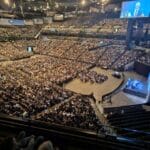

This is our own shortened transcription of the 2026 Berkshire Hathaway annual meeting video. Some answers are condensed, so please check the video for the exact wording. The words spoken by Greg Abel, Warren Buffett, Ajit Jain and the other speakers remain theirs. Video © Berkshire Hathaway and CNBC, as applicable.
Watch the official video: CNBC Warren Buffett Archive, 2026 meeting.
Share prices and performance: 12 months before the meeting (May 2, 2025 to May 1, 2026). Closing prices; S&P 500 without dividends, Berkshire pays none. Source: Yahoo Finance daily closes. Net cash on March 31, 2026: cash, cash equivalents and U.S. Treasury Bills minus payables for Treasury Bill purchases and notes payable and other borrowings, all segments, from Berkshire Hathaway’s Form 10-Q for the first quarter.
Photos: Greg Abel by Tankforwin, CC BY-SA 4.0, cropped; Warren Buffett by U.S. International Trade Administration, public domain; Becky Quick by Financial Times, CC BY 2.0, cropped; Katie Farmer © BNSF Railway (bnsf.com); Adam Johnson © NetJets (netjets.com).
