
Berkshire Hathaway Annual Meeting records: What Buffett actually built
40,000 investors. 74 extra commercial flights. A side event with 2,600 RSVPs. A website unchanged since 1999. One man who stepped down after 60 years on stage: those are just a few of the Berkshire Hathaway Annual Meeting records.
The Berkshire Hathaway Annual Meeting is, by almost every measure, the most remarkable investor event ever built. It has a collection of records that no other event in finance — and few events of any kind — can match.

Why am I able to share these records with you?
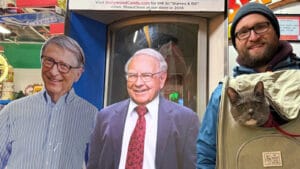
I’m Tilman Versch, a Berkshire AGM nerd, YouTuber, and community host. I’ve been to Omaha 7+ times, built the AGM guides that 150,000+ visitors have used to plan their trip, and spent 1,000+ hours documenting it.
What follows is the most comprehensive look at these records you’ll find anywhere.
Follow me for more insights like this:
Table of Contents
Do you want to navigate this post quickly? Use the Table of Contents:
- Why am I able to share these records with you?
- Scale record: The largest investor event in the world
- Ticket record: 138,000 tickets sent out in 2025
- A truly global event: 35-40% international visitors
- International Record: One event, 20-35% of Nebraska's annual international visitors
- Aviation record: 74 Commercial planes and 100+ private jets for single weekend
- Efficiency record: One person runs the whole show
- Exhibition sales records: The Berkshire Bazaar of Bargains
- The trade fair record: The largest trade fair in the Value Investing world
- Press record: A Global Media Footprint in the Heartland
- Digital record: The most-watched annual meeting on earth
- Duration record: The massive shelf-life of the Annual Meeting
- Virality record: One Question, 1.8 Million Views
- The small redistribution: From Wall Street to Farnam Street
- Culture record: The most fun event in finance
- Finance book sales record: The biggest book bazaar in Value Investing
- The social media paradox record: A massive social event run from a 1999 website
- In the global champions league: On a similar level to the World Economic Forum
- Consistency record: The real compounding machine
Scale record: The largest investor event in the world
There is no other investor event on earth that comes close to this scale. Roughly 30,000+ people join the Berkshire Hathaway Annual Meeting every year.
That figure alone puts it in a different league from every other investor conference on the planet. There is simply no comparable event. Nothing in the value investing world, nothing in the hedge fund world, nothing on the institutional side comes anywhere near it. For investors, this is the Super Bowl, the World Cup, and the Woodstock rolled into one — and it takes place in a city of 500,000 people in the Great Plains.
Ticket record: 138,000 tickets sent out in 2025

In 2025, Berkshire sent out approximately 138,000 tickets to shareholders — a record. Only around 40,000 people actually showed up.
That gap is not a failure. It is a feature of how the system works. Berkshire sends credentials to anyone who requests them, and shareholders often hold multiple tickets. The result is that almost every attendee walks in with at least one spare, making it easy for non-shareholders to join through peer-to-peer sharing.
But 138,000 tickets sent out is a Berkshire Hathaway Annual Meeting record. It reflects the continued global interest in the event and the extraordinary breadth of the 1 million shareholders in the Berkshire shareholder base — which spans dozens of countries and all kinds of institutional and retail investors.
A truly global event: 35-40% international visitors
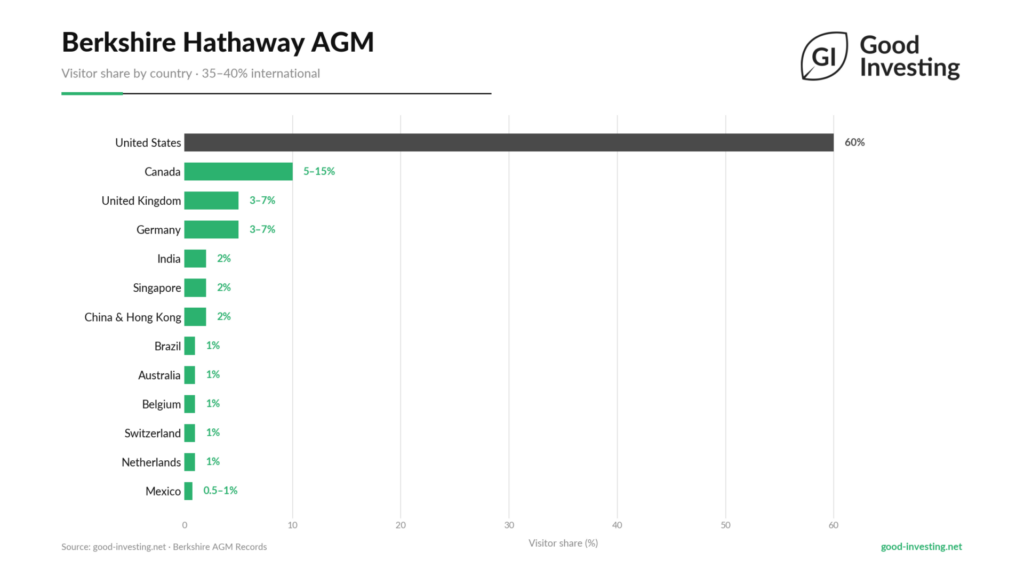
The Berkshire Hathaway Annual Meeting is a truly global event with visitors from all continents showing up in May in Omaha. 60-65% of the visitors are from the United States, the rest of the visitors are coming from all over the globe:
International Record: One event, 20-35% of Nebraska’s annual international visitors

Nebraska received roughly 49,000 international visitors in 2024. The Berkshire Hathaway Annual Meeting alone — a single weekend — is estimated to bring in somewhere between 10,000 and 16,000 international visitors. That means the Berkshire AGM alone may account for around 20–35% of Nebraska’s entire annual international tourism count.
No other event in Nebraska approaches that concentration of international visitors in a single weekend. For the city of Omaha, AGM week is transformative. Hotels sell out months in advance. Restaurants are packed. Private aviation traffic spikes. Omaha becomes a global city on the Berkshire Hathaway Annual Meeting weekend.
Aviation record: 74 Commercial planes and 100+ private jets for single weekend
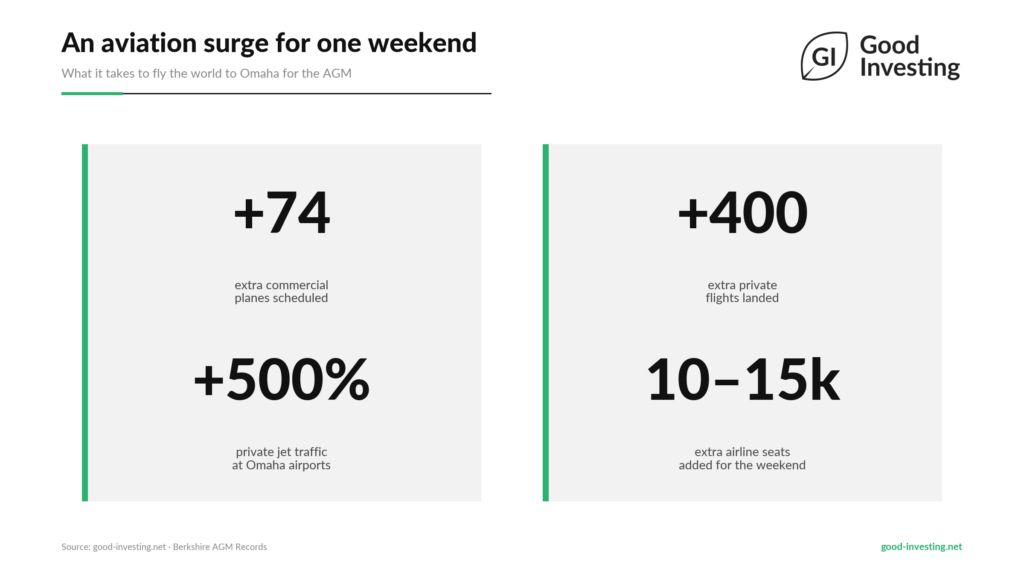
The meeting has a massive logistical impact: For the 2026 meeting week, 74 additional commercial planes are added to the schedule to fly into Omaha. They are adding 10,000 to 15,000 extra seats.
Additionally, hundreds of private jets made the trip to Omaha. The private jet traffic at Omaha (OMA) and Millard (MLE) increased by over 500% at the AGM weekend. Over 400+ extra private flights landed at both airports during an AGM weekend.
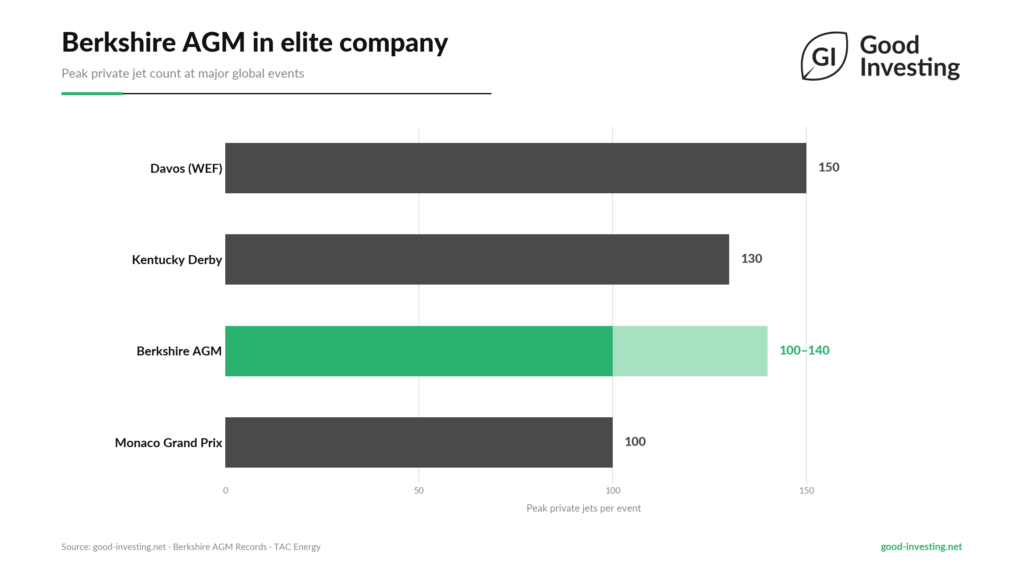
The peak private jet count at Omaha Eppley Airfield has rivaled that of many world-famous events in the past:
The Annual Meeting weekend has also become the busiest time of the year for the Berkshire Hathaway subsidiary NetJets. NetJets put great effort into ensuring a smooth logistics for all their customers flying to Omaha.
Efficiency record: One person runs the whole show
Perhaps the most astonishing Berkshire Hathaway Annual Meeting record has nothing to do with attendance. It is this: the meeting — which draws 40,000+ people, adds 74 commercial planes to the schedule, hosts a two-day exhibition, runs a 5K race, and manages press credentials for dozens of journalists — is organized by a team of roughly 27 people at Berkshire’s headquarters. And within that team, just one person is primarily responsible for running the meeting itself.
No comparable event operates this leanly. Davos has a full-time secretariat of hundreds. Major music festivals have operations teams in the dozens just for logistics. The Berkshire meeting does it with a skeleton crew and — every year — pulls it off without visible dysfunction.
This is Berkshire’s operating philosophy made visible: extreme decentralization, minimal bureaucracy, and trust in capable individuals. The meeting is a true expression of the culture Warren Buffett built.
Follow Tilman for more insights
Follow Tilman for more insights
Exhibition sales records: The Berkshire Bazaar of Bargains



The Friday before the main meeting hosts the Berkshire Bazaar of Bargains — a shareholder-only shopping event spread across more than 20,000 square feet (ca. 1,858 m²) at the CHI Health Center. Subsidiaries from across Berkshire’s vast portfolio set up booths, sell limited-edition products, and let shareholders interact with the actual businesses they own.
In 2025, Buffett opened the Saturday meeting by announcing that the Friday exhibition had broken Berkshire Hathaway Annual Meeting records across the board:
- Friday afternoon attendance: 19,700 people — up from 16,200 the prior year, itself the previous record
- See’s Candies single-day sales: $317,000 — up from $283,000
- Brooks Running single-day sales: $310,000 — an all-time record for the brand
Buffett noted that most numbers were capacity-constrained. Lines ran throughout the day. The demand was there; the space was not infinite.
The trade fair record: The largest trade fair in the Value Investing world

The Berkshire Hathaway Annual Meeting is not just a meeting. Over the decades, it has quietly become something else entirely: the global trade fair for the value investing industry.
Think about what a trade fair actually is. It is a place where an industry gathers in one city, at one time, to do business, make connections, showcase ideas, and take the temperature of the field. By that definition, AGM week in Omaha is the most comprehensive gathering the value investing world has ever produced — and it was never designed to be.
Nobody planned this. Berkshire Hathaway did not build it. What happened instead is that the meeting’s gravitational pull — Warren Buffett, 40,000 investors, a single weekend — created the conditions for an ecosystem to form around it. And form it did, organically, from the bottom up, over many years.
In 2025, more than 60 distinct events took place during AGM week in Omaha. Fund managers hosted dinners. Universities flew in students. Authors sold books at brunches. Podcasters recorded live. Companies held listener Q&As. Emerging managers met with institutional allocators who had flown in from Singapore and London and São Paulo.
The Markel Omaha Brunch alone — one satellite event at the edge of this ecosystem — grew to 2,600 RSVPs in 2025, making it the second-largest investor event in the world. The second-largest investor event in the world is a side event at the Berkshire meeting.
That number tells you everything about the scale of what has been built here.
The relationship between the AGM and its surrounding events is symbiotic. The meeting draws people to Omaha. The events give them reasons to stay longer, come back earlier, and return next year. Many visitors come for the first time to see Buffett. They return for the friends they made, the connections they formed, and the events they discovered. The auxiliary ecosystem is, in a very real sense, the retention mechanism that helps the meeting growing year after year.

This trade fair dynamic also changes who comes. Alongside retail shareholders and value investing enthusiasts, AGM week draws fund managers, institutional allocators, family offices, listed companies, authors, journalists, content creators, and students from the world’s leading universities. It is not just an event for Berkshire shareholders. It is the annual gathering of an entire investment subculture — one that happens to be anchored by the world’s most famous shareholder meeting.
Omaha’s infrastructure is quietly well-suited to all of this. The city is affordable, walkable in the right areas, and genuinely hospitable in a way that larger financial centers are not. Running an event in Omaha costs a fraction of what the equivalent would cost in New York or London. That cost advantage compounds across dozens of organizers running dozens of events, making the whole ecosystem cheaper and easier to sustain.
None of this appears on Berkshire’s agenda. None of it is organized by the 27-person team running the meeting. It is entirely self-organizing — a trade fair that emerged without a trade association, without a central organizing body, without a single person deciding it should exist.
Press record: A Global Media Footprint in the Heartland
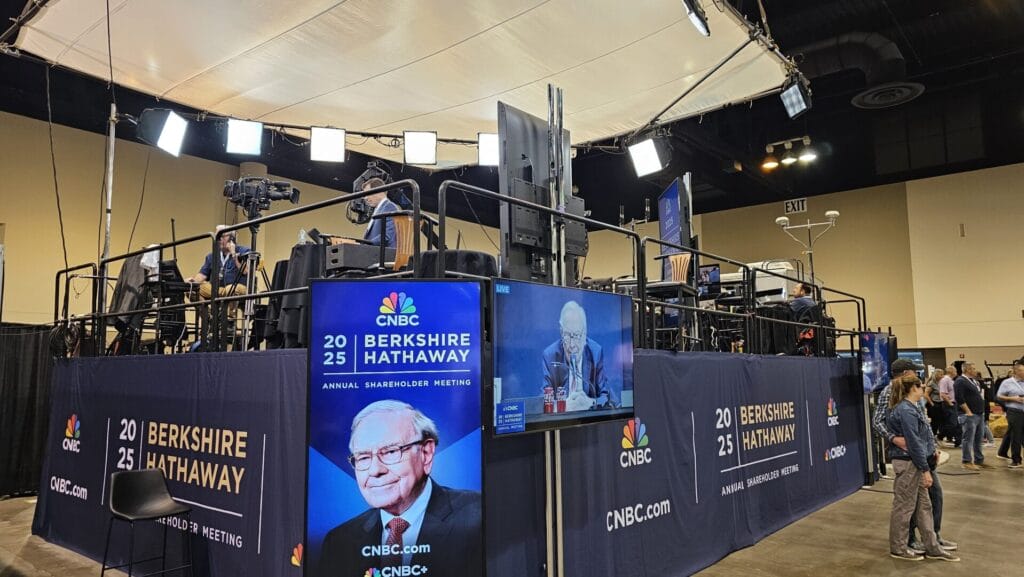
Between 50 and 150 journalists attend the meeting each year from outlets around the world. For a weekend in Omaha, Nebraska, that is a remarkable media presence. CNBC broadcasts live from the floor. Financial journalists from Asia, Europe, and Latin America file dispatches. The meeting generates international coverage that no other shareholder event in the world can match.
Digital record: The most-watched annual meeting on earth
The physical meeting is only half the story. The Berkshire Hathaway Annual Meeting also holds digital records that no other investor event approaches.
The 2025 livestream broke records, reaching several million views on YouTube. No other shareholder meeting, no earnings call, no investor conference comes anywhere close. The meeting is simply in a different category.
But what is even more striking is not the live viewership.
Duration record: The massive shelf-life of the Annual Meeting
The shelf-life of the AGM is another record. Most live events decay fast. A product launch gets millions of views in week one and almost none in year three. The Berkshire meeting works differently.
Recordings of the Q&A sessions continue accumulating views for years and decades. Estimates based on YouTube data show this: AGM videos from 1994, uploaded to YouTube in 2018, still attracted over 100,000 views. Content that old rarely gets that kind of attention in any genre. This chart shows the views of content from historic meetings until 2015 that was uploaded on YouTube in different waves from 2018:
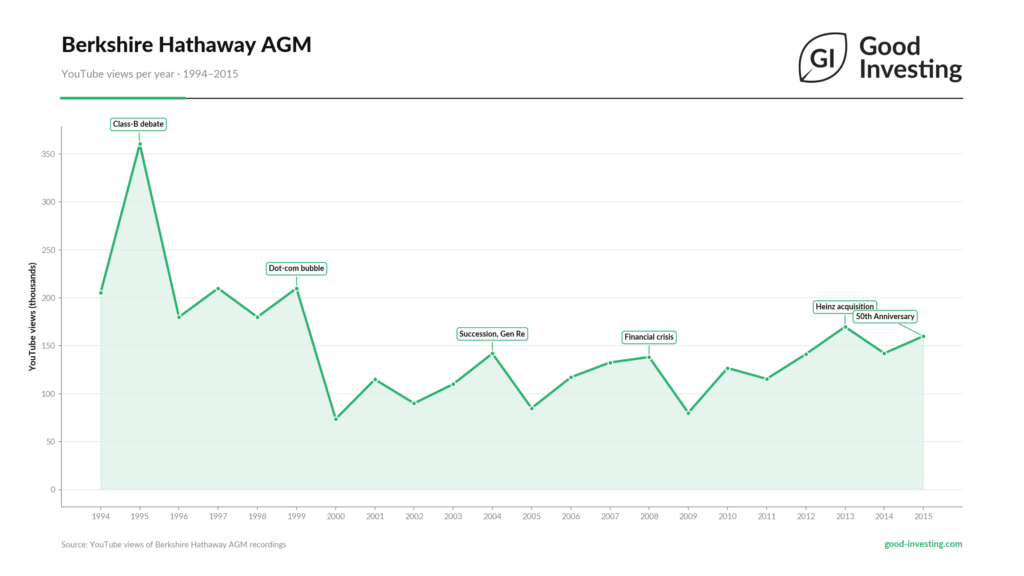
This gives the Berkshire Hathaway Annual Meeting the longest content shelf life of any live investor event I am aware of. The meeting was never designed to be a classroom. Buffett runs it as a shareholder meeting. But it has become, almost accidentally, the largest ongoing study room in the investing and finance world.
Virality record: One Question, 1.8 Million Views
There is one more dimension to the meeting’s digital reach worth noting: a single sharp question asked in that arena can become a global media moment within hours.
Audience questions from the floor at the Berkshire Hathaway Annual Meeting have gone viral on a scale that no other investor event produces. One question — asked by my Plus community member Sirapob Wu— reached 1.8 million views. That is not the kind of number you see from a conference panel or a quarterly earnings call. It is the number you see from entertainment content.
The meeting creates genuine virality around investing questions. That is almost unprecedented. It means that showing up, preparing a sharp question, and getting to a microphone at CHI Health Center can give an investor more visibility than most podcast appearances or published articles ever will.
The small redistribution: From Wall Street to Farnam Street
There is something quietly subversive about the Berkshire Hathaway Annual Meeting:
Every year, some of the most sophisticated investors in the world — from New York, London, Hong Kong, Singapore, Tokyo, São Paulo — board planes and fly to Omaha, Nebraska. A Midwestern city of 500,000 people, known for steakhouses and wide roads, briefly becomes the center of the global investing universe.
And they spend money there. Hotels, restaurants, rideshares, local events. For one week every year, $25 to $75 million flow from the major financial centers of the world directly into Omaha’s local economy.
It is a small but real redistribution mechanism — from the Wall Street to Farnam Street.
Culture record: The most fun event in finance
Finance conferences are, as a rule, not fun. They are useful, informative, occasionally interesting. But fun? Not particularly. The format is panels behind a table, name badges, catered lunches, and networking that feels like work.
The Berkshire Hathaway Annual Meeting is genuinely fun — and that too is a record of sorts.
There is an epic shareholder movie. There is a shopping event that feels like a carnival for shareholders. There are Brooks running shoes with Buffett’s face on the insole. There are celebrity investor sightings. There is a 5K race where 3,000 people show up. There is the ritual of lining up at 3am to get a front-row seat in a basketball arena to watch a 94-year-old man answer questions for five hours — and people love it.
Buffett himself called it “the Woodstock for Capitalists.” That label has stuck for a reason. For value investors, this meeting delivers what a music festival delivers for music fans: the combination of your people, your ideas, and an intensity of shared experience that you cannot get digitally. You meet a hundred people in a weekend who think the way you think and care about the same things. That is rare. In finance, it is almost unheard of.
Follow Tilman for more insights
Follow Tilman for more insights
Finance book sales record: The biggest book bazaar in Value Investing


The retail records from the exhibition floor get attention. But there is another commercial record around the Berkshire Hathaway Annual Meeting that is less discussed and just as remarkable: books.
AGM week in Omaha is likely one of the single biggest book sale events in the investing world. The range of titles on offer is extraordinary — Buffett biographies, Charlie Munger collections, investing classics, and titles from the broader value investing canon. Serious investors come prepared to buy. And they do, in significant numbers.
This extends beyond the exhibition floor. The airport bookstore in Omaha does extraordinary business during AGM week. For a mid-sized regional airport, the volume of investing titles moving through that store in a single week is almost certainly without parallel anywhere in the country.
This is part of what makes the Berkshire Hathaway Annual Meeting difficult to categorize. It is not just a shareholder event. Not just a shopping event. It is also an intellectual marketplace — one where the right book can end up in the hands of thousands of motivated readers who would never have found it otherwise.
The social media paradox record: A massive social event run from a 1999 website
Here is the paradox at the heart of the Berkshire Hathaway Annual Meeting’s digital footprint: it is one of the most photographed, most clipped, and most shared investor events in the world — and Berkshire runs the smallest digital infrastructure to make any of that happen.
Berkshire Hathaway’s official website was last meaningfully redesigned in 1999. The most considerable change that year was switching from a single bulleted list of links to a two-column bulleted list with slightly more white space. The homepage today is still a list of plain text links and PDFs. No navigation bar. No images. No social feeds. No blog.
The annual meeting’s entire official digital presence consists of one section of that website, one eBay page for ticket sales, and a PDF visitor guide. No event app. No hashtag campaign. No social media team.
And yet every May, the meeting generates an enormous wave of organic content. Thousands of photos on X and LinkedIn. Video clips of Buffett’s sharpest lines circulating for days. Videos can go viral and create million of views. The content archive — spread across dozens of channels, fan accounts, and journalist uploads — is vast, decentralized, and entirely self-sustaining. Berkshire has not built this. It has simply allowed it to happen. The community does the work, and the work compounds.
In a media landscape where companies spend millions on content strategy and social media teams, the Berkshire Hathaway Annual Meeting produces one of the most-discussed events in finance from an office of 27 people and a website that looks unchanged since the Clinton administration. Extreme efficiency, zero vanity, and results that are globally unbeaten.
In the global champions league: On a similar level to the World Economic Forum
The Berkshire Hathaway Annual Meeting is in a league of its own among investor events. But if you want to understand its true scale and significance, one comparison is worth making: the World Economic Forum in Davos.
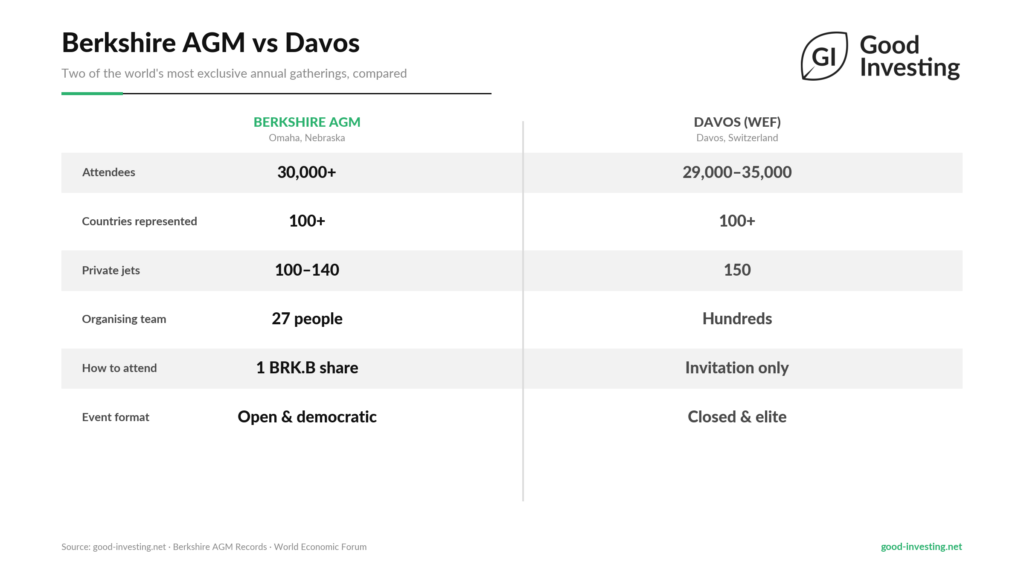
These two events are more alike than most people realize — and their differences reveal exactly what makes the Berkshire meeting so unusual.
At the surface, the numbers are surprisingly close. The WEF draws between 29,000 and 35,000 people — making it actually smaller than the Berkshire AGM. Both events pull visitors from 100+ countries. Both attract a high concentration of global elites, which shows up in a concrete way: private jet density. Davos sees roughly 100 to 150 private jets per event. Omaha, as noted above, is in the same range.
Both events share a geographic logic that is easy to overlook. Davos and Omaha are cities that matter to the world exactly once a year. The rest of the time, they are flyover country — a Swiss mountain ski village and a Midwestern prairie city respectively. For one week every year, each becomes the center of a global conversation.
There is also a striking physical similarity. The core footprint of both events is compact and walkable. At the Berkshire meeting, the action runs from the CHI Health Center to the Old Market — roughly a mile. In Davos, the equivalent stretch runs from Davos Platz to the Davos Kongress. In both cases, the density of the event creates a genuine sense of community that sprawling conference centers never achieve.
And both events have generated thriving ecosystems of satellite meetings, dinners, and side events that have become nearly as important as the main attraction. The AGM week in Omaha now features dozens of independently organized gatherings — just as Davos has become surrounded by a constellation of adjacent events that run in parallel with the official WEF program.
Finally, both events have a measurable and significant impact on local economies. Hotel occupancy in both cities approaches 100% during the events. Air traffic spikes sharply. The hospitality and retail sectors feel the effect for weeks.
The AGM is also a far more democratic event. In Davos, you need an invitation. In Omaha, you need a share of BRK.B — which trades for a few hundred dollars. Anyone can show up. Locals benefit directly: Berkshire’s shareholder shopping event offers real discounts on real products, and Omaha residents are fully welcome to participate. There is nothing equivalent to that in Davos.
Put together, the comparison makes the Berkshire Hathaway Annual Meeting’s achievement even more striking. It matches the WEF on scale, global reach, and elite density — while running on a fraction of the organizational budget, with no political apparatus behind it, in a city most of the world has never visited.
Follow Tilman for more insights
Follow Tilman for more insights
Consistency record: The real compounding machine
The Berkshire Hathaway Annual Meeting is not just a big event. It is evidence of something deeper: that doing things right, over a long period of time, compounds. Buffett has been running this meeting for 60 years. The early ones drew a few dozen people, that had to be invited personally to the event. Now they draw the world.
The records are massive. Another record is the consistency — the same principles, the same format, the same culture, year after year. That is what builds something that cannot be replicated overnight.