
Berkshire AGM 2026 attendance is likely down 50% or more — here’s why
My estimate is that the Berkshire Hathaway Annual Meeting 2026 attendance is down 50% or more compared to the record year 2025. That translates into a turnout of somewhere above 10,000 to 20,000 visitors for the Annual Meeting 2026.
Why am I sharing this? To help you understand and navigate this new situation as a visitor. The drop in attendance this year is not a bad thing at all. You still join the world’s largest investing event: with a great infrastructure and a ton of fun people! Compared to 2025, you have more opportunities as the infrastructure is nearly the same. Have fun in Omaha!
How certain is this prognosis? Personally, I am a massive fan of the Berkshire AGM. So, I hope that I am wrong here and my data misses some visitors. But there is a significant attendance drop compared to 2025 in my data visible. Exact numbers are difficult to pin down — even Berkshire Hathaway doesn’t track precise headcounts. What we do know: 2025 was an all-time record year, which makes the drop feel sharper than the comparison to previous years.
Why is Berkshire AGM 2026 attendance down?
Several factors are driving this decline:
Warren Buffett is not on stage anymore
The single biggest factor: Warren Buffett is not appearing on stage. Warren has a massive global brand — as this previous social media analysis shows. Tens of thousands came to Omaha to see him in person and had hoped to do so again this year.
This showed up clearly in the hotel data I tracked: through February, many hotels near Old Market were fully booked. Once it became clear that Warren would be seated in the front row rather than on stage, rooms started opening up again.
The Buffett premium kept prices high longer than demand warranted
Given the historically high demand — and the above-average spending power of AGM visitors — prices for the 2026 meeting weekend remained extreme compared to a normal week in Omaha. This sample illustrates the gap:
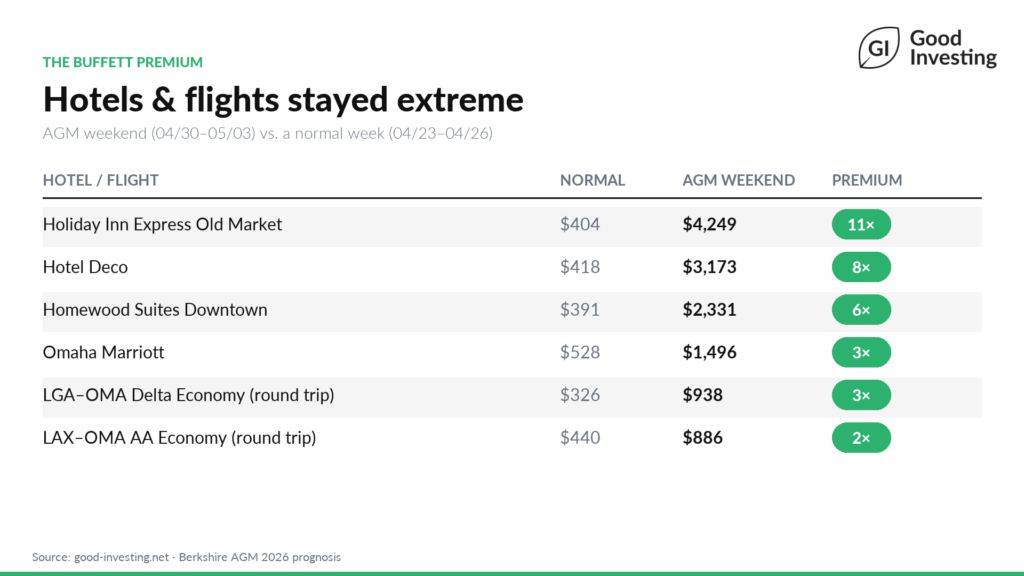
Despite significantly lower demand this year, prices never fell enough to make the trip affordable for a broader audience. These are the likely reasons:
- Hotels still hoped for a late demand surge in March and April as happened in the last years.
- For some properties, it may have been more profitable to run lower occupancy at high rates than to discount and fill rooms.
The bottom line: lower demand never translated into lower prices, and for many, the trip simply stayed too expensive to see the new, unknown CEO on stage.
Greg is not Warren
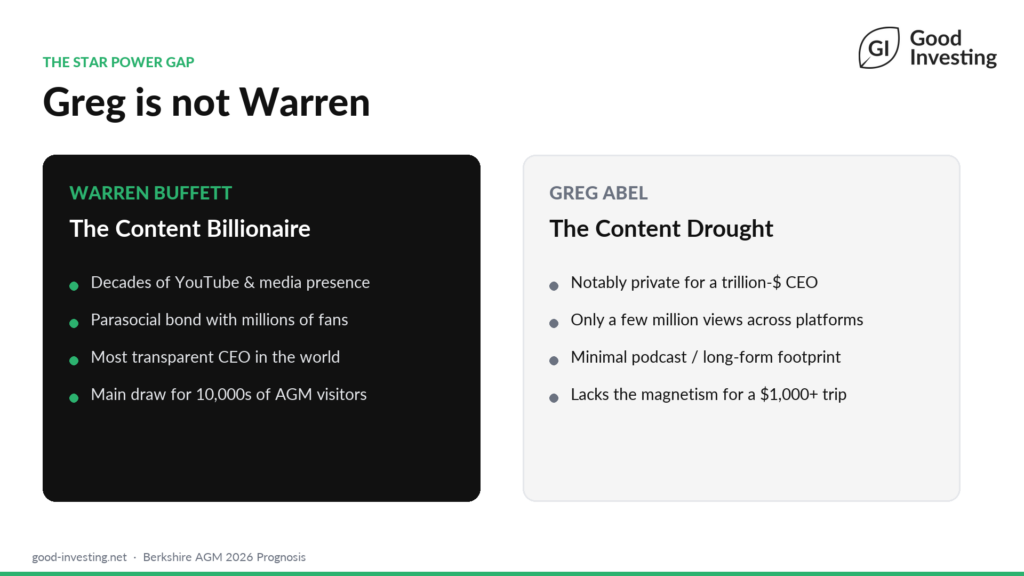
Warren is not only the world’s best-known investor — he may also be the world’s most transparent CEO. Through his YouTube presence alone, he has built a parasocial relationship with millions of fans around the world.
Greg, by contrast, remains a notably private figure — especially for the CEO of a trillion-dollar company. Another statistic makes this stark contrast visible: While Warren is a content billionaire, Greg only has a few million views across platforms.
Greg’s public content footprint is minimal, making it difficult for outsiders to form a clear picture of who he is. Compared to peers at other major companies, he has what one AI tool aptly called a “content drought.”
For many shareholders, Greg simply lacks the magnetism Warren projected. That made it challenging to justify a costly trip to Omaha for many as Warren, the main draw, was no longer on stage.
Warren is Berkshire’s public face
Berkshire Hathaway’s operating model gives their managers and subsidiary CEOs a lot of privacy. They can focus on business and operations.
For decades, that model worked because all attention was captured by Warren and Charlie. They were the public-facing stars. As both have now stepped away — without having built up successors with comparable public profiles — the lack of a recognizable face becomes a structural challenge.
Greg’s and Warren’s media appearances had limited impact
Both Greg and Warren appeared on CNBC lately. The interviews produced a visible spike in ticket sales — but fell short of what similar appearances would have driven in prior years:
CNBC posted only an audio file on YouTube, without a proper thumbnail, along with short clips from both interviews. The full video interviews sat behind a paywall. This significantly limited global reach.
Greg also stayed away from showing up in other media formats, like podcasts. Appearances here could have boosted attendance.
Fewer international visitors are coming to the US — and Omaha
In the 2020s, international guests made up 35–40% of AGM visitors. Here is the breakdown by top 10 source markets that I observed in 2025:
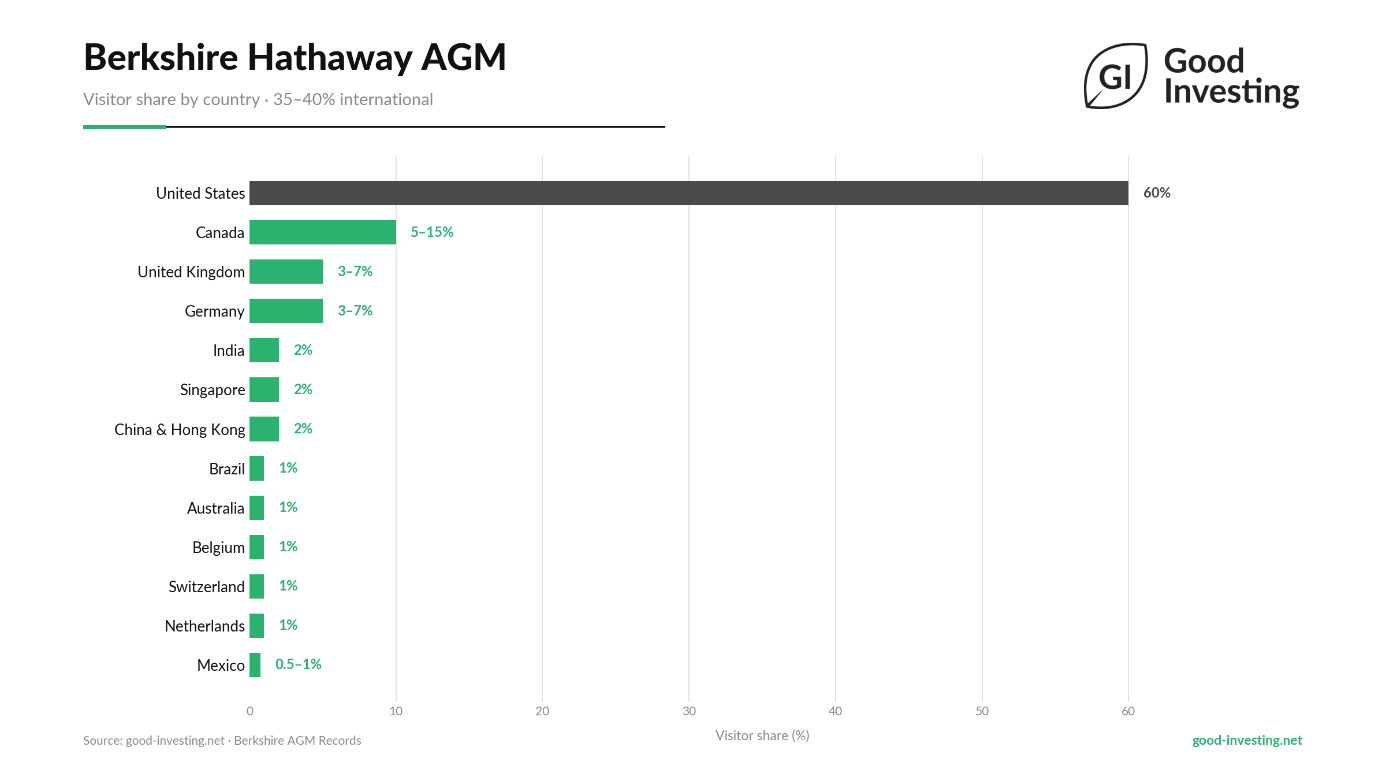
In 2026, visitor numbers are down across every source country. Geographic diversity has also declined: my guide received search traffic from 145 countries in 2025; this year that’s down to 105.
The international turnout is falling faster than the US turnout, meaning the AGM is gradually becoming a more domestic event again.
Canada, historically the second-largest international source market, is especially soft this year.
Why are there fewer international visitors showing up?
The Trump administration is one important factor here. Many international visitors right now think twice before making the visit to the United States.
Incidents involving ICE earlier this year alarmed many international visitors and long-time US supporters. Reports of harsh treatment at the border have also circulated widely. Proposed restrictions on ESTA visa-waiver access have added further uncertainty for travelers from eligible countries.
Canadians were historically the second-largest international visitor group at the AGM. In response to Trump’s threats against Canada, many Canadians are currently boycotting travel to the United States altogether.
Visitors from Asia and India face an additional constraint: the Iran war has disrupted travel routing and schedules for many, making the trip to Omaha logistically harder than in past years.
Demand was pulled forward
Given Warren’s and Charlie’s age, a wave of visitors made the trip to Omaha in 2023, 2024, and 2025 with a sense of urgency. They were driven by the feeling that they had to see their idol on stage while they still could. That urgency is gone now.
These visitors might come back in the future, but their visits to Omaha usually happen in a 2-to-10-year interval. In 2026, they are missing.
The meeting demographic changed to generation YouTube – they lost their 95-year-old star
YouTube and the wide availability of AGM video content there became a powerful flywheel for attendance — making the meeting younger and more international in the process.
Because Greg’s and the other panelists’ YouTube presence is minimal and fragmented in comparison to Warren’s 500+ hours on the platform, that sales funnel is effectively broken for 2026.
While visitors could binge-watch Warren and Charlie on stage for hours, finding comparable content about Greg Abel, Ajit Jain, Katie Farmer, and Adam Johnson on YouTube is nearly impossible. Their combined content footprint is so thin that it’s difficult to build the conviction needed to spend $1,000+ on a trip to see them on stage.
The YouTube & international shift could have held away American visitors
Some American visitors who attended regularly in the 2010s stopped coming in recent years, put off by how much the event had grown. For them, it felt more like a “circus” than the shareholder meeting they remembered. They stayed home or shifted their attention to other events.
Some US visitors may also have been priced out by competition from international guests willing to pay almost any price for a once-in-a-lifetime chance to see Warren Buffett on stage.
Berkshire Hathaway’s stock underperformed
Berkshire’s stock has underperformed since the last meeting, which may have dampened interest among more momentum- or performance-driven attendees.
AI disruption and economic slowdown keep former visitors busy
AI disruption is creating real pressure across many industries, and the pace of change is especially demanding for those in software and tech. The AGM draws heavily from business owners and engineers — a group that right now has less bandwidth for extra travel right now.
Broader spending caution is a factor too. Budgets are tighter than a year ago, and a trip to Omaha is a meaningful expense — one that’s easier to skip when the headline act has stepped back.
Some side events have been discontinued
The side event calendar around AGM weekend remains extensive, but some events have been discontinued. Most notably, the Markel Omaha Brunch — which drew over 2,600 RSVPs last year — is not returning. Its absence likely sent a negative signal and may have influenced some travel decisions at the margin.
Follow Tilman for more insights
Follow Tilman for more insights
Why am I qualified to make this prediction?
I’m Tilman — Berkshire AGM nerd and community host. Here’s the data I’m drawing on:
The clicks on my AGM guides
Since 2022, I have built a set of guides that rank highly in search results for the Berkshire Hathaway Annual Meeting. Over the past year they received 150,000 clicks in total. That click data has been a reliable indicator of visitor turnout in 2023, 2024, and 2025. It shows a clear weakness for 2026.
Ticket sales via eBay
Ticket sales via the official eBay account have been surprisingly weak. Through mid-April, only around 2,000 pairs had sold. Since not every ticket pair converts to an attendee, I estimate that these 4,000 sold tickets represent roughly 3,000 actual visitors.
Last year, Berkshire Hathaway shipped 138,000 tickets in total. Based on the click behavior on my guide, roughly 40-45% of visitors were purchasing their tickets via eBay. This indicates a drop from 55,000 to 4,000.
Airbnb and Hotel availability
Booking.com and Airbnb have let me track actual visitor bookings for AGM weekend. Where accommodations on both platforms were fully booked in previous years, hotel rooms and vacation rentals are still widely available this year.
Only a minority of Old Market hotels are fully booked. Properties that sold out weeks in advance in past years still have rooms, and some have quietly cut prices in the last two weeks to fill capacity.
Airbnbs in the neighborhoods most popular with AGM visitors are only 60+% booked. Listings that would normally be gone by now are still sitting open.
Flight data
Flights to Omaha for AGM weekend are still widely available. Last year, nearly every seat was sold out well in advance. Especially, the economy class has vacancies in 2026.
What will the 2026 attendees be like?
The AGM has always been a gathering of distinct visitor groups, as I’ve analyzed previously. Every group is likely to be smaller in 2026. A few will see sharper drops:
- Retail investors: While First Class on many flights to Omaha is booked out and many expensive hotels have a good filling rate, economy feels empty.
- International visitors: Fewer international visitors are making the trip this year, making the event somewhat more American in composition.
- Younger investors: As their star 95-year-old Warren Buffett won’t be on stage, younger investors will likely not do the expensive trip to Omaha this year.
These groups are likely to hold up better and will define the character of the 2026 AGM:
- Value Investing professionals: The meeting is a core event for the professional value investing scene. These visitors will keep on showing up.
- People who go every year: The hard core of Berkshire meeting visitors should stay solid.
- Nebraskans: A lot of locals are likely to still show up as the meeting is an attraction for Omaha and the region.
What does this mean for you as a 2026 visitor?
My recommendation: approach this with radical acceptance. The turnout numbers are what they are — and there are real upsides in the quieter format.
The lower crowds create real opportunities and more chances to have a fun event!
- Less lines in the morning: This year, we will likely see fewer or maybe no lines in the morning. The seat competition in the CHI Health Center might also be less intense. And you can sleep longer!
- More space for you: Same infrastructure, fewer people. That means more space to ask questions and contribute to the discussion. For instance, you will have more opportunities to speak with Berkshire’s subsidiary management during the exhibition. Or you might have more chances to get a selfie with your investor hero.
- Opportunity to go deep: Go deep instead of wide. There will still be plenty of people worth meeting — use the lower volume to build real relationships rather than collecting contacts.
You will still be able to join the world’s largest investing event with a ton of fun people in a great moment of history and transition. Enjoy yourself and have a great time in Omaha!
What does that mean for 2027?
The next meeting takes place on May 1, 2027.
There’s an opportunity to rebuild the “Woodstock of capitalism” from a smaller base — and in a different shape. Attendance is unlikely to return to 2025 levels, but it can start growing again from 2026 attendance once more.
By then, we’ll all know what a Greg-era meeting feels like. He’ll have had more chances to demonstrate business results and build a more visible public presence as Berkshire’s Chief Show Pony.
Prices will also normalize earlier. Without the Buffett premium embedded in hotel and flight algorithms, the trip to Omaha will become more accessible — which is good for events, for the community, and for growth.
The only downside could be: Flights might be less widely available in 2027, as airlines could potentially cut additional connections. Watch that!
Follow Tilman for more insights
Follow Tilman for more insights