A three-stock Charlie Munger portfolio – Shaurya Gupta (Gupta Partnership)

- Shaurya Gupta started his firm at 21 and has run it for eight years (2026).
- In his portfolio, TSMC was about a 20% position, held for four years (2026).
- Amazon and Alphabet were around 10% each, both held for over seven years (2026).
- A state-of-the-art fab costs around 20 billion dollars, against a few billion dollars for a 28-nanometer fab around 2010, he said in 2026.
- Amazon delivers over 60% of products the same day or next in the top 60 US metros, he said in 2026.
TSMC (TSM) · Amazon (AMZN) · Alphabet (GOOGL)
Costco (COST)
Berkshire Hathaway (BRK.B) · JPMorgan Chase (JPM) · Dow (DOW) · DuPont (DD) · General Electric (GE) · Anthropic (private)
👉🏻 Get Shaurya’s Alphabet thesis here: https://go.good-investing.net/shaurya-alphabet

How did Shaurya Gupta start his firm at 21?
TL;DR: He started his firm at 21 and bet on himself. His lesson after eight years: double the pain tolerance you expect (2026).
He was 21 when he started his firm
 Tilman Versch [00:00:12] Shaurya, when did you, how old were you when you started your firm?
Shaurya Gupta [00:00:15] I was 21 years old.
Tilman Versch [00:00:17] Are you nuts?
Shaurya Gupta [00:00:17] Huh?
Tilman Versch [00:00:18] Are you nuts to start an investing firm of 20, maybe a little bit. 20, 21 years?
Shaurya Gupta [00:00:23] Yeah, yeah, maybe a little bit.
He felt ready and bet on himself
Tilman Versch [00:00:24] What drove you to start an investing firm?
Shaurya Gupta [00:00:27] It’s hard to answer that. I mean I just, I just figured I was ready to do it, and in hindsight I was, and so you know, for anybody young that’s listening or here in the room, um, I think sometimes it pays to bet on yourself.
[00:00:39] Especially in a game like investing which is extremely democratic and anybody can set up an account, if you can also have some people that trust you, you’re only going to learn by doing. Um, I don’t think there’s any way I could have experienced the last eight years in theory, so um, yeah.
Double the tolerance for volatility you expect
Tilman Versch [00:00:55] What did you learn through these eight years and what is like the, the thing that that changed you?
Shaurya Gupta [00:01:02] Yeah, the one thing I would say is that whatever expectation I had for, um, for an ability to stomach volatility, double that. You’re gonna go through experiences whether it’s portfolio-wide or it’s an individual position, where things are far more volatile than you ever expected, and so your threshold for volatility even if you’re confident in your thesis and you’re good in your research, should be extremely high. Your pain tolerance I guess is how you would define that, so yeah.
A three-stock Charlie Munger portfolio
Tilman Versch [00:01:31] And what do you bring us today outside of a great disclaimer?
Shaurya Gupta [00:01:36] Yes, yeah, I gotta start with this, um, past performance is not indicative of the future, uh, this is not a buy or sell recommendation, and so on and so forth, but the topic of today is a three-stock Charlie Munger portfolio, and it was meant to be sensational as well, so yeah.
Tilman Versch [00:01:57] I think everyone, we, we uploaded for you that you can read it in detail. I think everyone else has read the disclaimer already and so the floor is yours.
What is a three-stock Charlie Munger portfolio?
TL;DR: Three companies Munger admired but did not own directly. All three are large holdings at Gupta Partnership, one at about 20% (2026).
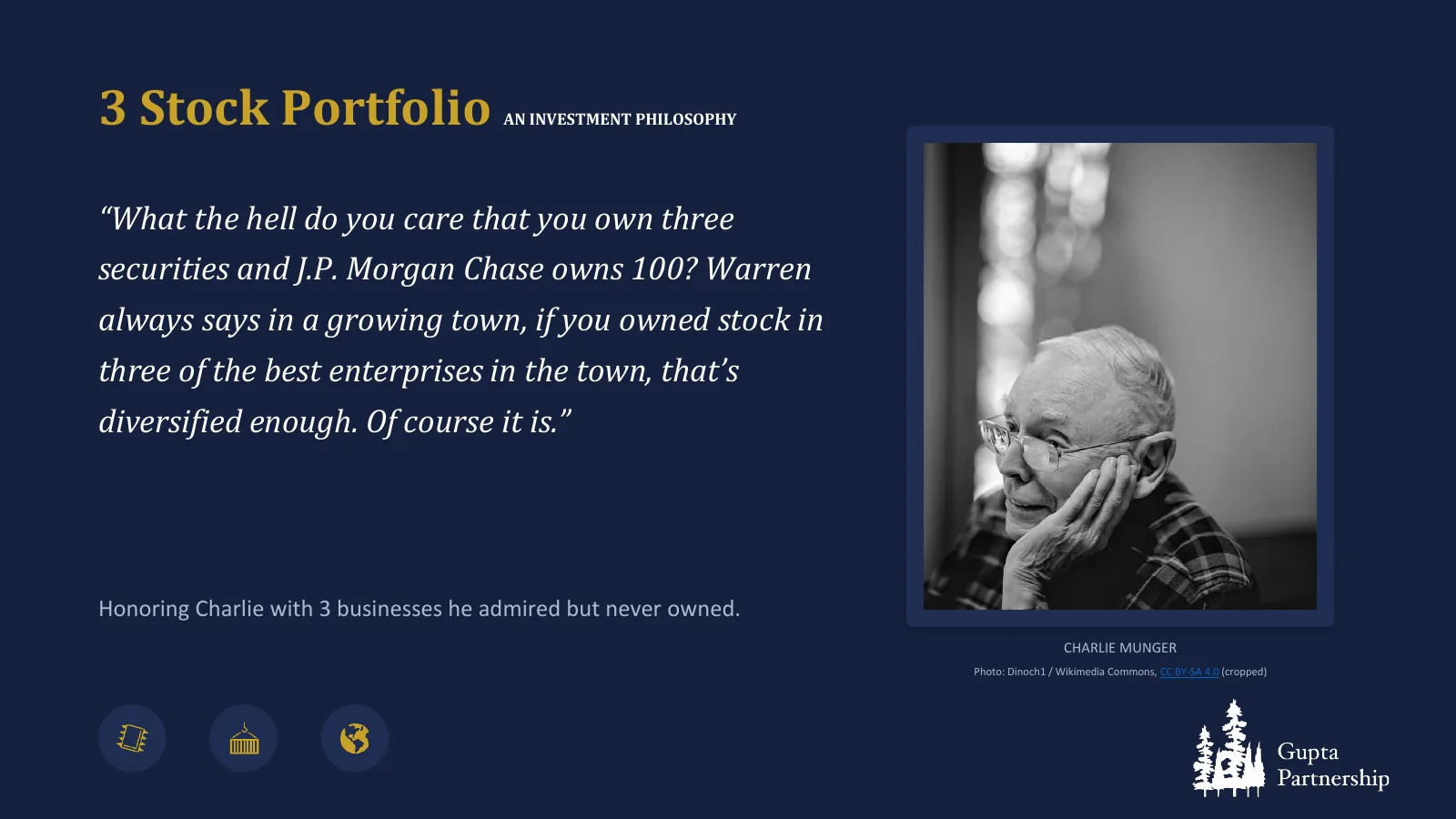
Shaurya Gupta [00:02:09] Okay, great, there you go. Okay, so I’m gonna start with this quote: “What the hell do you care that you own three securities and J.P. Morgan Chase owns a hundred? Warren always says, in a growing town, if you own stock in three of the best enterprises in the town, that’s diversified enough.” Of course it is, and so I love that quote and today’s talk is that quote in action.
[00:02:27] Today’s talk is not about three companies that Charlie famously owned and it’s not about three companies he, it’s not fan fiction about three companies he might have owned if he was still with us today. Uh, today’s talk is about three companies that Charlie studied, that he admired, and he spoke extremely highly of, but none of which that he owned directly himself as far as we know, although some two of them he might have owned through a money manager.
[00:02:54] Um, the first company is one that Charlie says, uh, might be a wonderful investment for somebody younger who understands it better than he does. The second one, he said that he never saw it coming, so he doesn’t regret missing it, because it’s an utter phenomenon of nature and now that it’s happened, it has a long way to keep going up. And the third company, which I don’t think we’ll have time to get to, but we’ll talk at the bar about it, um, and I’ll mention its name.
[00:03:20] Um, the third company he says he deeply regrets missing, because, um, he’s deeply ashamed by it, but now of course Buffett and Berkshire have atoned for that mistake by making it a very large position. Um, the first comp… all three companies are very large holdings at my firm. Um, the first company we’ve owned for four years now, it’s a 20% position, uh, right now. Uh, the other two we’ve owned for over seven years, and, uh, both of them are sort of around 10% each.
[00:03:46] Uh, low teens, it depends on the account and it depends on the day. Uh, all three of these companies have helped my firm Gupta Partnership compound for the last eight years at around 15% a year net of fees. Uh, and I’m confident that they’ll help us continue to do well, so with that we’ll get to the first company, which is Taiwan Semiconductor Manufacturing Company. So Charlie once, uh, explained his discomfort with semiconductors like this.
What did Charlie Munger miss about TSMC?
TL;DR: In his view new fabs cost around 20 billion dollars, but old fabs keep running at full utilization. He put TSMC at around 20 times this year’s earnings (2026).
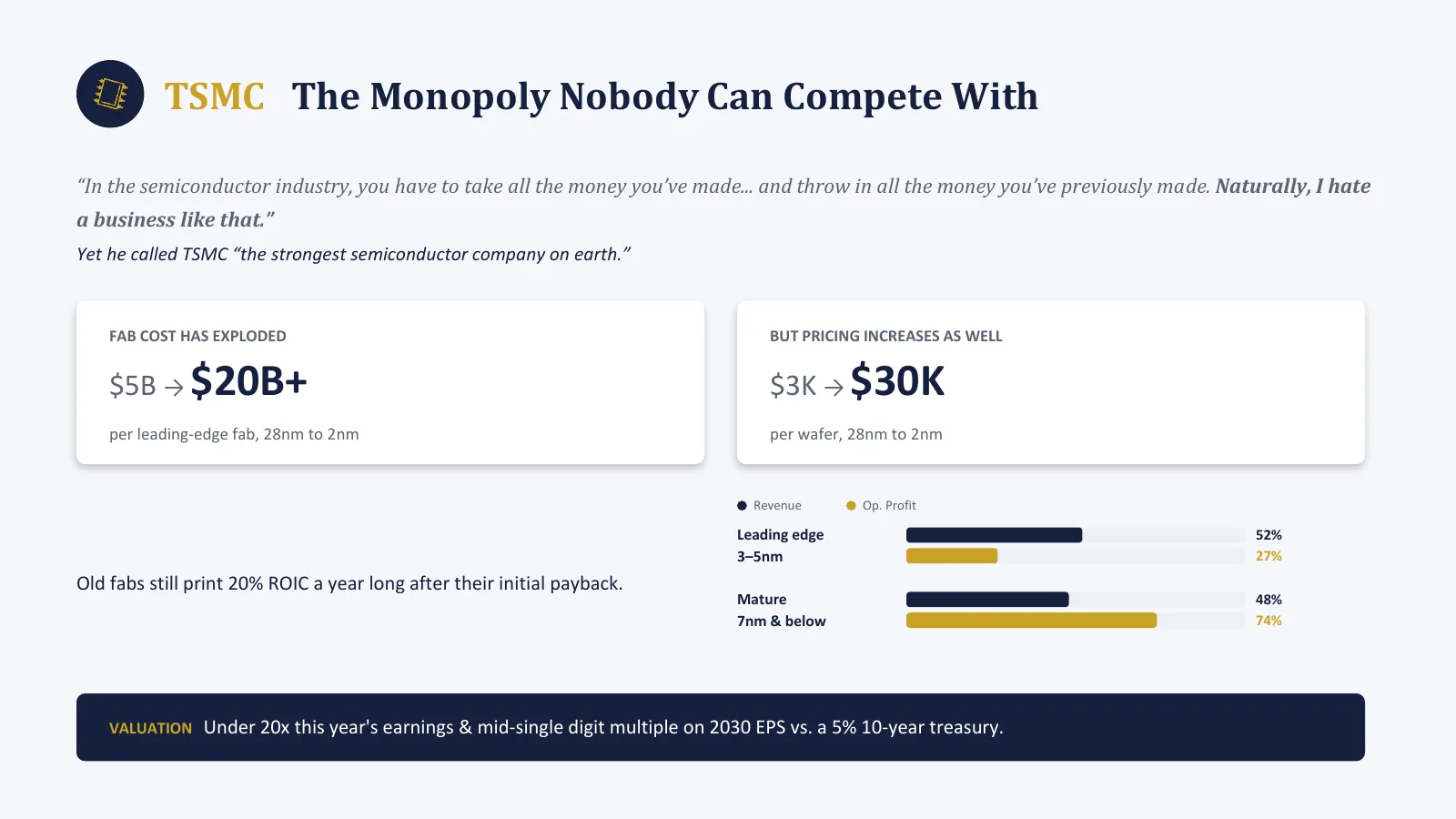
[00:04:09] He said in the semiconductor industry, you have to take all the money you’ve made and with each new generation of chips, you throw in all the money you’ve previously made. Naturally, I hate a business like that. But then he made an exception, he called TSMC the strongest semiconductor company on earth and he said he’s a big admirer of what they’ve achieved and the fact that I don’t like it because I’m an old man and I don’t like learning new tricks, doesn’t mean it isn’t right for some younger person who understands it better than I do.
[00:04:35] So what might that younger person say? Um, what that younger person would say to start is that Charlie’s right about one thing, the ante keeps going up. So the cost to construct a 28-nanometer fab around 2010 was a few billion dollars, and the cost to construct a state-of-the-art fabrication facility now, um, is around $20 billion, but at the same time, the price of what comes out of those foundries is going up as well.
[00:04:59] And so the price of a 12-inch equivalent wafer at 28-nanometer was a few thousand dollars, and now the price of a 2-nanometer wafer is approaching $30,000. And so the right question is what Charlie always asked us to ask, which is what is the return on invested capital? And the return on invested capital has remained strong, um, this entire time.
[00:05:19] So if you do some simple math, some of the more expensive TSMC fabrication facilities in Arizona, which would be the most expensive ones that they build because it’s American construction, cost about $20 billion in terms of construction and equipping the fabrication facility. Um, those facilities can do about 30,000 wafers per month, and as I said depending on if it’s 2-nanometer or 3-nanometer, it’s going from $20,000 a wafer to $30,000 a wafer.
[00:05:47] And so after the operating costs, which are relatively minimal in this industry, um, you’re talking about 25 to 30% returns on capital, so you’re getting a payback period of anywhere from three to five years. Um, and what’s amazing too, and sort of what Charlie missed in his statement about taking all the profits from the past and putting it into the new node transition, is that he’s right that you acquire all those profits from old fabs to invest in the new node ramp.
[00:06:12] That’s part of the moat, because if you weren’t successful in the past, it’s hard to be successful in the future. But, when you ramp the new node, the old nodes don’t stop printing money. So the reality is that today, even as TSMC has ramped 3-nanometer and is going to 2-nanometer, 5-nanometer, 7-nanometer, um, 28-nanometer, um, these fabrication facilities are all running at full utilization.
[00:06:37] And so you don’t throw away past generations when the new generation comes. Those old generations, they print money for a long time, decades after they’ve paid back their initial cost, um, and long after they’ve been fully depreciated. Um, and so you’re sort of stacking generations on top of each other. And when you run a DCF on all the cash flow streams of those facilities, um, this company is undervalued.
[00:07:02] And so our first one is TSMC, it’s trading at around 20 times earnings right now, uh, on this year’s earnings. It’s like a mid-single digit multiple on earnings five years out. Of course you gotta be conservative in your appraisal. And if you compare that to a 5% treasury yield on the 10-year, um, when they’re able to reinvest that yield at 25% returns, I think it’s extremely attractive.
What makes Amazon the digital heir of Costco?
TL;DR: In his view Amazon is close to double Costco in the US and still grew about 15% last quarter. US ad spend on Amazon was about 60 billion dollars last year (2026).
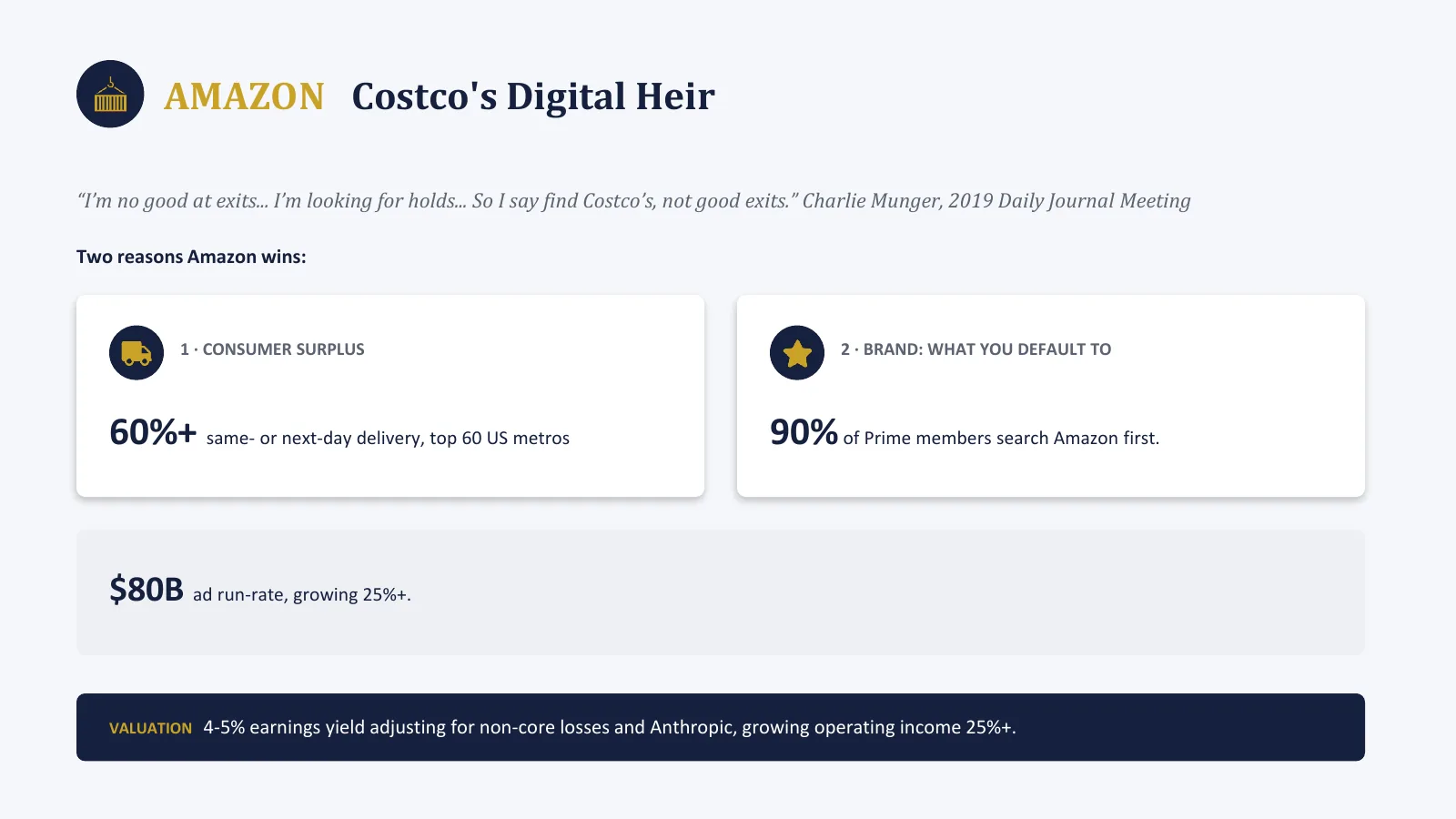
[00:07:24] Um, we’ll get to the next one, actually, sorry about that. So the next one, so, I’ll start with a quote from Charlie, raise your hand if you’re familiar with Charlie’s love for Costco. Every hand should be, every hand should be up. Um, so Charlie had said at the 2019 Daily Journal meeting, he said, “I’m no good at exits. I don’t like even looking for exits. I’m looking for holds.”
[00:07:46] “Think of the pleasure I’ve got from watching Costco march ahead. Such an utter meritocracy and it does so well. Why would I trade that experience for a series of transactions? I’d be less rich, not more, after taxes. The second place is a much less satisfactory life than rooting for people I like and admire, so I say find Costcos, not exits.” I’m here today to say find Amazons, not exits, and the reason for this is Amazon is Costco’s digital heir, and I think it’s a better business in the digital age.
[00:08:13] Um, so if we take, if we start with data, Amazon’s first-party business in the United States is larger than Costco’s business in the United States, and if you add the GMV from Amazon’s third-party business, Amazon is significantly larger than Costco, it’s not exactly double, but it’s close. And even so, this last quarter, Costco grew at about 10%, excluding changes in gasoline prices. Amazon grew at 15%, despite being about double the size.
[00:08:36] Um, people get lost in percentage numbers, but that means that they’re adding tens and tens and tens of billions of dollars of product sales every year, even now. And, Charlie taught us to always ask why, and if I was to answer that question I would say two things. Number one is tremendous consumer surplus. So now over 60% of products Amazon’s delivering the same day or next in the top 60 metros in the United States.
[00:09:01] And so it is literally gaining share of wallet, and whether consumers are doing this subconsciously or consciously, more and more of their weekly purchases and their budget is going to Amazon.com. Um, the second thing is that Amazon is a brand, and so, 50% of US shoppers and over 90% of Prime members, they begin their retail purchases on Amazon.com.
[00:09:20] Um, and so, you know, I’ve always said that a brand is what you default to, that’s how you can prove a brand, it’s what someone defaults to, and consumers are defaulting to Amazon.com, and why that is is selection, prices, and now fast delivery. And so, Costco has this great pitch which is, you know, we have this really massive purchasing power over a curated, limited amount of SKUs, and Amazon has that as well, but then it also has this infinite shelf.
[00:09:45] Which I think is incredibly valuable because not only do you get curated products, but then you also have products that are personalized on the long tail. And in the past this might have led to analysis paralysis, and that’s where AI comes in, so having chatbots like Rufus with the metadata on all the products, it increases conversion dramatically because consumers can find the specific product that they desire.
[00:10:01] Um, and another proof point for how valuable Amazon is as a browsing destination, and for everything discretionary and non-discretionary, is the ad business, because advertisers know that it’s a browsing destination and that your intent is incredibly high when you’re on Amazon.com. And so last year in the US they spent about $60 billion on ads. Costco, relatively speaking, is at a few hundred million.
Tilman Versch [00:10:24] Shaurya, we have to also to do fast delivery now, one more minute for you.
What role does Alphabet play in the three-stock portfolio?
TL;DR: He calls Alphabet the Berkshire Hathaway of technology, the third of his three companies. The details were left for the bar (2026).
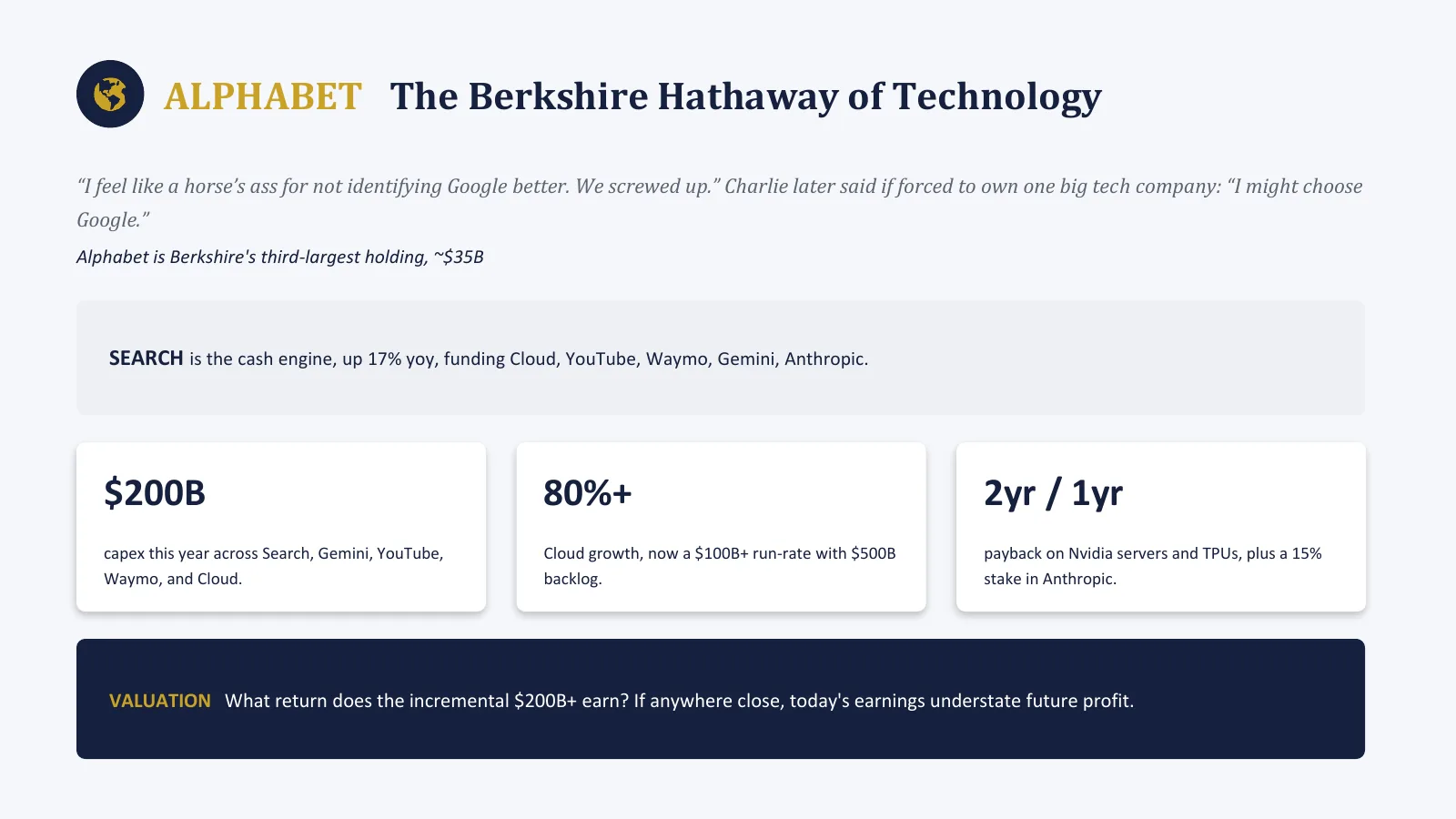
Shaurya Gupta [00:10:28] Okay, so I’m here to say find Amazons, not, not exits. Okay, our third company, which we’re not going to get to, but find me at the bar, it’s the Berkshire Hathaway of technology, it’s the company that Munger regrets missing, and Buffett has atoned for, it’s Alphabet. We can talk about their returns on capital, we can talk about how the AI cloud is becoming like the, uh, airline business post-regulation.
[00:10:49] And how the most important variable is load factor, and if load factors do go down which everyone’s worried about, Alphabet is in the strongest position for three reasons, find me at the bar later. Now, my conclusion which, and the people online, there will be a link below with more on this case as well.
Tilman Versch [00:11:02] Yes.
Shaurya Gupta [00:11:06] But this part I’m going to finish, if we can all lobby Tilman to let me finish this part, it’s just the conclusion.
Tilman Versch [00:11:11] Maybe.
How did five stocks turn 300,000 dollars into 1.5 million?
TL;DR: Munger’s story of a woman who bet on electricity and chemistry in the 1930s. Gupta Partnership has charged no management fee for eight years (2026).
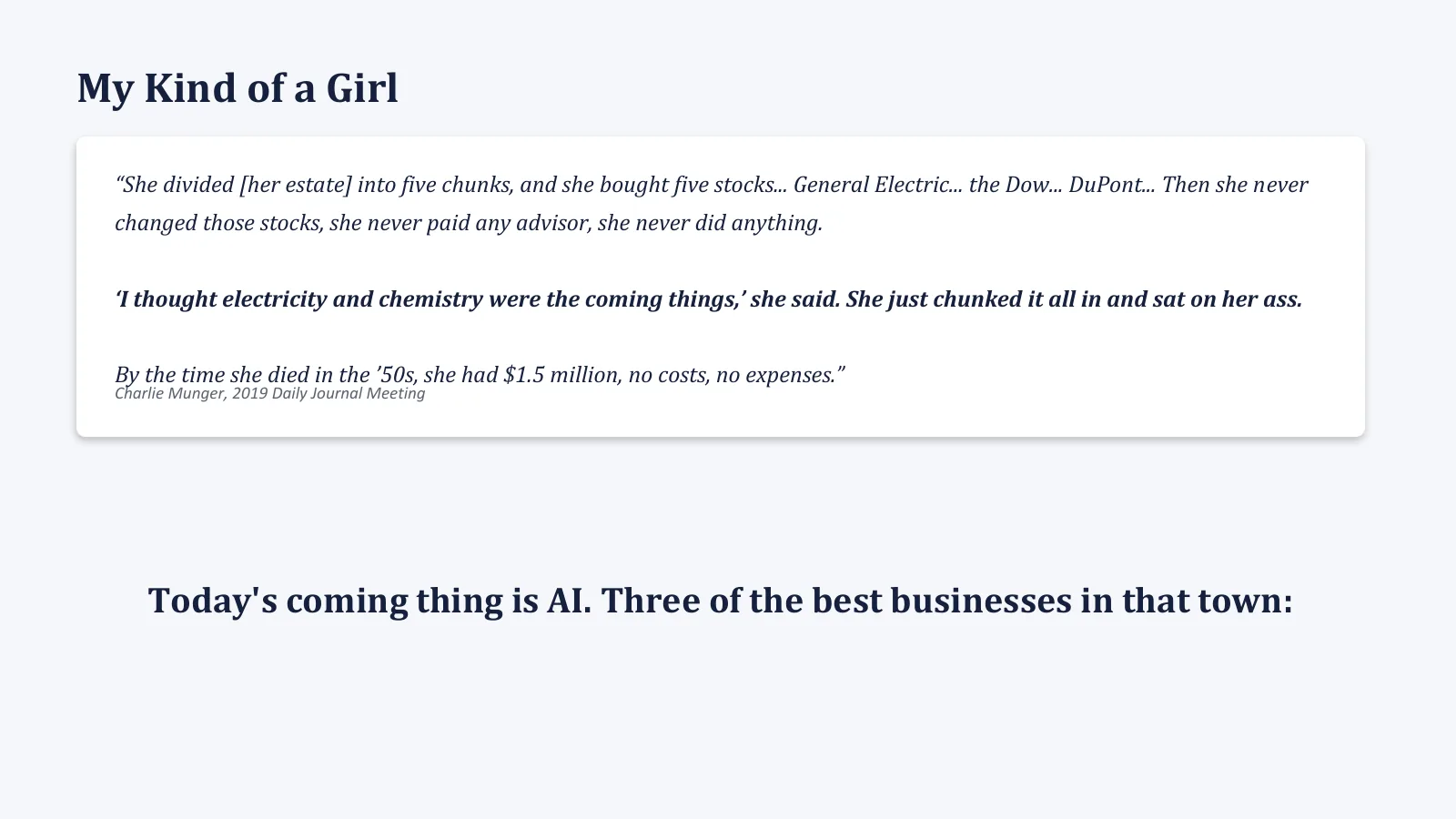
Shaurya Gupta [00:11:11] So Charlie tells a story about, um, this woman whose estate he helped probate, and basically she inherited $300,000 in the 30s from her father who sold a soap company. And that was a lot of money at the time, and she took the money, she put it into five stocks, and in the 50s she died with $1.5 million. She lived modestly, she didn’t pay advisor fees, she didn’t pay commissions, and of the five stocks Charlie remembers three: Dow, DuPont, and General Electric.
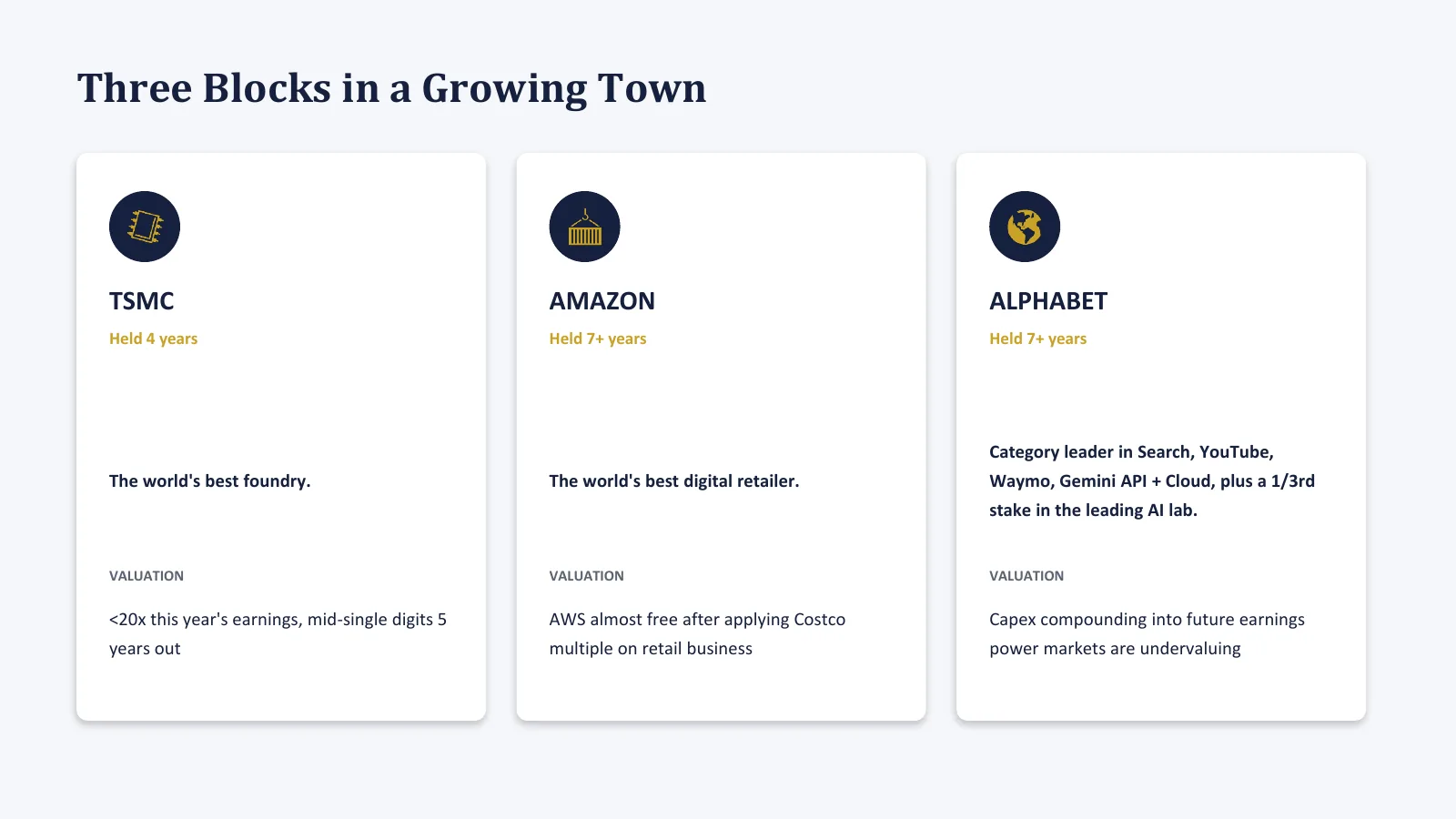
[00:11:36] And he asked her, he said, well, what made you think of those companies? And she said, I thought electricity and chemistry were the coming things, and Charlie ends that story by saying, that’s my kind of woman. So, if today’s coming thing as we know is AI, then three of the best businesses in that town, TSMC, Amazon, and Alphabet.
[00:11:55] And finally what I would say is, Charlie has said, if you invested Berkshire Hathaway style, you’d be sitting on your ass, the client would be getting rich, and after a while the client would think, why am I paying this guy a percent a year on my wonderful passive holdings? So what makes sense for the investor isn’t always what makes sense for the manager.
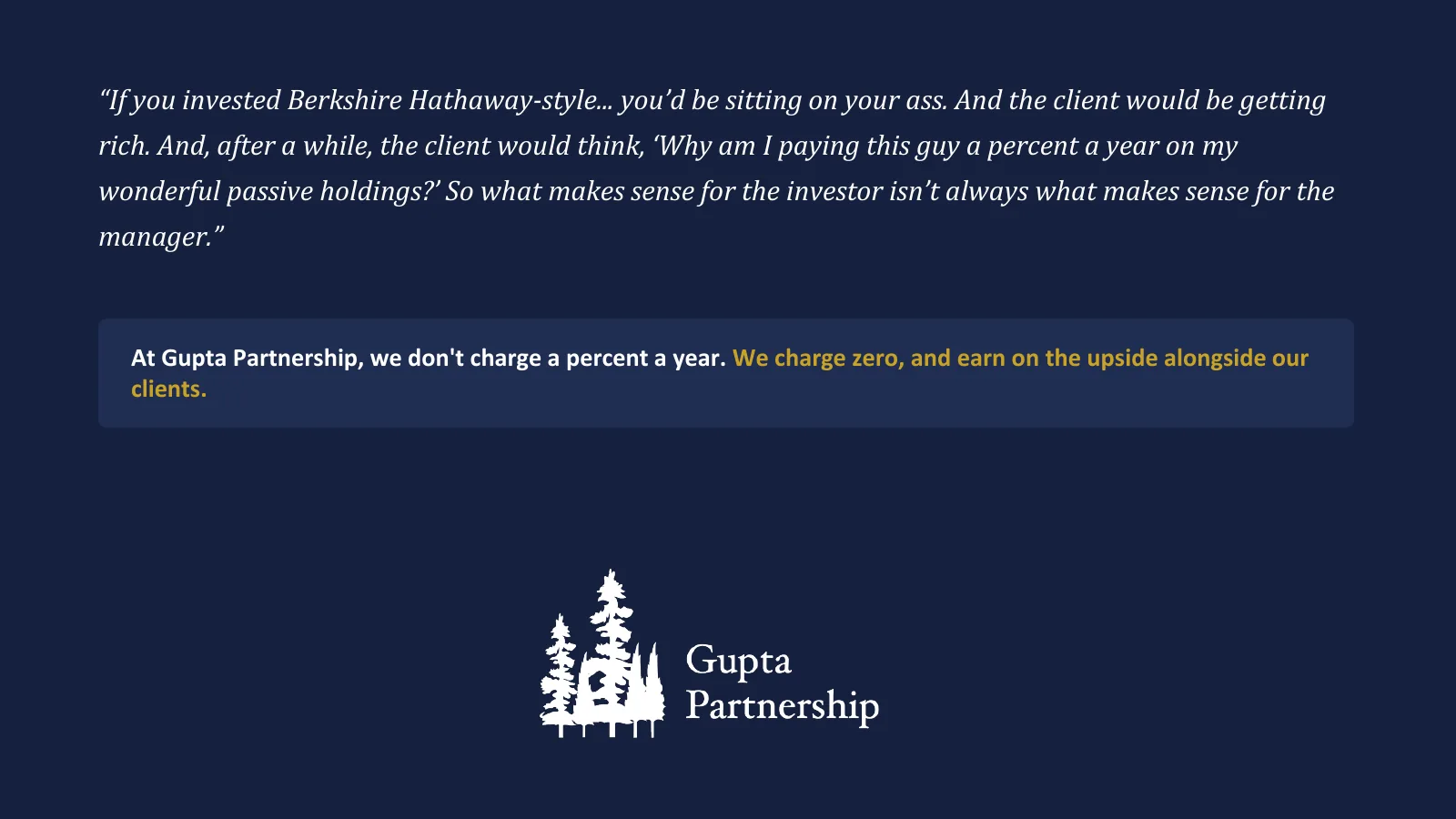
[00:12:12] At my firm I’m proud to say for the last eight years since I was 21 years old, we’ve never charged a management fee, we only charge performance fees over a hurdle and a high water mark, and so I think I’ve earned the right to suggest that what’s right for myself is also right for clients, and today I’m here to suggest that in your portfolio whether it’s 3 stocks, 5 stocks, 10 stocks, 20 stocks, what could make a lot of sense is a block of TSMC, a block of Amazon, and a block of Alphabet. Thank you.
How does Shaurya Gupta think about TSMC’s country risk?
TL;DR: He sizes the position for it and found no perfect hedge. Amazon and Alphabet together own a third of Anthropic, he added (2026).
Size the position, since there is no perfect hedge
[00:12:36] Question: Hi, thank you for your presentation. I have two questions. On TSMC, how do you get comfortable around the country risk? Cause I imagine that to be a quite binary outcome for the company. And the second question…
Tilman Versch [00:12:53] I’m sorry. A short question.
Shaurya Gupta [00:12:55] Yeah. I mean it’s not easy. You position size it accordingly. I’ve looked for hedges, it’s probably one of the only positions in my career where I’ve looked for hedges.
[00:13:04] There’s no perfect hedge. Um, so ultimately you just have to sit with it and, um, you there’s so many ways to justify it. I think Charlie has said that he just views after all these recent wars that the probability of an invasion is low. I mean that that’s a justification, looking at the summit this year, it seems to be a mutual understanding. What I would say is that a lot of people talk about that risk as if it’s binary.
[00:13:26] The future is a distribution of a lot of probabilities. People don’t talk about possibilities which is, it sounds unreasonable but there’s possibilities in which the US and the China and US and China sort of allow even if China does annex Taiwan for the fabrication facilities to be run almost like a Vatican because they have so much global impact. So there’s so many future possibilities, but as humans I think we latch onto what’s sensational.
[00:13:47] Um, and so it’s a, it’s a longer discussion. Um, and one thing I want to add too guys with TSMC, Alphabet, and Amazon, I forgot to mention this because of the time, together Amazon and Alphabet, they own a third of Anthropic. So just adding that to this. Thank you.
👉🏻 Get Shaurya’s Alphabet thesis here: https://go.good-investing.net/shaurya-alphabet