
Markel Annual Meeting 2026 Transcript
- Tom Gayner hosted the Markel Reunion in Richmond on May 20, 2026.
- Combined ratio slightly below 93% in each of the last three quarters (2026).
- Markel Ventures earnings grew 16% a year over five years, capital only 6% a year (2026).
- About 10% of the shares bought back in five years (2026).
- Unrealized equity gain of a little over $8 billion at the end of Q1, about $2 billion of deferred tax (2026).
Markel Group (MKL)
Berkshire Hathaway (BRK.B) · Jana Partners (private)
JPMorgan Chase (JPM) · Guidewire (GWRE) · Anthropic (private)
How did Tom Gayner open the Markel Reunion 2026?
TL;DR: Tom Gayner tied everything back to the Markel Style from 1986. He said the stock compounded at roughly 15% a year since then.
On stage: Tom Gayner (CEO), Simon Wilson (CEO of Markel Insurance), Andrew Crowley (President of Markel Ventures) and Brian Costanzo (CFO). Tyler Brown read the submitted questions.
[00:00:49] Start: The meeting starts with corporate intro video showcasing Lancing, AMF Bakery Systems, Havco Fusion Floor, EPI, Costa Farms, VSC Fire & Security, and Brahmin.
Welcome and Agenda
Tom Gayner [00:06:41] Good afternoon. It is absolutely wonderful to see you here for our 2026 reunion, the Markel Group annual meeting, or as we say, the reunion. None of us actually came up with that name, “reunion.” We just heard you use the phrase pretty frequently. We do our best to listen and learn from others, hence the reunion became the crowdsourced name. So thank you very much for the idea.
Here is our agenda for today. I’m going to share just a few thoughts, and then Matt Johnson will soon present our Markel Style Award winners to associates selected by their peers for our highest honor. Following the style awards, your senior management team, including our CEO of Insurance Simon Wilson, our President of Markel Ventures Andrew Crowley, and our CFO Brian Costanzo, will join me on stage to present some financial highlights and opportunities. Then we’ll be here to answer your questions.
After your questions, we’ll take about a 10-minute break to prepare for our formal AGM, which will be conducted by our Chairman of the Board, Steve Markel. During that break, feel free to either remain here for the formal AGM or join us outside at the reception for some hospitality in the form of food, drink, and music. It’ll be right out that way.
Now, before we kick off the meeting, let me first welcome you all. I also want to take just a minute to thank some of the people that made today happen. A lot of work goes into preparing for the reunion, and I just want to take a minute to thank some of the people who have led that effort. Unfortunately, time and space keep me from being able to thank everyone, but I do want to specifically thank a few.
First, I want to thank Tyler Brown. He has led the effort for the last three years in making this meeting special, and we would not be where we are today without his leadership. Tyler would be the first to say it’s a team sport, and he’s right. As such, I also want to thank Caroline Paul for her partnership with Tyler.
I’d also like to thank Cynthia Green, who leads events for our insurance business, for joining this effort, as well as her teammates Gretchen Nearburgger, who is succeeding Cynthia in that role, and Cara Mountain Wilman. I’d also like to thank a couple of all-around athletes, Cynthia Federman and Christina Mati, for their crucial contributions to anything and everything that comes up in all matters reunion. And finally, I’d like to thank Lynn Blevins, who captains the many Markel volunteers who shepherd us through all of the aspects of this meeting, from planning to helping us know where to find a bathroom, a bite to eat, or a place to park. Thank you all for the work you do.
The Purpose and Purpose-Driven Philosophy of Markel
Tom Gayner [00:10:20] In 1986, when Markel went public, Alan Kirshner, along with Tony and Steve Markel, penned our company’s creedal statement of values: the Markel Style. Those 214 words will forever be the philosophical and cultural lynchpin of your company. The Markel Style establishes the foundation of how the company approaches its business and long-term decision-making. It guides how we allocate capital and serve all of our constituents. We are not perfect. We’re human. But the Markel Style remains as a constant north star.
That’s important because Markel Group today is more than 22,000 people. We’re a decentralized system of exceptional leaders and teams operating market-leading businesses across an array of industries. We believe in autonomy and accountability. Our creed, as stated in the Markel Style, keeps all of us grounded in our common values and moving forward together as one team.
In its own way, the Markel Style addresses the question: what is the purpose of a company? We believe it is to serve. We work every day to serve our customers, to serve our fellow associates, and to serve our shareholders forever and right now.
First, the Markel Group serves its customers. We pay insurance claims for storm damage, ocean shipping losses, professional liability claims, and other complex specialized risks. We also provide essential products and services such as bakery equipment, pre-cast concrete structures, and concierge medical services, just to name a few. Doing so day after day, week after week, month after month, year after year, serving our customers dependably and reliably over time both fulfills our purpose and builds value. There are no shortcuts. There is no finish line. The journey is the destination.
Second, the Markel Group serves its associates by emphasizing culture, autonomy, decentralized decision-making, respect for expertise, and opportunities to build long-term careers. We want associates to come here and stay. We want them to tell their family, friends, and their personal networks to join us as well. We seek to create a home that attracts people with equal parts of talent and integrity. We cherish the relationships that we build throughout your company.
Third, the Markel Group serves its shareholders by focusing on building the long-term value of each share you own. We want shareholders to relentlessly compound their savings and build wealth, and we have a long-term record of doing so. From 1986 to the present, our stock price compounded at roughly 15%. That compounding record puts us in the upper tiers of public companies, and it has been true for decades, not just the last few minutes. That compounding has put kids through college, funded retirements, and created the ability to give and contribute to communities and create good.
Personally, I grew up in the shadows of Philadelphia, the center of Quakerism in the US. As the old joke around Philly says, “The Quakers came to America to do good, and they did well.” So is Markel. I want to thank you as fellow shareholders for helping us continue this path, which does so much good for so many.
Well, that all speaks to why we exist. In a few moments, Simon, Andrew, and I will tackle the question: how are we doing? We’ll review some specific financial measurements to describe that part of the answer. We’ll also talk a bit about our future and the opportunities we see. As is always the case, I think it’s important to remember that the numbers are the output. The input is the Markel Style and our system.
Living our values and serving each of you each and every day is how the magic happens. That is the system and the process which underlies our financial performance. We run Markel with the mindset of a good farmer. A good farmer farms for the next generation, not just the current crop. We’re building your company for forever and right now. I’m grateful for the chance to help build Markel. It’s a joy to do so.
Before I turn over things to Matt Johnson, give me just a minute to say a word or two about Matt. There’s so much to say about Matt that I’m going to limit myself just to words that begin with the letter C. First off, and we’ve got a picture of Matt getting ready backstage, creative. Matt is creative in every possible way. He sees into the future and imagines possibilities ahead of the rest of us.
Connector: he connects people and ideas all around the Markel Group. He has done so throughout our insurance and ventures businesses, and he has done so all around the world. COVID: Matt played a critical role during the times of change and reconfiguration driven by COVID. He helped so many of us figure out how to operate in a different way and to be able to continue to productively go about our work.
Consultant: recently, Matt stepped back just a bit from his non-stop pace as a full-time associate of Markel and took on the role of consultant to remain connected and to continue to help us craft and tell the story of Markel. I’m so grateful for all that Matt has done over so many years. With that, please welcome Matt Johnson to the stage, and enjoy this video about this year’s Markel Style winners.
What is the Markel Style Award, and who won it in 2026?
TL;DR: Matt Johnson honored 18 associates, chosen by their peers from more than 22,000 people across the Markel Group (2026).
[00:16:54] [Video Presentation: Style Awards Introduction] Videos tracking historical company documents and introducing the core philosophies of the Markel Style are shown.
MJMatt Johnson [00:18:09] All right, how is everybody doing today? They didn’t tell me they were going to do that video setup, so I feel like it’s payback for all the times I put these style award winners’ faces on the jumbotron. Thank you very much, Tom, that means quite a lot.
It is my honor to present to you this year’s winners of the Markel Style Award. Every year we give this award to people who embody the values of the Markel Style with their actions and not just their words. Our winners were selected from the more than 22,000 people who are part of our family of companies.
We think it’s important to celebrate them because they represent the best of who we are and what we can be. As I read through the names of this year’s winners, I’ll stop along the way to tell a few stories to illustrate the caliber and character of these individuals. Are you ready to meet the winners of the Markel Style Award? All right then, let’s do it.
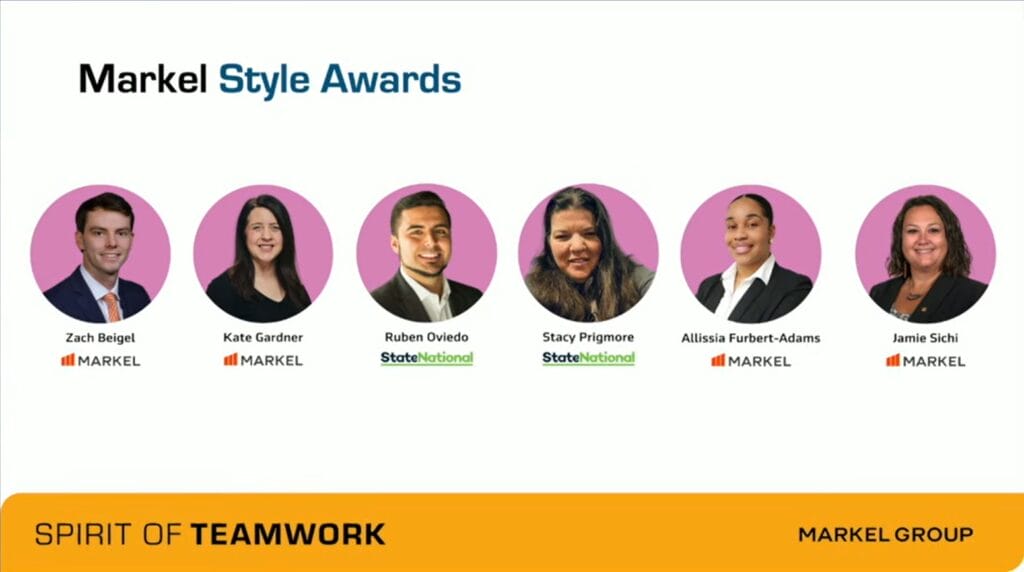
The first group of winners: Zach Bell, Kate Gardner, Ruben Otero, Stacy Pridmore, Alysia Furbert Adams, and Jamie Siki. Over 20 years ago, Jaime worked at a daycare that shared a parking lot with Markel. She had been in that job for about eight years and was looking for more opportunity in her career. It just so happened that one of the parents at the daycare was a woman named Kimberly LeFortune. Is Kimberly here today, by the way?
The astute among you will recognize that name because Kimberly won a style award last year. She was so impressed with Jamie at the daycare that she started printing out open job positions to encourage Jaime to apply. Jaime eventually did, and she got a job in the file room in 2005. She has been promoted multiple times since and she now leads a team of underwriting support specialists. That is the spirit of teamwork.
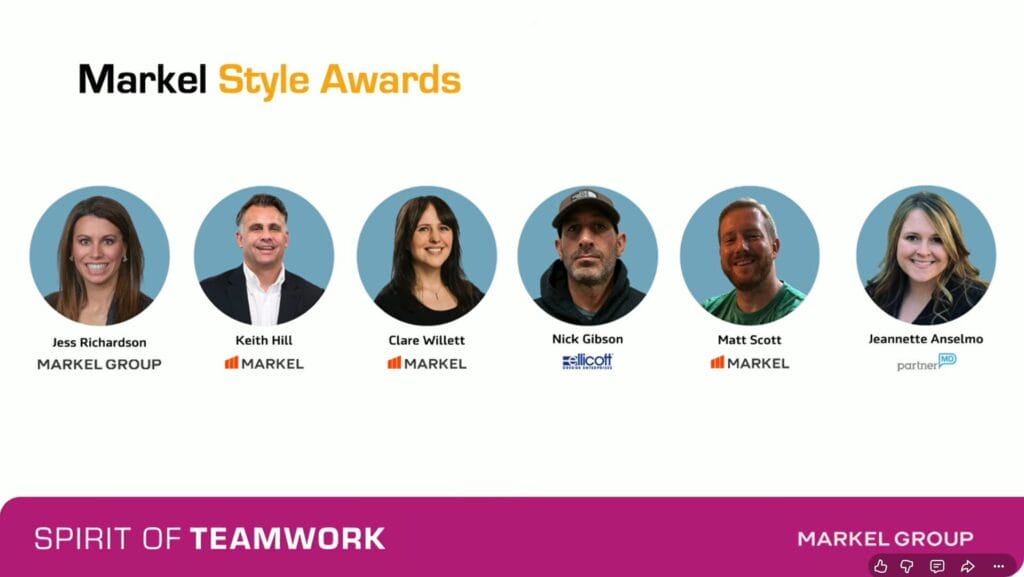
MJMatt Johnson [00:20:15] Next group: Jess Richardson, Keith Hill, Claire Willet, Nick Gibson, Matt Scott, and Janette Anselmo. You haven’t even heard her story yet, and there is already applause! Janette went into healthcare to follow in the footsteps of her grandmother. When she got out of college, she went to work for an anesthesia practice. She really came to like that company and its culture, but a few years later, that company was acquired by a private equity firm.
There were layoffs, leadership changes, and restructures, and the company eventually became a shell of what it once was. As this was happening, Janette was actually earning her MBA. It was a professor in that program who connected her with what would become her dream job. She got the opportunity to lead a small concierge medical practice in Charlotte, North Carolina called Signature Healthcare. For the next 15 years, she and the team built that into an incredible organization.
Then Janette got a call last year that she didn’t necessarily want to receive. She heard from the owners of Signature that they were considering a sale to a company called PartnerMD, which was part of a large global corporation called Markel Group. Janette feared the worst. She feared that a deal like this could kill the culture that she and the team had worked so hard to create over all those years. But it really wasn’t her decision to make. Janette took a meeting with Zach Smith, who is the CEO of PartnerMD.
Zach said all of the right things, and at the end of the meeting, he promised her that PartnerMD would take care of what she and the team had built at Signature. Despite her apprehensions, Janette moved mountains to make that deal a success, and she did not lose a single person through that transaction. You can look at this and say Zach and PartnerMD kept their promise, and Janette, you kept your promise too. Both organizations are stronger for it. That is the spirit of teamwork.
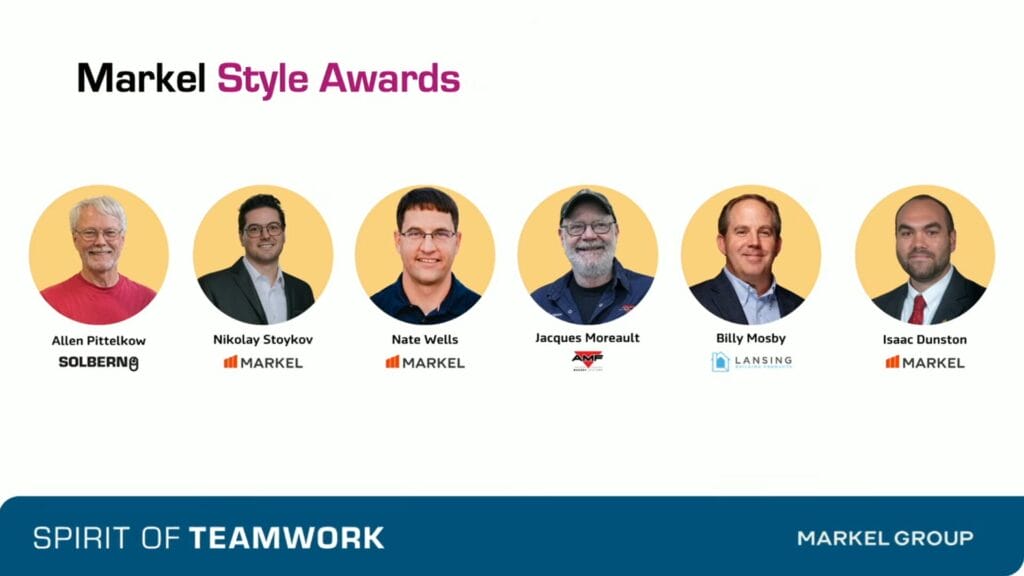
MJMatt Johnson [00:22:28] The final group of winners: Alan Pilcow, Nikolai Stoyoff, Nate Wells, Jock Maro, Billy Mosby, and Isaac Dunston. Last but not least, Isaac. Isaac was working as a server in various restaurants after he graduated from high school. He did that for a few years until a family friend who worked at Markel told him that he might want to apply for a job with the customer service team.
Isaac did and he got a job in the call center, despite the fact that he actually didn’t really like talking on the phone at the time. But he stuck it out with that job, eventually led a team in that call center, and now he’s an underwriter in our personal lines business. We love a story like this because one of the pillars of the Markel Style, as Tom said, is the idea that when you join one of our companies, you join a place where you can reach your full potential.
When you want to know what Isaac is all about, there is so much more to the story. For that, we need to go back to 2018. Isaac lives in Waukesha County, right outside Milwaukee, and he was alarmed to see that more and more people were struggling financially. He wanted to help out, but he only had about $200 to give, and he couldn’t find an existing organization providing rapid, direct financial support to neighbors in need. So Isaac decided to do something about it. He started his own nonprofit called Simply Helping People. It was based on the relatively simple premise that you could pair generous donors directly with neighbors in need. That’s what they’ve been doing since 2018.
Let me tell you just a few stories about the work they’ve done. A woman going through cancer treatment needed help covering basic expenses, and Simply Helping People provided a grant. A family had a kitchen fire and needed help getting back on their feet; Simply Helping People provided a grant. Another neighbor hit a deer, only had liability coverage, and couldn’t fund the car repairs to get to work; Simply Helping People provided a grant. And this last one is a uniquely Wisconsin story: a woman’s car was hit by a snowplow. Luckily she was okay, but the car was not, and she needed help covering expenses. Isaac’s organization provided a grant. A year later, Isaac gets a phone call from that same woman. She says, “Hey Isaac, are you still doing that nonprofit thing?” He says, “Yeah.” She says, “Well, I’ve been saving for the last year, and I’d like to pay that money back.” And that’s what she did.
As Isaac was telling me these stories, I became immensely grateful that people like him exist because they show us what’s most important in life: simply helping people. That’s what the spirit of teamwork is all about, and that’s what these people do every single day. Please join me in congratulating this year’s winners of the Markel Style Awards.
How has Markel performed over the last 15 years?
TL;DR: Tom Gayner walked through three five-year buckets. Underwriting profit fell from $700 million to $600 million in the middle bucket, and Markel bought back about 10% of its shares in five years (2026).
Tom Gayner [00:25:41] At this point, we’ve got some updates with slides, and Andrew, Simon, and I will go through a few things to give you an update on our financial performance over the last 15 years. Brian is here to answer any tough questions that none of us are prepared to do, and we might just call on him anyway.
First off, here is the disclosure statement that happens at the front of any financial presentation or conference call, the SEC equivalent of the Miranda warning. Anything we say can and will be used against us, but please don’t do that. We’re giving you the forward-looking disclosures. We had a contest where we were going to offer somebody the chance to read this to everybody, but nobody chose to participate, so you’ll just have to read it for yourself.
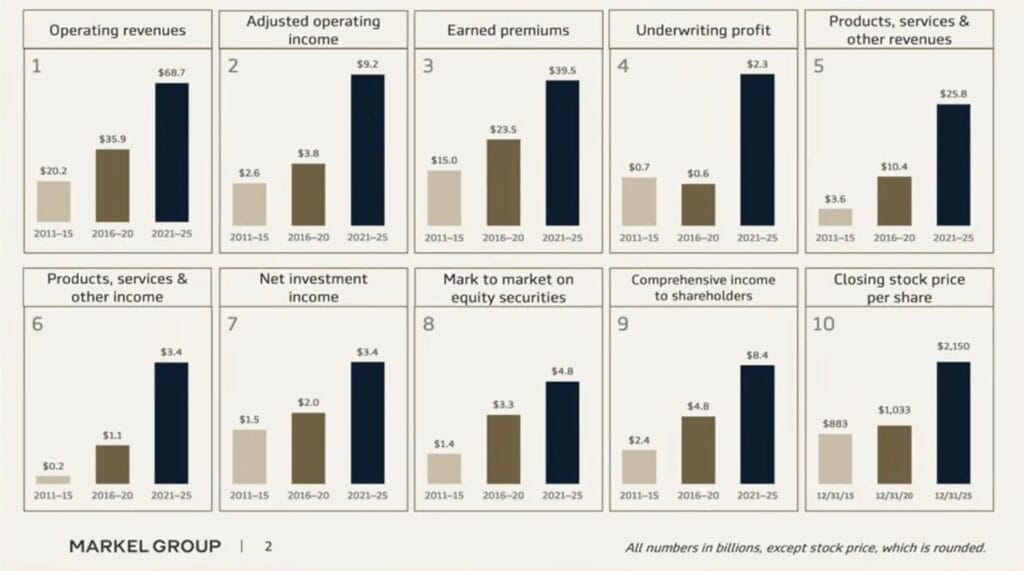
We’ll go into the slides. One of my colleagues noted, “Gosh, this is a busy slide, and boy, there’s a lot of stuff up there,” wondering how much time I was going to spend talking about it. In the annual report, I talk about five-year buckets, and we talk about being a long-term company all the time.
I think five years is sort of the minimum amount of time required to tell whether people really know what they’re doing or are good at their job. You have to give people time to let them do the job you’ve asked them to do. On page four of the annual report, in the letter there, I talk about five-year buckets. This chart and these numbers are exactly from that letter.
There are 10 boxes within there, all the way through 10, and I’m going to talk about each of them. Before I ask for a few minutes of your time, there was one little math computation I did when I was thinking about this. This represents 15 years of time at Markel. Let’s just say we have 22,000 people and they work 2,000 hours a year. 15 times 22,000 times 2,000 is 660 million man-hours of time being represented on this single slide. If you wouldn’t mind just giving me about eight minutes out of those 660 million man-hours, I’d deeply appreciate that.
- Box Number 1 (Operating Revenues): Over the years, you can see that in those five-year buckets, the revenues have gone from $20 billion to $36 billion to $66 billion. Let’s just say it goes from a number to a bigger number to an even bigger number. It’s accurate and directionally correct, which is one of my hallmark phrases. That represents billions of dollars of votes from customers who are choosing to do business with us, buying what we are selling them in terms of products and services. There’s nothing we can do without starting with customers buying from us.
- Box Number 2 (Adjusted Operating Income): This is where it starts to matter, the adjusted operating income that we’ve earned from those revenues and sales. You can see it has gone from $2.6 billion to a bigger number, to an even bigger number. We’ll break down that slide in a little bit.
- Box Number 3 (Earned Premiums): Our core legacy business is insurance. Breaking down the total a little bit to the earned premium numbers, you can see the premium growth that has happened in those five-year buckets over the years. Again, it shows the same delightful pattern of a big number, a bigger number, and an even bigger number.
- Box Number 4 (Underwriting Profit): This is where it starts to get interesting. You can see in the first bucket (the 2011 to 2015 timeframe), there was $700 million of underwriting profit. In the next five-year timeframe, there was $600 million. That is lower, despite the fact that premiums went up significantly. That was a foul period for Markel. As I cited when we first talked, we are not perfect. We’re human. We make mistakes and get off track sometimes, but we’re honest about that. We recognize it, figure out what we need to do differently, and then go about the hard business of correcting it and making it better. We always want to communicate candidly with you, and I think those five-year buckets convey very important information.
- Box Number 5 & 6 (Markel Ventures Revenue and Income): For products, services, and other revenues, the Markel Ventures set shows an amazing growth story from a small number to a bigger number to a much bigger number, a very rapid rate of growth. Looking at box number six, the products, services, and other income came along at an even faster rate of growth. Andrew will break that down for us in a moment.
- Box Number 7 (Net Investment Income): One of the features of the Markel Group is that as we operate the insurance business and other operations, they produce cash. That cash gets invested into high-quality fixed-income securities and equity securities, producing a recurring stream of interest and dividend income. You can see the same pattern emerging of a big number to a bigger number to an even bigger number.
- Box Number 8 (Mark-to-Market and Equity Securities): Tying this back to box number two where we use the word “adjusted”, Andrew helps me out with a lot of due diligence issues. Whenever we see a presentation or slide that has the word “adjusted,” what he does is “de-adjust” it and go back to the original world. What were we adjusting for in that adjusted operating income? We were taking out the short-term volatility that happens in the equity markets on any given period. But you can see over longer periods of time, and five years is long enough, we’ve made good money investing in equity securities. Again, the total returns show a big number to a bigger number to an even bigger number pattern.
- Box Number 9 (Comprehensive Income to Shareholders): Netting all of those things together, you get comprehensive income to shareholders going from $2.4 billion to a meaningfully bigger number.
- Box Number 10 (Market Value / Share Price): This concludes with share price performance. With some time delays and short-term volatility, the market generally figures it out. When we make more money, the value per share of stock tends to recognize that over time with some lags, as seen in the long-term rate of growth in the share price.
Tom Gayner [00:32:50] As I said, I do want to dive into the adjusted operating income, and the point I want to make here is the degree to which the diverse collection and array of businesses we have was really quite helpful. You can see the insurance segment (the lower bar) from 2018 through 2020 was flatter to down a little bit. It started going up in ’21, but during that six-year era, we really didn’t have a breakout or the up-and-to-the-right patterns that we would normally hope to see in our insurance operations. Simon will talk about that in a minute.
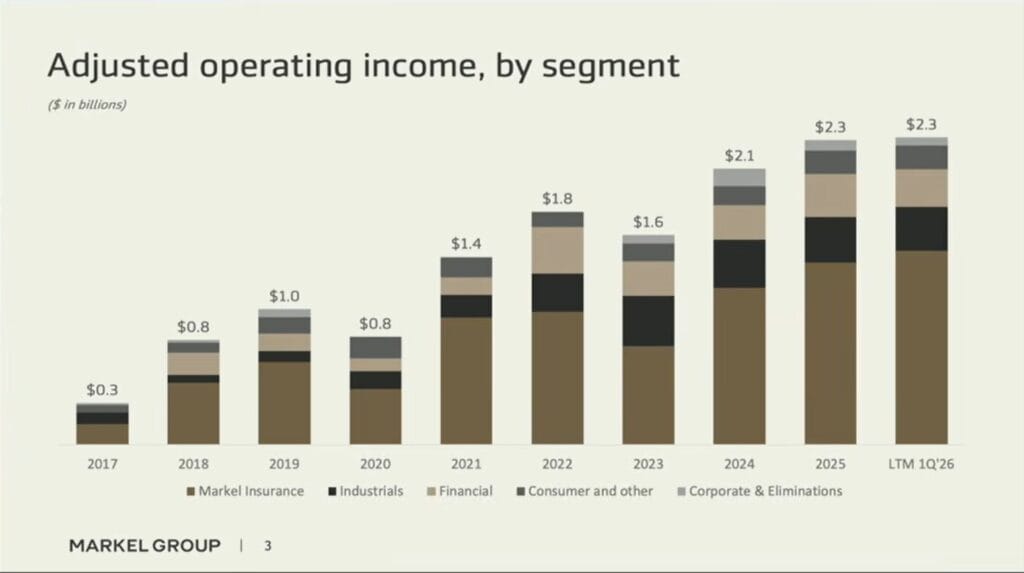
While that was taking place, the other businesses, the Ventures set of businesses, were growing quite nicely. Not only did they contribute income and cash, but they also contributed resiliency and the ability to take a long-term view of things. They gave us the ability to make the right long-term decisions, to not take shortcuts, and to do things the right way.
It’s much easier to do that with a full bank account than an empty one, and the resilience and diversity that comes from the array of businesses we own is seen clearly there. What you’re also starting to see as we go into ’24, ’25, and ’26 is that we are back on track. Simon will talk about what’s going on in the insurance business and things that have changed under his leadership, but it’s certainly getting to a pretty good place, and we’ve had continued growth in the Markel Ventures collection of businesses as well.
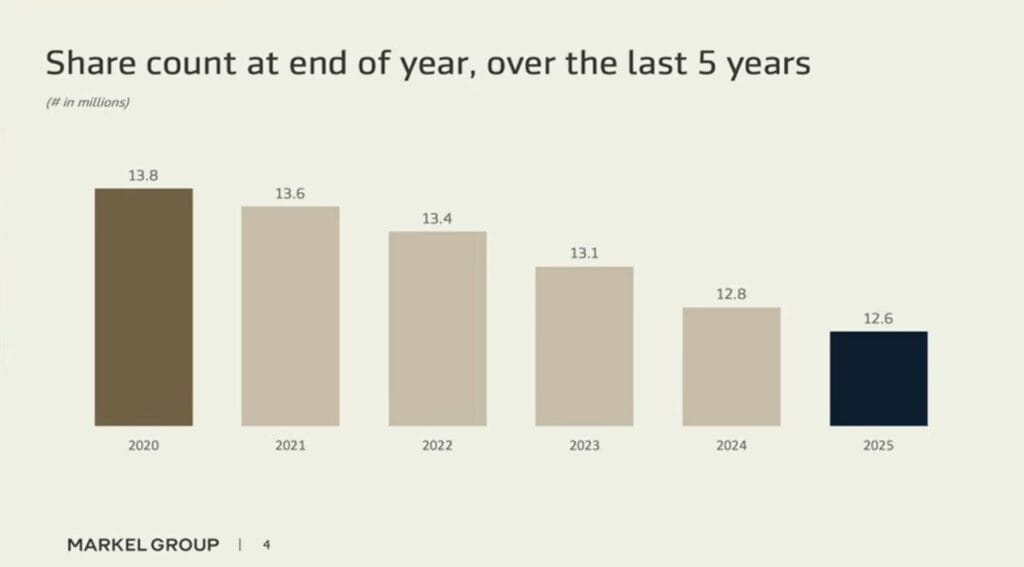
Tom Gayner [00:34:16] By the way, all of those good things that are going on financially are about building the intrinsic value of each share of Markel stock that you own. Over the course of the last five years, we’ve bought back about 10% of our shares because we allocate our capital to where it has the highest and best use, as best we can find it. We are able to fund the organic growth of our existing businesses, be they insurance or non-insurance.
We’re able to make acquisitions of insurance and non-insurance businesses. We buy publicly traded securities, which you saw reflected in the growth of net investment income and the value of the portfolio. We also pencil out the math to see how our stock is trading relative to what we think the value is. As you’ll see, actions speak louder than words, and we have repurchased about 10% of our shares at this point.
Tom Gayner [00:35:11] How did all this happen? What are the components that made this reality come to be?
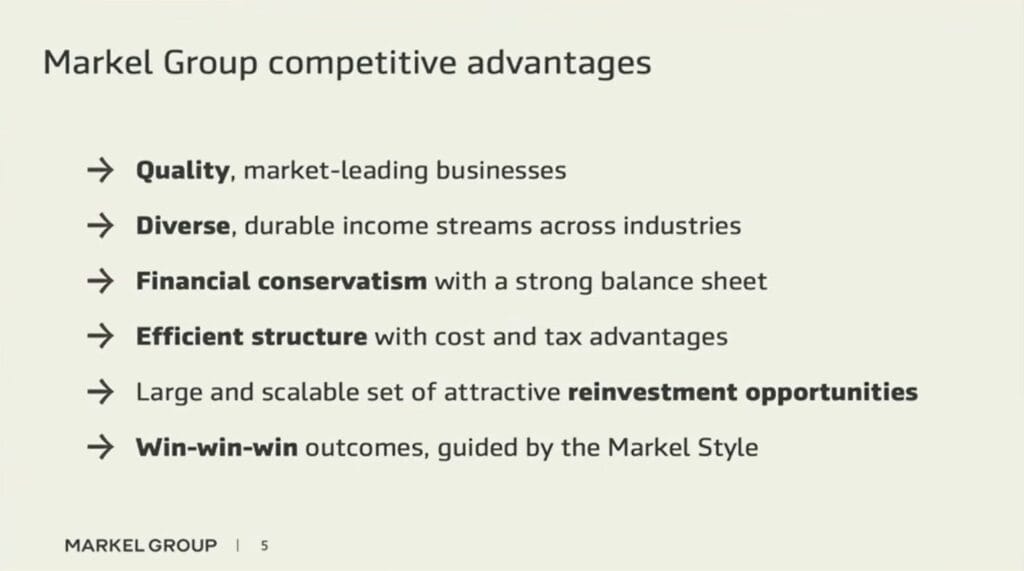
- Quality Businesses: These are market leaders. Simon will talk about his dream of building one of the world’s premier specialty insurance companies; it’s a spectacular business. The array of businesses within Markel Ventures, the leading grower of indoor houseplants, the leading car carrier trailer manufacturing business, trailer flooring, industrial gases, are all leading businesses in the niches they operate. They persistently serve their customers and associates well and compound value over time.
- Diversification: We have an array of these businesses. At any given time, one business is going to be doing better than another. Different economic cycles will apply to different businesses at different points in time. By virtue of the fact that we have fingers in a lot of different pies, there’s always plenty of pie, and that’s a good thing.
- Financial Conservatism: We operate in a fiercely conservative way. We don’t excessively lever the balance sheet. We keep the debt low, and again, that aids us in keeping long-term time horizons and thinking about things in a long-term way, rather than being under the gun of a current interest bill or an upcoming debt maturity.
- Efficient Structure: I think this is extraordinarily important and it’s one of the reasons why Markel has done so well and will continue to do well. There are three levels of very important cost savings, two of which you can see, and one of which is not immediately visible but is real nonetheless.
- Tax Efficiency: When we make money anywhere in the world in any business, we pay the tax on that. That is the appropriate thing to do as law-abiding citizens. However, if we distributed that money out in the form of dividends to you as a taxable shareholder, you would pay another layer of tax. By keeping the capital inside the business, we pay one level of tax at the corporate layer, allowing us to invest full after-tax proceeds, as opposed to taxable shareholders who would be reinvesting after another layer of tax. That is a very important structural advantage to the architecture of the Markel Group at large.
- Cutting Out Fees: We cut out a lot of fees. If we distribute capital and then need to get capital back from Wall Street intermediaries when we have a new idea, those intermediaries can’t and shouldn’t work for free. There are a lot of fees and commissions attached to moving capital in and out of an organization. As the old ads would say, we cut out the middleman and pass the savings on to you. That’s a vital level of cost efficiency.
- Explicit Reporting: Andrew highlighted this point to me and he’s exactly right. Every penny of what we spend in terms of management salaries, employee compensation, and incentive compensation flows explicitly through our income statements each and every period. By contrast, if you look at a private equity-backed organization, oftentimes some of the biggest chunks of management compensation don’t come year-by-year through the income statement; they come when the business is sold via an exit payout or bonus. Those expenses never actually flow through the operational financial statements of those companies, making it a hidden difference. Those costs are still real and absorbed implicitly by the investors. In the case of the Markel Group, you’re getting explicit reporting of everything it costs to run your business, which creates a huge tailwind of efficiency to help compound your capital.
- Reinvestment Skills: By virtue of the fact that we’ve operated in both insurance, non-insurance businesses, and public markets for decades, almost a century, we’ve developed the skills and abilities to reinvest that money and put it to work at good rates of return over time. Finally, in keeping with the Markel Style, it’s truly a win-win-win system where our customers win, our employees win, and our shareholders win.
With that, let me turn it over to my partner Andrew to break things down in those five-year buckets a little bit more in the realm of Ventures.
How did Markel Ventures grow earnings faster than capital?
TL;DR: Ventures earnings grew 16% a year and capital 6% a year over five years. Organic growth averaged 8%, and acquisitions cost less than 9 times operating income (2026).
ACAndrew Crowley [00:40:02] Appreciate it, Tom. Can we hop to the next slide?
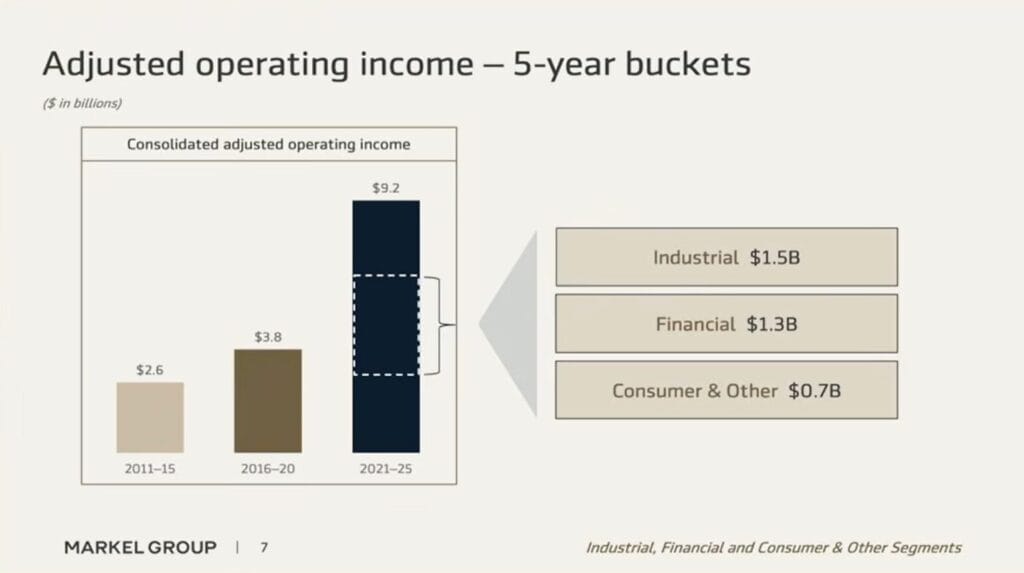
(Graphics shown on screen: Markel Ventures segment table from the 10-K, showing Adjusted Operating Income and Total Capital by segment: Industrial, Consumer, and Financial. Chart/Graphic Marker: 00:40:07 to 00:43:52)
I will say, while we’re switching over here, in Tom’s defense on the numbers, I’ve never seen such big numbers show up so small on a screen. Despite seeing billions and billions, they were quite small for us up here on stage, though a little bigger for you all behind us. Tom talked about being directionally correct. One of the things that I think we work through over time is that I like to be maybe a little more magnitudinally correct. One thing I noticed in the five-year buckets as they went across is that from the middle bucket to the most recent bucket, on average, those figures doubled or more than doubled. For those financial minds in the room, you know the rule of 72 and can quickly see that represents mid-teens compounding over that period. That’s a really, really strong number, adding some magnitude to the direction.
Where are we going to spend a few minutes now? My role at Markel is predominantly oriented to the businesses we report to you through our industrial, consumer, and financial segments in our updated financial disclosures. I want to take a few minutes and talk about some of the patterns I see, particularly related to performance, that you can track in the information we share.
We’ll look at the performance over the last five years, talk a little bit about why and what the key elements to that performance are, and then discuss why I think this is systemic, this isn’t just a recent phenomenon, it is built into the DNA of Markel Group. On this slide, you see the consolidated adjusted operating income that Tom showed earlier, along with the total numbers for each of those divisions.
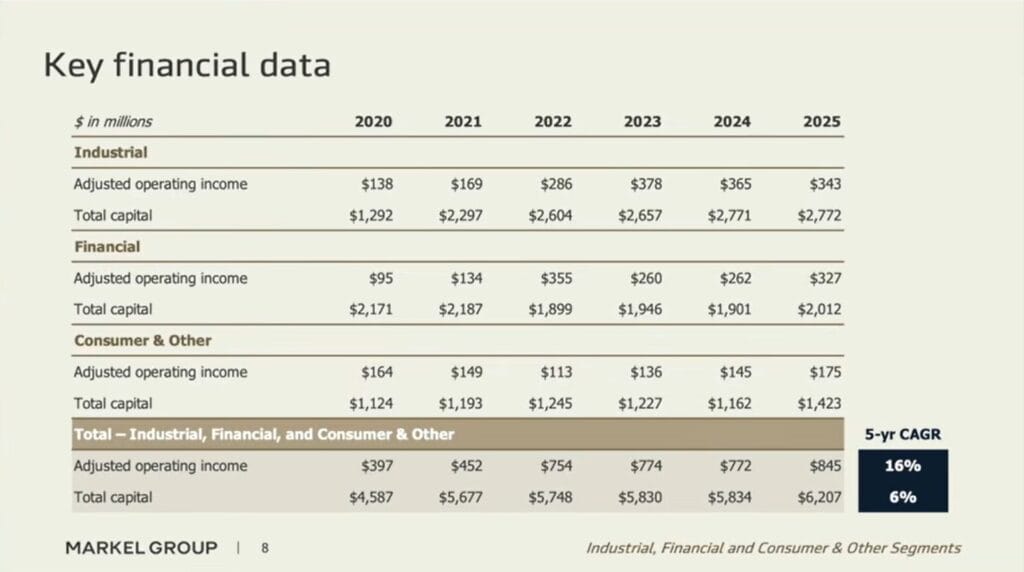
We talk a lot at Markel about relentlessly compounding your capital over time. My early training in finance pointed out something that holds true in any timeframe: growing earnings at a rate that is at or above the rate of capital growth is a strong indicator of your ability to increase returns on capital and thus shareholder returns over time. It’s a lens that when we’re underwriting a new business or looking at our own existing operations, I always want to stare at.
On the screen here, you’ll see an excerpt from the KPI table that we put in our most recent 10-K. Thank you to the team that helped pull that project along and update our disclosures; it was a heavy lift, but the valuable information is right here. What you see is adjusted operating income by segment as well as total capital by segment. In the bottom row, you’ll see the three segments added together. Next to that, you see a five-year CAGR, which shows that the earnings power of these businesses grew 16% per year on average over the last five years. Capital, on the other hand, grew at 6%.
That ratio is about two and a half to one. Earnings grew at a rate two and a half times the rate of capital. Without doing a whole lot of math, that tells me that we’re doing significantly better today than we were five years ago. It’s just a simple way to keep track of that discipline over time. It won’t happen every single year and it may not always happen to that magnitude, but it’s something we’re really proud of our businesses for achieving.
ACAndrew Crowley [00:43:53] Let’s talk a little bit about what drove that. First thing is you have to grow earnings; you can’t just do that by decreasing capital. There are a lot of ways to think about earnings growth, but one area where we provide information is around the organic growth of the businesses in our family. It’s a question we get a lot. Tyler Brown and I have a healthy debate about the value of organic growth, and at the end of the day, there is immense value in understanding if the core businesses at Markel Group are growing natively.
If you looked at all the numbers in that grid and took an average annual organic growth rate, you’d see it was 8% over the last five years. That’s a big number. In any one period, you might see a specific segment grow 15% and you might see another segment shrink 3%, that’s the natural behavior of unmanipulated businesses rather than artificial constraints put in place to hit short-term targets. But averaging 8% organic growth over the last five years is excellent.
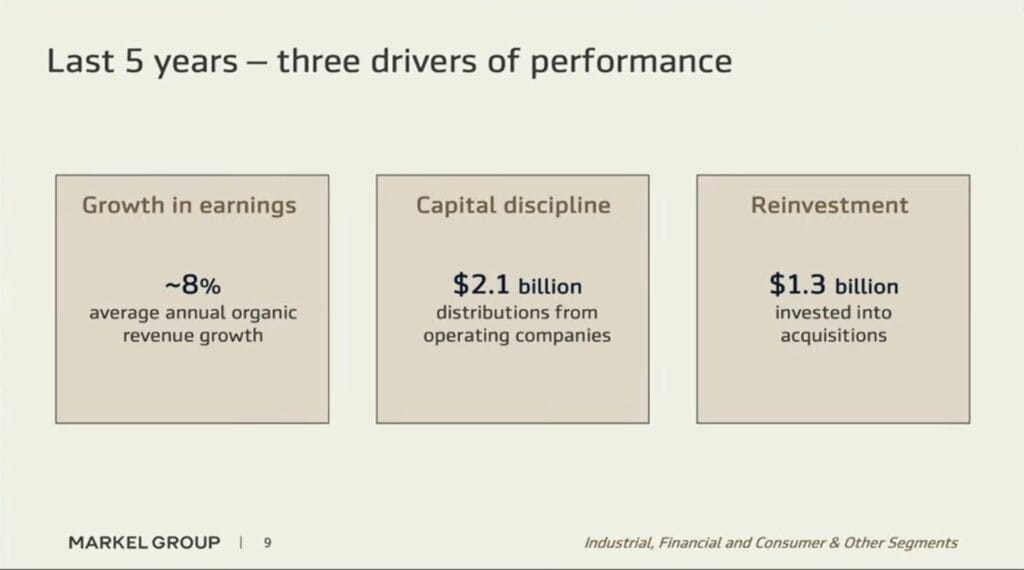
The next point is capital discipline, and this is something that our system is designed to help our leaders maintain. We constantly talk about large capital decisions, excess cash, where that cash sits, and whether it’s truly needed to run local operations. Every business within our family is well-capitalized, but they also generate a lot of cash.
When that cash isn’t needed in that individual business, the goal is simple: send it up to the holding company. Everything that we do about capital allocation requires the generation of cash and the ability to redeploy it centrally. Over the last five years, businesses across these three segments generated even more cash than this, but they sent $2.1 billion net back up to the holding company. It’s a fantastic number.
Just growing earnings and having capital discipline still isn’t enough; we still have to find intelligent ways to put that capital to work. To put one number out there, over the last five years, we’ve invested $1.3 billion into acquisitions. Just doing acquisitions blindly isn’t enough, you have to pair all three of these things together. When you ask how in the world we grew capital at such a small fraction and earnings at such a large fraction (two and a half times the rate over five years), these are the three key operational elements.
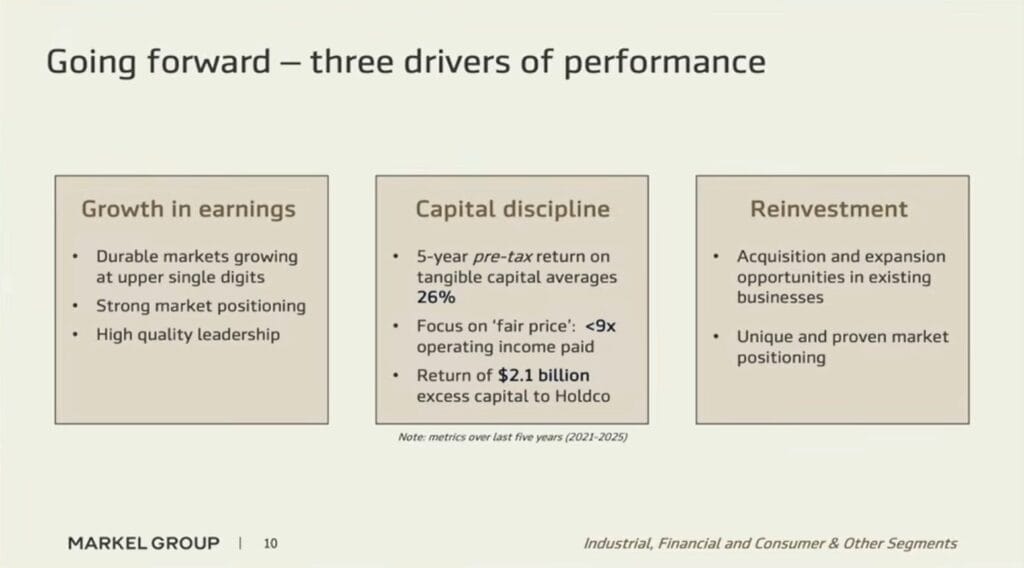
ACAndrew Crowley [00:45:45] They’re not just a feature of the last five years. Let’s talk about what’s behind that and why I think it will continue.
- Durable Markets: On growing earnings, Tom mentioned this in his commentary around our system. Our businesses operate in durable, essential markets that are growing at low-to-mid single digits natively, but they grow consistently over time. Anytime we talk about a business in our family or look at a prospective acquisition, the first thing we ask is: does it have a structural headwind or tailwind? Is the wind going to be at our back, or are we going to be fighting every day just to stay in the same place? We are very blessed to have businesses operating in a host of markets that possess secular tailwinds, whether it’s fire protection, specialized agricultural products, concierge medicine, or industrial services.
- Market Leadership: Second, our businesses are market leaders. It’s nice to have that little blue ribbon saying you’re the market leader, but what does it actually enable pragmatically? It enables structural cost advantages, pricing power, innovation at scale, and the ability to recruit and retain incredible talent, some of whom you’ve met today. There are so many structural advantages that come with market leadership. We have a strong desire to lead the niches we’re in, and our businesses do a great job maintaining that edge.
- Incredible Leadership: I was at a university not too long ago, there’s actually a student in the room from that class, and I hope he doesn’t mind me sharing, but we were talking about leadership. One of the comments from a prior case study was that Apple is such a good business it could be run by a ham sandwich. I don’t know that I would call Tim Cook a ham sandwich; I think the guy is probably one of the top five CEOs of the last 20 years, and his predecessor was up there as well. Our businesses are absolutely not run by ham sandwiches. These are incredible leaders. I get choked up thinking about it. You got to see Simon earlier, and you all got a lot of laughs from Ross. I wish I had Ross up here now, it’d be a lot more fun. Kyle, and I could go on and on. We’ve got many leaders in the room, but these businesses are well-run by great people, and this system natively attracts them. Anytime we have to make a leadership change or someone retires, we hold our breath. We worry about who’s next and whether we can keep it going. What I can comfortably tell you is that over the 15 years I’ve been here, every single time we go through a transition, we get stronger. This system is built to attract high-quality leaders.
- Capital Returns and Pricing Discipline: Look at pre-tax returns on tangible capital. What it really means is if you rip out the non-cash purchase accounting intangibles when we buy a business, how is that business performing on its inherent operational capital? Over the last five years, that number averaged roughly 25% to 26%. That’s a remarkably strong number. When we reinvest capital organically, we’re reinvesting at a high rate of return. We always focus on a fair price. Tom always talks about our four lenses, and fair price is the fourth lens. Fair price means that when you walk away from the negotiation table, you’re excited but you’re also a little uncomfortable, and so is the seller. To quantify that discipline, over the last five years, when we’ve made an acquisition, the aggregate multiple has been less than nine times operating income. That’s in a world where private market prices have continued to skyrocket. We’ve maintained our discipline, seeking high structural quality while remaining absolutely disciplined around price. As mentioned, we returned $2.1 billion of cash to the holding company, and we’ll continue to do that over time. If cash is useful in a business, let’s keep it there; if it’s not, let’s move it up so we can reinvest it elsewhere.
- Deal Flow and Reputation: We see a massive number of opportunities. It’s a real privilege to have you all as aligned partners, to have the leaders of our companies, and to have a select group of intermediaries who share high-quality proprietary ideas with us. Over time, we might review 500 opportunities in the course of a single year, and that structural deal flow is an important part of our ability to discern what constitutes an elite home for your capital. We’ve been at this for 21 years on the Markel Ventures side. That’s not that long compared to the near century of Markel Group’s history, but in the middle-market corporate world, it’s a reasonable amount of time. I think we’ve proven to have a completely unique, highly differentiated model out there. It’s not for every seller, but there are founders, leaders, and families who look to us as a unique permanent partner. When that’s the case, we’re set up for structural success. I want to stay focused on that and continue to perpetuate our reputation in that area. It’s an intangible asset that doesn’t show up on the balance sheet, Brian won’t let us capitalize it, but I do think we’ve got a wonderful model that will help us keep going over time.
With that, I’ll hand it over to Simon.
How is Simon Wilson rebuilding Markel Insurance?
TL;DR: After two weak years, the combined ratio was slightly below 93% in each of the last three quarters. Markel exited Global Re ($1.2 billion of premium) and split insurance into 14 business units (2026).
SWSimon Wilson [00:50:41] Thanks, Andrew. It’s fantastic to sit up here and look at some of those numbers. A lot of the things that you guys have been doing across the broader group have given me the structural opportunity over the last year or so to be able to make some of the hard operational changes that we’re going to talk about in this next section.
On to insurance. I can feel people on the edge of their seats in this auditorium. This is a phrase that we kicked off the year with in 2026: we call it “Building to Win.” I like it because it really captures the essence of our actions. Every single decision that we’ve been making over the past 12 to 15 months has been intentionally designed to build an organization, or rebuild an organization, that can go out into the marketplace and start winning at a high level again. Everything I’m going to talk about today centers around those concepts of building and winning.
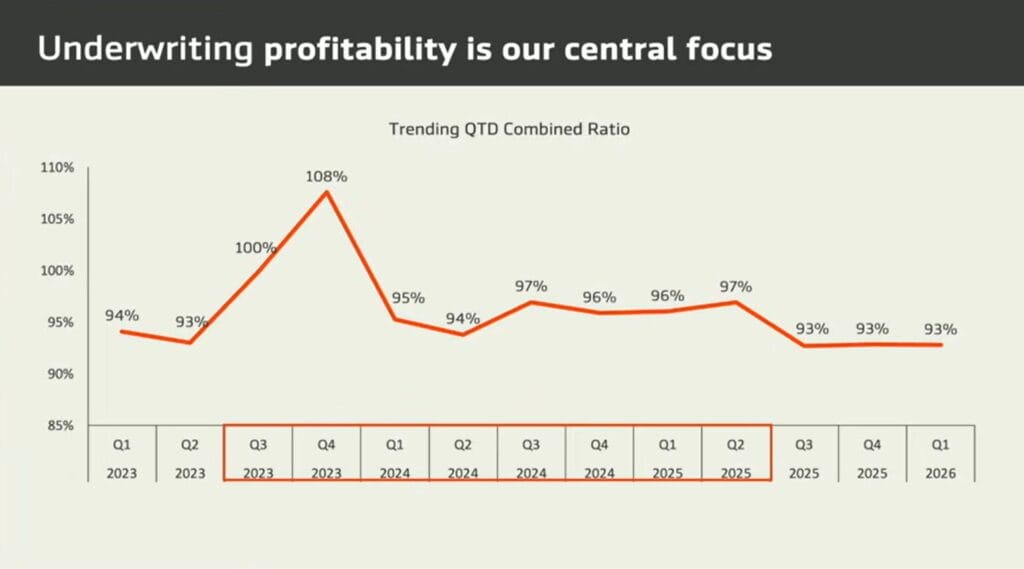
At the very core of my job within this organization and this system is to produce consistent, predictable underwriting profits. Without that gold standard at the center of what we’re doing here, the entire compounding engine doesn’t work to the degree that it should. I did this in Omaha last year, but I want to be completely honest and transparent with people about where we’ve stood over the last three years or so of underwriting.
You can see that boxed off on the screen, this is our combined ratio over time on a quarterly basis. For those of you who follow insurance, the lower the score, the better. If you’re over 100, you’re actually writing at an underwriting loss. You can see in that period from Q3 2023 to Q2 2025, so a full two-year period, we were pretty marginal, at times loss-making within the insurance business.
There was a lot going on underneath the covers there. It wasn’t that specific period of time that was natively the problem; the seeds were sown long before that in many respects. A lot of what we have had to do to get back to consistent underwriting profitability is really hard, grinding work on our portfolio risk management. Let me share just a few things that we’ve done on that underwriting portfolio:
- In the casualty business in the US, we’ve significantly reduced the proportion of construction risk that we’re underwriting.
- We’ve decreased our average line size quite significantly across the board to limit volatility.
- We have completely exited our public D&O (Directors and Officers) underwriting in the US, which was roughly a $200 million line of business.
- We completely came out of Collateral Protection Insurance (CPI), which was an operational misstep.
- We have completely exited Global Reinsurance (Global Re).
Now, a lot of those decisions that we made at the time were correct economic ones. But if you go talk to brokers about lines of business that you’re now stepping away from, lines they heavily relied on you to underwrite, that is not a popular thing to do. It’s hard yards to go and execute those restructurings. But this is not a popularity contest; it’s a profitability contest, and that’s really important for our teams to understand.
As we’ve seen the improvement in the recent quarters, the last three quarters have actually been slightly sub-93% in each quarter, we can see the green shoots emerging from those difficult decisions that we had to make over the course of the last 18 months. It’s hard yards. For those of you on the insurance side of the business in the audience, that work was worth it and it will continue to be worth it. We have to keep going and producing these types of results for another three quarters, and another three quarters after that. I think we’ll get our “halo effect” back that Tom talks about quite a lot if we continue to consistently execute results like this.
You can do some good portfolio management by cutting things, and often that’s required, it’s like pruning in a garden. But you cannot cut your way to greatness. You have to do things to rejuvenate organic growth in an organization and to become a market leader again.
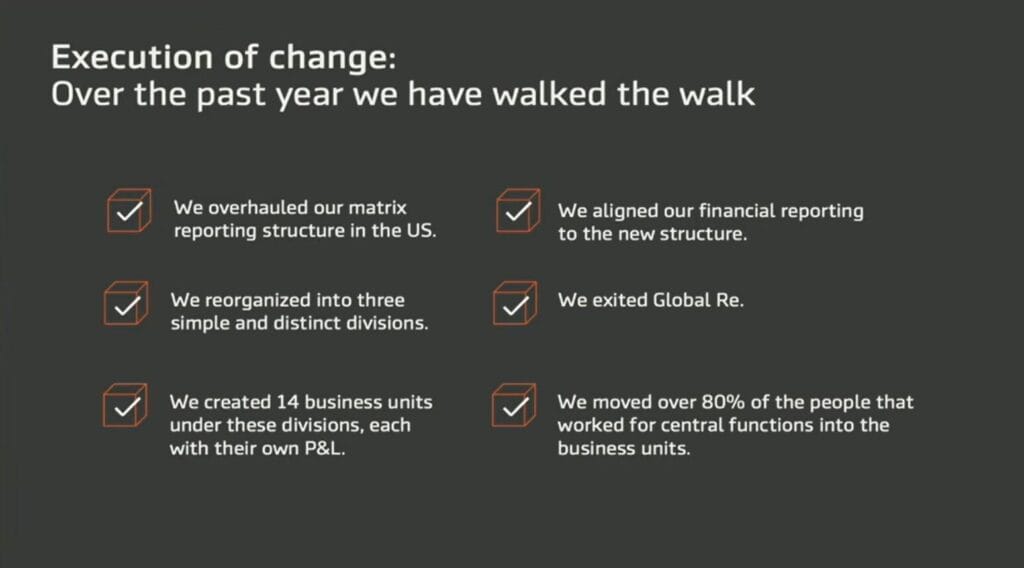
SWSimon Wilson [00:54:26] Last year, I sat on stage and I talked a lot of talk. I was saying these are the things that we’re going to do, talking about P&Ls, reorganizing, and getting rid of complex matrix structures. Over the last 12 months, I think the team has really walked the walk, and I’ve picked the big six structural milestones that actually happened:
- The dreadful four-dimensional matrix structure in the US, which meant every single decision we were making on the underwriting side had to be done by an expansive committee, is gone. There is now detailed clarity on exactly who is responsible for what.
- We reorganized the entire global business into three clean divisions: Wholesale and Specialty, Programs and Solutions, and our International business. Each of them is led by a terrific leader: Wendy Hower, Alex Martin, and Andrew McMillan, respectively.
- Under those three divisions, we’ve established 14 business units, and every single one of those 14 business units has its own distinct, accountable P&L and a leader that sits squarely on top of it.
- All of our financial reporting and management information, thanks to massive efforts from Brian and his team, are now perfectly aligned to that new structure.
- The incentive compensation of the leaders who drive that new structure is now directly tied to those distinct P&Ls.
- We stepped away from the loss-making Global Re business, which represented $1.2 billion worth of gross written premium. Concurrently, 80% of the 2,200 people who used to work for the central, corporate part of our organization have now been decentralized and embedded directly into those 14 operational business units. They are now close to the business, close to the customers, and going to work every single day with winning on their minds. This massive amount of organizational change, on top of the portfolio changes, sets us up fantastically for 2026 and beyond.
SWSimon Wilson [00:56:21] Let’s talk about a few core concepts and pillars that are going to drive our success over the next three to five years, and it all begins with strategy. In strategy, there are just two questions that you need to care about: the first is where to play, and the second is how to win. For a long time in the insurance business, we were fiddling around with lots of different things regarding where we wanted to play. But our heartland, the place where we built this business, is in specialty insurance. That is a $700 billion to $800 billion marketplace globally. We write $9.5 billion of that total. There is ample road to run in the space where we can make a structural difference, and we should be completely confident in attacking that space. By the way, that market tends to grow every single year as well; it’s not a zero-sum game. There is plenty of opportunity there, and the grass is not greener elsewhere.
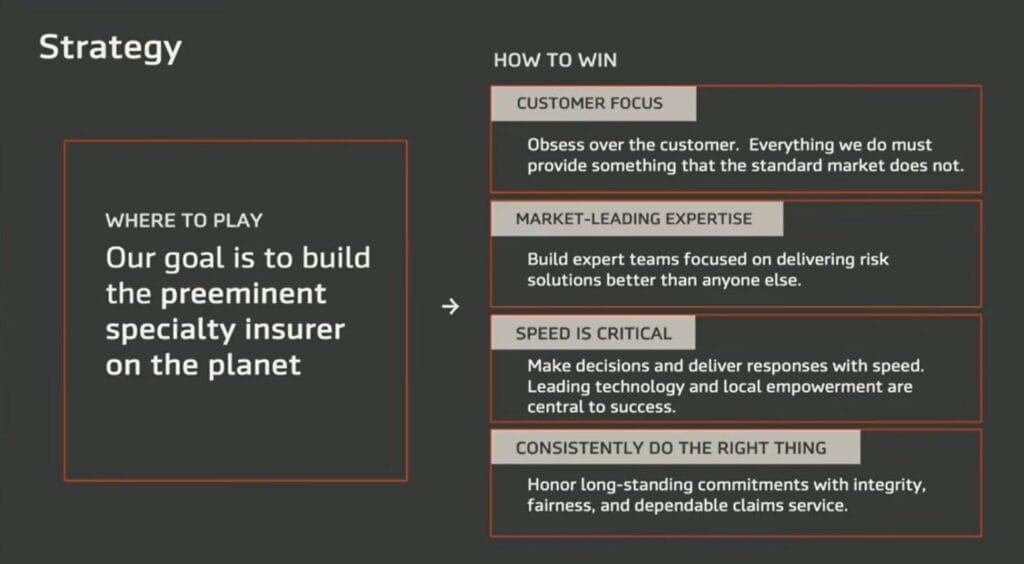
Once you become comfortable in where you’re playing, the question then is: how do you win at that game? I feel passionately that there are four things above all others that differentiate a winner from the also-rans:
- Customer Focus: A complete obsession over customers. If we can’t outcompete the standard marketplace, business will never transfer to the specialty marketplace. We have to offer solutions to our customers that others cannot.
- Market-Leading Expertise: That unique value comes from deep expertise. We need to put together teams of people who are absolutely focused on their specific niche of our industry and are complete experts in it. We create these specialized “Navy SEAL teams” because people in this industry buy deep expertise and rely heavily upon it.
- Speed: Speed is utterly critical. The structural ability to make underwriting decisions at ground level close to the customer at speed will win you business nine times out of ten in this industry. You have to eliminate corporate bureaucracy. The decision-making autonomy which we’ve pushed down into the divisions as a result of the new structure, paired critically with modern technology, is what will drive that speed to market.
- Trust: Finally, this is a trust game. People are buying a piece of paper that promises them we will be good for our claim in the event of the worst happening. Consistently doing the right thing in both claims management and the way that we act with our customers is absolutely tantamount to success. You do those four things well within specialty insurance, and you’ve got a heck of a good chance of building an incredible business.
SWSimon Wilson [00:58:54] Strategy is one thing, but how do we structure ourselves? It’s simple in my mind. I talk about building blocks, a ground-up mentality that Tom talked about earlier. We’ve got Markel Insurance at roughly $9 billion, split a third, a third, a third into our three major divisions. Underneath that, you’ve got the 14 P&Ls. Within those 14 business units, the business gets broken down even further by those business unit leaders into highly specialized lines. Every single one of those blocks has people, products, technology, and customers sitting around them.
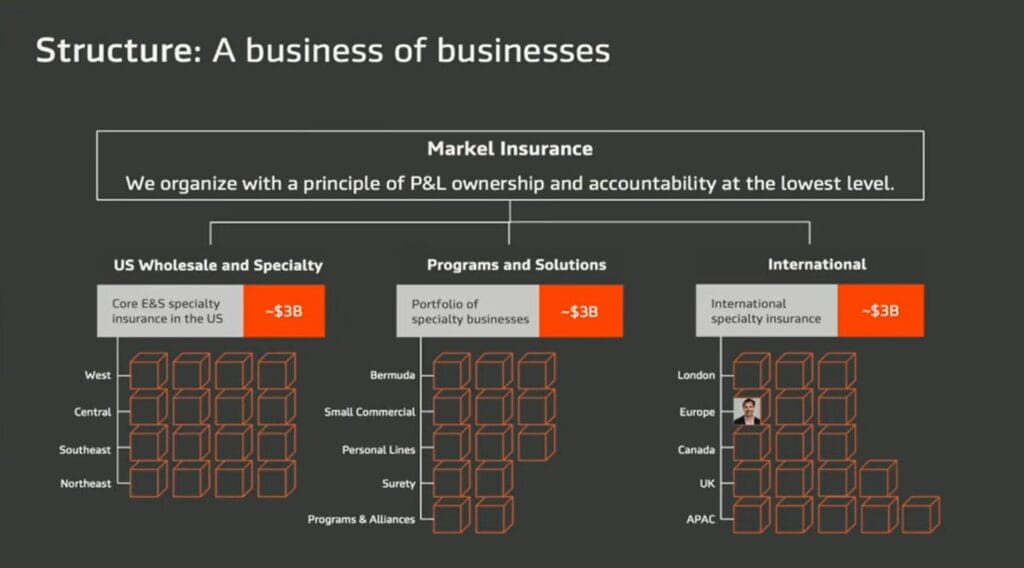
Those leaders who sit in those blocks, that’s where the magic really happens in this specialty business. There’s a picture of one individual on the screen, a guy named Esteban Manzano, a man we sent out to Madrid back in 2005 to go build a business from scratch. The wonderful thing, my favorite meeting of the whole of 2025, was when Tony Markel and I got on a plane and went around Europe. Tony had never been to our office in Madrid.
Tony was able to walk into our office with his name above it, he looked quite pleased about that, Tony, and see 80 Markel associates in a $65 million business operating at a combined ratio sub-90%. Tony had never even been there before. The guy that drove that was Esteban and the team he built around us. If you took any one of the blocks you see in front of you, there’s a story equivalent to Esteban’s within each and every one of them. It is a wonderful story of being able to build a business piece by piece. If we decide to add a new block in here, it works seamlessly within the system and structure we’ve created.
Technology and Artificial Intelligence (AI) Implementation
SWSimon Wilson [01:00:57] I am certain that we’re going to have a ton of questions about technology and AI, so I’ll keep my comments very brief at this stage. There are three levels of strategic bets that you need to make on AI and technology in a business of this global breadth:
- Transformational Bets: I believe we can build brand-new businesses completely from scratch within Markel Insurance in the next few weeks that can transform the way we provide services and transact business in certain aspects of the specialty market. We can go ground-up from scratch and create a completely new operational model.
- Reimagining Existing Divisions: We can structurally redesign the business divisions we already have. In areas like Financial Institutions in the US and Transactional Liability over in London, we have completely reimagined how we provide our insurance business through the use of AI, building workflows from the ground up.
- Continuous Quick Wins: Finally, there are hundreds and hundreds of incremental optimization opportunities to improve our business 1% every single day via quick wins.
I’d just like to turn over to a video so the people making these quick wins happen can talk directly to you and give you a flavor of what’s happening with AI in Markel Insurance.
[01:02:16] Video Presentation: AI in Insurance
SWSimon Wilson [01:06:25] All right, so there’s a lot going on around AI. That’s just a flavor, and I’m sure we’ll touch on it later during Q&A.
The final pillar that has truly been transformational over the last 12 months centers around culture. What we’re trying to do is take an organization which had become a little bit middle-aged, we had slowed down on grinding out new products, and really instill what we call a “Founders’ Mentality” across the entire organization. There are three elements of a Founders’ Mentality that are critical:
- Insurgency: The clear idea that what we are doing is just going to be fundamentally better than everybody else in the marketplace, a complete passion to deliver something superior for our customers.
- Customer Obsession: The fact that we obsess over and deeply understand our customers, meeting them exactly where they are every single day.
- Owner Mindset: We’ve heard that a couple of times. Every single dollar that we spend on these businesses feels like it’s our own personal money, and we are proud of the businesses that we’re building.
The second part of culture is simply beginning to win again. The idea that we come to work to win, rather than just to do work, is a critical cultural shift across the organization. Bureaucracy is the specific thing, more than anything else, that kills once-brilliant organizations. Our job is to stamp bureaucracy out wherever we find it, and that is a core cultural aspect of how we run this business.
Finally, pure joy and enjoyment. I hear laughter in the air more than I have in a long period of time, and I hear deep ambition in every corridor that we walk down. You put the strategy alongside the structure, the intelligent use of new technology, and people really wanting to be part of this organization, and you put some laughter in and amongst that, I think we find ourselves in a position now where we can really take this organization to the next level and place ourselves back as the preeminent specialty insurer on the planet. Thank you.
With that, back to Tom.
How did management answer Jana Partners and the Berkshire question?
TL;DR: Tom Gayner called some of Jana’s points fair and keeps Markel Ventures. The Berkshire stake stays, with an unrealized equity gain of a little over $8 billion (2026).
Tom Gayner [01:08:35] Simon, thank you. Thank you all. This is a delightful time when we get to share the progress that we’ve made, and I hope you can feel the sensation of joy that we’re finding in getting things back on the right track. Time for Q&A. We’ve got three spots from which to take questions: Zone 1, Zone 2, and our own Tyler Brown over there with submitted questions.
You’re more than welcome to ask any question that you would like; we’d love to hear from you and have a discussion. If you would be so kind as to tell us who you are and perhaps how long you’ve owned Markel shares when you are recognized, and then proceed with your question. With that, Zone 1.
How does Markel answer Jana Partners?
[01:09:20] Shareholder (Jeff Stacy, Toronto): Thank you, Tom. My name is Jeff Stacy. I’m from Toronto, a longtime Markel shareholder. I just want to start by thanking you and your colleagues for putting on such a terrific reunion; it’s just an amazing forum to learn more about our company. So congratulations and well done. My question is about the recent letter from Jana Partners to the Markel board. I read the letter very carefully, and it strikes me that because Jana is so public in stating their views, it’s easy to get the impression that they represent the majority of Markel shareholders.
I think the reality of the situation is much different. Speaking for myself as a longtime shareholder, I think it would be a huge mistake to sell the Markel Ventures unit. Personally, I like the permanent business economics and the cash flow diversity that it brings to Markel. I’ve spoken to many other shareholders, and I haven’t found a single one that supports the notion that selling Ventures is a good idea.
The other issue that Jana raised was around share repurchases. It seems to me that there’s more common ground between Markel and Jana on that issue. Markel has been buying back shares, as you showed in your presentation, for a number of years now, and you’ve publicly stated that given the current share price, you would expect that robust pace to continue. I will just say that tender offers can make sense in many situations, but they’re also costly, time-consuming, and they often result in low take-up rates and higher prices being paid than a slow, steady, methodical compounding purchase of shares in the open market.
Even on this issue, I find the approach you’re already taking more compelling than what Jana is suggesting. While I accept that Jana has the right to advocate for any course of action they want, as does any Markel shareholder, I think the time has come for them to recognize that they don’t represent most shareholders, and their views are contrary to what most shareholders want. For them to continue advocating with this approach is just a time drain and a distraction for management. My question is simply: would you care to comment on this?
Tom Gayner [01:12:41] I think I prefer hearing you comment on it, Jeff! No, thank you very much, I appreciate the thoughts. To be fair, when Jana first raised the issues, I happened to have been in New York City at the time. I was in a meeting, and my phone started buzzing quite a bit. I excused myself, looked at my phone, and said a bad word.
I called those folks and noted that they make their actions public without telling us first or giving us a call beforehand because they have their own agendas and things they’re trying to achieve. I mentioned that since I happened to be in New York City, I’d be happy to meet with them and discuss this face-to-face, offering to be at their office by 2:00 PM the next afternoon. I did.
I was advised by my advisors and counselors to go in and be “listen only, listen only, listen only.” I went into this meeting, and for the first 45 minutes, I would give myself an A, maybe an A+, on being listen-only. I probably slipped to maybe a B+, or maybe even a B or B-minus as we got into the last 15 minutes or so, because there were some factual things where I just wanted to ask, “Where did you come up with this?” or “Where did you come up with that?” to make sure we agreed upon the baseline facts.
I also noted at the same time that they raised a lot of legitimate issues. We talked about those five-year buckets and how bureaucracy had crept in, as Simon would say, and that we had lost our way a little bit. That was a fair criticism, and I acknowledged that then and say that right now. However, we had already started to take steps to make that better, and we were working hard at it.
I will share a story with you which my wife tells me not to do, so of course, I’m going to do it. In that conversation, I asked if they had executed insurance-related investments before, and they really hadn’t done much in the insurance space. We talked about the unique accounting and time sequences involved. If we sell an insurance policy, we collect that premium on day one, but we accrue and earn that premium over the course of a year, and normally it’s at least two years before you really get a true accounting indication as to how well that particular book of business is performing.
The kinds of underwriting restructurings that Simon is doing right now and the operational corrections we’ve implemented take time to clear through the financials. I used the phrase “green shoots” when discussing our recent combined ratio of 93%, but there’s a lot more plural to come behind that “s.” I was just trying to have an accounting conversation, which people love having by the way. I said, “No disrespect here, Simon, but if we had Jesus Christ running our insurance business, it would still be two years before we knew for sure if he knew what he was doing or not yet. So give the guy a break. Give him some time.”
I think the core difference and the core way in which we see the world differently, and it’s not natively right or wrong, it’s just different, is that Markel is a long-term company. We are coming up on a hundred years of history. People invest their entire lives in this company. I have shareholders come up to me and say, “The biggest chunk of my net worth is in Markel stock.” That is a heavy responsibility, and it’s a responsibility I take very seriously. There is an epic amount of trust that has been placed in us by investors and our colleagues; it’s our own life story as well.
When you think about things in the permanent time horizons that we do, the pace at which we repurchase shares is subject to a lot of other moving parts, what deals are we seeing, our desire to maintain dry powder to execute on opportunistic acquisitions, and our structural ability to answer the bell for the next round of the fight over and over again, no matter what happens to the macroeconomic environment. Our financial conservatism and methodical pace are reflective of that commitment to make sure that we continue to compound the value of your company forever and right now. But thank you for the question. Zone 2.
How will float grow after the reinsurance exit?
[01:17:13] Shareholder (Joey Opin, Richmond): Hi Tom, my name is Joey Opin and I’ve been a shareholder since 2019. I’m based out of Richmond. Thank you again for holding such a wonderful event. Andrew answered my first question during the presentation, so I’ll go with my backup. This question is for Simon and Brian. How should we look at the future of float over the next few years after exiting the reinsurance business? Should we expect it to accelerate as more resources get funneled into specialty, and Markel Insurance doubles down on its bread-and-butter core business? Thank you.
Tom Gayner [01:17:50] I nominate Costanzo.
BCBrian Costanzo [01:17:52] Yeah, thanks for your question. I think you’ll see two different dynamics going on there. First, we put the Global Re business into runoff. When we do that, we stop writing new premiums, so that specific line stops generating new float. However, the reserves sit there for a long time. We’ve got about $3 billion of reserves attached to that business, and those are longer-tail reserves. That float is going to sit on the books for a while and continue to be invested in the securities that we hold.
On the other side of the equation is what Simon talked about, all the organic growth strategies that we have and how we redeploy that capital into our other specialized business units. That’s where you’ll see the secular growth in the float coming in the future. The structural ability to grow in those 14 P&Ls will allow us to continue to accumulate float and compound it, but at significantly better combined ratios and better returns on capital.
At the end of the day, the two operational metrics that we’re looking at on a day-in, day-out basis are: what’s our combined ratio (how much are we making on underwriting profits), and how efficient are we with the capital that we’re deploying to generate those underwriting profits? The changes in the financial disclosures we made to highlight Return on Equity (ROE) as a key metric reflect that focus. That’s near and dear to everything that we do and it’s core to how we manage the business every day.
SWSimon Wilson [01:19:14] One point I would offer on that is that we obviously stopped underwriting the reinsurance business, and as Brian says, it’s now in runoff. We continue to actively look to draw a permanent line underneath that reinsurance book if the right structural transaction comes across the table. If we can execute a loss portfolio transfer (LPT) reinsurance policy or an adverse development cover (ADC) at the right economics, we will likely take that so we can release the encumbered capital and move on with our growth strategies. That area of capital optimization is something we discuss on a very frequent basis. Thank you, Joey. Mr. Brown.
Does Buffett’s retirement change the Berkshire stake?
TBTyler Brown [01:20:02] All right, I was going to begin with a question about Omaha because, for the first time since 1991, we didn’t have our Omaha brunch, which would have been naturally where a lot of shareholders would have gotten some of your perspective on Berkshire, and we had some questions to that effect. I wanted to give you the opportunity to answer Scott Chapman’s question: has the retirement of Warren Buffett as CEO changed your thinking about the large allocation to Berkshire Hathaway, and do you feel constrained by the large unrealized capital gain in that position?
Tom Gayner [01:20:33] Well, thank you. I’ll start with the end: being constrained by the large unrealized capital gain position. May the Lord smite me with such a curse! We will worry about those kinds of high-class problems as much as we possibly can and would love to do so. That massive unrealized gain directly contributes to the tax efficiency that we talked about earlier.
If you look at the equity portfolio in total, at the end of the first quarter, the unrealized gain was a little north of $8 billion, and it’s probably more than that today. That represents roughly a $2 billion deferred tax liability on our balance sheet. That means there is $2 billion of interest-free capital working on your behalf as shareholders, for which our cost of capital is exactly zero. That is an awesome, asymmetric advantage.
I think that total dollar number of unrealized gains is probably the second highest of any public company in the country. It’s stunning that this little business that grew out of Richmond, Virginia now has the second biggest unrealized gain of any company in the country, obviously with the largest one being Berkshire itself. It’s a high-class problem. If the underlying economics were ever such that I was concerned we should sell it anyway and give up that tax advantage, we would do it, but we would always do it thoughtfully, calculating whether reinvesting “80-cent dollars” into something else is wiser than leaving “100-cent dollars” compounding where they are. Sometimes it is, so we’re very open-minded.
In terms of the brunch out there, we decided we would trade the Omaha brunch for the Richmond barbecue. I didn’t know it was going to be 100 degrees literally for the barbecue, but we did want to shift the focus and emphasis to Richmond because things are changing out there.
To the first question regarding our view on Berkshire Hathaway: I think it remains a wonderful investment. I think it will continue to be a good investment. It is highly diversified, low cost, and very well run. Greg Abel will do a fine job. In the course of time, it reminds me of a parallel: if you think about JPMorgan, it’s a great company that is over 150 years old. If most of us had to take a bet on naming the first chairman ever of JPMorgan, we could probably come up with the winning bet: JP Morgan.
I think there are a lot of people who can also name the current chairman and CEO of JPMorgan, Jamie Dimon, a very public figure and well-known business leader. But there were a lot of executives who served in that role between JP Morgan and Jamie Dimon, and I don’t know any of their names off the top of my head. I think a lot of us would struggle to come up with those names. But they were seasoned, professional executives who were highly qualified to do the job, and the underlying institution compounded.
I think the case we can expect with Berkshire for a long time to come is that it is a major, substantial, well-diversified business that will be well run by a talented team of professional executives. There will never be another Warren Buffett; he is one of a kind. But the good news is that’s not what Berkshire needs at this point. What Berkshire needs are talented executives to run the operational businesses, and they have them. Zone 1.
What did shareholders ask about competition, risk and returns?
TL;DR: Simon Wilson worries more about lawsuits than storms. Tom Gayner pointed to a five-year return of a little over 15% a year to the end of 2025 and faster buybacks (2026).
Which competitor would Markel remove with a silver bullet?
[01:23:47] Shareholder (Raith, Richmond): Zone 1. My name is Raith, I am from Richmond, and I’ve been a Markel shareholder for five years. I have a small question, and I will be happy if all four of you can answer. It’s not an original question, I was reading The Davis Dynasty, and Shelby Davis senior used to visit insurance companies and ask this specific question: “If you had one silver bullet to shoot a competitor, which competitor would you like to shoot?”
Tom Gayner [01:24:19] I am not going to even allow my colleagues to answer that question! I don’t like to be dictatorial or top-down, but I’m going to say that. We are fiercely competitive and we want to win, and there are times where we see people doing things or saying things about Markel that sort of gets under our skin, and so be it.
But positivity is important, optimism is important, goodwill is important, and grace, trying to meet people halfway in a positive way, is essential. We’ve been through a time period of operational adversity and some challenges, but at the end of the day, focusing on shooting competitors is handing over your agenda to somebody else and letting external forces control the way you feel, and that’s a mistake.
I love Matt’s story about the Simply Helping People nonprofit, identifying a tough situation where you can help somebody directly, and then that goes so well that the recipient starts helping back, and a positive daisy-chain reaction is set off. We are not about the business of shooting other people. We have shot ourselves in the foot from time to time, and we are stopping doing that. So we are putting the guns down and running our own business. I told the colleagues they can’t answer, but I see Simon micro-expressions over there.
SWSimon Wilson [01:25:28] I’m going to say one thing. Often people think about competitors through the lens of, “Let’s get rid of them.” I don’t think like that. Some of our competitors have done brilliant things to outcompete us which we can learn from. If you just put your head in the sand and say, “I just hate the other guy,” you miss the point completely. Competitor feedback and competitors outcompeting you in an area can be a gift if you’re playing a long-term game. Figure the game out and outcompete them. I think that’s what we’re trying to do now; we’ve shifted our cultural focus. Don’t worry, Tom, I wasn’t going to name anybody.
ACAndrew Crowley [01:26:03] I was going to say, if you had asked me that question at 12:15 PM right after Coach Cook was done talking at the forum, when I was ready to run through a wall, I probably would have answered it! I’ve at least had a few hours to calm down now. I feel like I have to say something, even though you can see how well the dynamic of “the colleagues are not going to answer this” is working.
Our friends at Costa Farms have a great phrase around this. They are incredibly kind people, but they are die-hard competitors, and what they talk about is: “We want to promote that competitor to a customer.” At the end of the day, what they really mean is we want to execute so well on quality and cost that they buy our plants instead of trying to grow their own.
The notion of competition is that you earn the results you get; you don’t demand them. You don’t sit back and engage in self-victimization. If you’re going to beat the competition, you do it because you earn it. I think the leaders of our businesses think about that every single day: how do they earn the right to win? Iron sharpens iron, absolutely. Zone 2.
How does Markel underwrite climate risk and social inflation?
[01:27:07] Shareholder (Jovanna Ikner, Green Century Capital Management): Hello, my name is Jovanna Ikner. I am from Green Century Capital Management, and we have been investors in Markel for about five years now. My question is for Mr. Wilson in particular. Given the importance of Markel’s insurance business to investor returns and the company’s focus on long-term profitability, how is Markel assessing the potentially increasing exposure of certain lines of its businesses to physical risks, including increasingly severe and more frequent climate-related disasters?
SWSimon Wilson [01:27:40] Thanks for the question. I’ll take the property question as you’re touching on there, but I might pivot as well to casualty, because there are structural things happening in the US legal economy that we should be highly mindful of as well.
It is clear that there are certain catastrophic events which occur frequently. What is absolutely clear on windstorms in the southeast of the US is that as and when they do make landfall, the total insured value of the property that has been built in that particular part of the world is exponentially more expensive than it was 10 years ago, and clearly 20 years ago as well. So we have to be mindful that those incidents happen, and we’ve seen Category 5 hurricanes that haven’t made landfall that could have been catastrophic if they did.
What we’re doing from an insurance standpoint on property cat (catastrophe) exposure is that we are actually relatively limited in the total aggregate amount of property cat business that we write. We do have some cat-exposed risk, some energy installations in the Gulf of Mexico and some specialized properties up and down the Florida coast, but we are not overly indexed on that particular line of business, and we buy quite substantial reinsurance protection for it as well.
We do believe these physical risks are changing, and I think wildfire is something that is a very significant issue for us as well. All the modeling that we do in our property book and all the reinsurance that we buy are highly thoughtful in terms of establishing what’s the maximum probable loss (PML) that we would be prepared to stomach from an incident like a major windstorm or a wildfire, and we trade strictly within that capital bound.
The area that actually concerns me significantly more than property is the casualty problem. In property, you can model things mathematically and you know exactly where your physical exposure is and how much the replacement value of that exposure will cost you in the event of a storm. What is far harder to gauge is the casualty pricing problem, driven by what people call “social inflation.” The US legal system is absolutely unbelievable at the moment, and I say that as a Brit.
Let me give you a pragmatic example of this. There was a road traffic accident caused by one of our insureds who rear-ended a vehicle in front of him, causing really sad, severe injuries to the person driving the car in front. There was no doubt whatsoever that our driver was responsible for that, and a prompt payment needed to be made from a claims perspective. Historically, looking at our deep data in this area, quite large claims of this nature would typically settle for between $10 million and $20 million, depending on the venue and the specific arguments of the case.
We offered $11 million to settle the claim. The plaintiff’s attorney demanded $19 million. We moved to $12 million; they stayed at 19. We offered $13 million; they said 19. We offered $14 million; they said 19. Okay, let’s take this one to trial because we’ve offered and offered and we don’t seem to be making progress. It goes to trial. The jury returns a verdict of $200 million! You’re sitting there saying, “What the heck just happened?”
Depending on the specific geography where these trials are occurring and the jury selection dynamics, you are seeing these absolute “nuclear verdicts” come out of nowhere. Now, that $200 million verdict was subsequently reduced down to around $100 million in a post-trial motion, but you’ve still gone from an actuarial expectation to something that is 5 to 10 times what the data indicated it should be. That is happening increasingly because specialized legal firms and private equity litigation funding see the opportunity to profit from this kind of legal adventurism, throwing a wall of capital at the system to literally take insurance companies to court and sue them.
We are doing a heck of a lot within our casualty business right now to structurally reduce our vulnerability to this social inflation problem, shortening our limits and decreasing our line sizes. That is the hardest undercurrent in our underwriting portfolio that we see at the moment. Some of the underwriting issues that I described in those middle years that we are coming back from were directly akin to casualty and third-party liability losses that we were beginning to see manifest. I think we’ve gotten significantly cleverer about how we underwrite around it at the moment, but this pervasive litigation environment across the country isn’t going away anytime soon. Thank you. Tyler.
What makes a private business worth owning forever?
TBTyler Brown [01:32:07] Moving to a question from John Marin, which speaks to the competitive position of some of the Markel Ventures businesses. He asked: “Many of the Markel Ventures businesses like Brahmin or Costa Farms are businesses most investors would never encounter in public markets. What characteristics make a private business attractive enough for Markel to give up liquidity and hold it indefinitely?”
Tom Gayner [01:32:31] I’ll take the first stab at this and invite Andrew to jump in as well. We’ve talked for a long time about the four lenses we use to select our equity securities:
- We want a good business that earns good returns on its capital and doesn’t use too much debt to do it (not overleveraged).
- We want management teams with equal measures of talent and integrity.
- We want businesses that have the demonstrated ability to reinvest capital intelligently or execute capital discipline through acquisitions or dividends.
- We want those businesses at a fair price.
That has been the consistent methodology by which we’ve selected publicly traded securities for 30 plus years. It’s the exact same methodology that we use to invest in privately held companies. Actually, in the case of a tie between a public stock and a private company, we would structurally lean towards the privately held company because that ongoing capital reinvestment decision remains under our direct control rather than being delegated to an external board. We like that.
ACAndrew Crowley [01:33:36] I mean, we could speak business-by-business, and you would start to wrap your head around what we like about them practically, but looking at the structural concept of what you’re asking about, I’ll point out a couple of things that are embedded in our system. One is the notion of a corporate system that generates lower-correlated cash flows. We all appreciate that in certain macroeconomic crises correlations move towards one, but across normal cycles, having diversified cash streams is a healthy dynamic.
When you own a minority share of a public company, you don’t control the cash flows, you can choose to sell the shares, but that triggers a tax event. By having these private businesses wholly owned inside our system, they generate cash on a daily basis that can be dynamically reinvested elsewhere by the holding company. That’s a huge structural advantage.
Another is that capital works multiple ways in our system. One of the things we always ask ourselves at the holding company is if there is a more capital-efficient way to structure things. For those who are astute readers of our financial footnotes, you’ll see things like the holding company borrowing money from an insurance subsidiary across regulated lines. That’s one of the ways we drive capital efficiency, we get capital credits and qualitative benefits by having these diversified non-insurance cash flows supporting the group. There are specific micro-advantages to each business, but the macro concept of having this ecosystem as part of the broader Markel Group has massive advantages regarding baseline cash generation and capital efficiency.
There’s one other advantage, and Tom, you can just cut me off when you want me to stop talking, but I want to tell a specific story about one of the Markel Ventures companies where, in addition to the advantages I just spoke of, the business itself is structurally better off because it’s part of Markel. Our permanent structure helps the operating business execute better. I’m gonna tell the story of Brahmin handbags a little bit.
Tom Gayner [01:35:28] Stop now!
ACAndrew Crowley [01:35:31] Yeah, I knew you would say that.
Tom Gayner [01:35:33] In addition to the advantages that Andrew just spoke of, let me tell the Brahmin story. When that business first came to our awareness, my total knowledge of handbags rounded to exactly zero. I did ask Susan if she had ever heard of a Brahmin handbag, and Susan said, “Yes, I have two of them.” Susan is an engineer, she’s pretty tough, handles her own money, and the fact that she, completely independent of any deal awareness, had purchased two of them was a very interesting primary data point to me. I asked her to walk me through her decision process and why she liked them.
After hearing that, I went over to the Dillard’s department store here in Short Pump. Dillard’s carries Brahmin bags, and I was essentially a stalker in the handbag department, touching these handbags, looking at them, and evaluating them. A clerk came over and asked, “Can I help you?” and I said, “Well, I’m just looking.” And it was true, I was looking.
ACAndrew Crowley [01:36:44] I think I’m going to cut you off now!
Tom Gayner [01:36:45] No, no, no.
ACAndrew Crowley [01:36:46] I have my own handbag stories about you, but we’ll leave those for another day.
Tom Gayner [01:36:49] Fair! At any rate, what I could tell was that it was a fundamentally high-quality product. The cost of goods sold that goes into a Brahmin bag is a very high percentage of the retail price, the customer is getting exactly what they paid for.
Thinking about that compared to some of the ultra-luxury fashion brands where image, mystique, and cachet represent 90% of the price, if you wanted to knock off a brand like that, the margin structure makes it economically attractive for counterfeiters. When you buy a Brahmin bag, you are buying dense, physical quality. If somebody tried to knock that off, they really couldn’t deliver the same quality at a lower price because the leather and craftsmanship are too substantial. I thought that was a highly protected moat.
Where that relates to the permanent capital structure of Markel is that there are other competitors in that consumer industry who sometimes encounter short-term financial distress. They might have a crushing interest bill to pay, they might be overleveraged, or they might hit a brutal retail down-cycle through no fault of their own that puts them in a liquidity squeeze. The immediate temptation they face in that environment is to radically cut prices or degrade product quality to move inventory and survive. Because Brahmin is operated on the permanent capital foundation of Markel, they don’t face that pressure. They make a quality product and charge a fair price.
If sales are a little bit weak in a specific quarter due to macroeconomic factors beyond their control, that’s okay. The long-term equity of the brand is protected because they never have to compromise on quality or engage in brand-destroying discounting. Customers know they are getting exactly what they pay for. That’s just one of those subtle, compounding loops that happen over and over again all within the architecture of the Markel Group for the benefit of long-term shareholders. I hope I didn’t go too far. Zone 1.
Why stay invested after lagging the S&P 500 and Berkshire?
[01:38:51] Shareholder (Alan Dylan, Yardley, PA): Hi, I’m Alan Dylan. I’m from Yardley, Pennsylvania. More than five years ago, as an individual investor, I came across Markel Group as a value investment and I invested in it. This is my first annual meeting. I listened to you this morning and I came away enthused, and I come to this meeting this afternoon and I come away encouraged. But I look at the total return of my stock investment, and I have to tell you I come away disappointed. Why should I stay invested in Markel for the next five years, considering its underperformance compared to the S&P 500 or Berkshire Hathaway for the past five years? That’s number one.
If I can also ask an insurance question: with the recent spate of wildfires, many residences have been destroyed and people claim insurance against that. What has recently come to light is that with the modern construction materials of these homes, when they burn, they create an environmental toxic hazard on the building lots that becomes an additional liability. Does Markel take that specific environmental liability into consideration when they underwrite these properties?
Tom Gayner [01:40:15] I’ll let Simon take the insurance piece first, and then I’ll speak to the total return and ownership idea.
SWSimon Wilson [01:40:22] It’s an excellent point you raise. I did speak to wildfires earlier. I think wildfires are probably the single most destructive and heightened area of climate risk that impacts our property and specialized lines. We are very, very cautious in geographic places affected by wildfires. We had a few losses last year stemming from our fine art book of business, paintings and collectibles inside those high-end homes. Candidly, we do not write many primary standard home insurance policies, either property or liability, in high-hazard wildfire areas. Our underwriting decision there is essentially to stay away from the primary property exposure.
Where we did suffer losses was in the highly specialized fine art and classic car floaters that happened to be inside the properties. I agree with you, I don’t know enough about the specific toxic environmental liability of the modern building materials sitting here on stage, but I do know how incredibly difficult underwriting against wildfire risk is, and we saw those losses in California. Sadly, I think there’s more of that risk to come across the industry.
Tom Gayner [01:41:22] Let me speak to the total return. I’ve not checked the stock price today; I try not to look at it on a day-to-day basis to the best of my ability. I do know that as of the end of the year 2025, tracking things in terms of our five-year buckets, the five-year total return to a Markel shareholder was a little north of 15% per year. That’s a good compounding return, and I will sign up for 15% a year for the rest of my life.
We’ve given back some of that gain in the first part of 2026 due to the market reactions to our first-quarter financial results, and the market can make whatever short-term judgment it wants. I can tell you that as active repurchasers of our own shares, we responded to the fact that the stock went down by accelerating our buybacks and buying more.
The way I would ultimately frame what happens in the next five years or the next 50 years reminds me of a story from a number of years ago. It was spring break, my daughters had already gone off to college, and my son was the only one left at home. We were driving somewhere, Susan was behind the wheel, my son Jack was in the passenger seat, and I was in the back seat with a canvas bag full of books and investment reports to read.
I was reading an analyst report about Exxon, and Exxon at that specific point was very heavily repurchasing their shares. The analyst was making the mathematical point that at the current rate of share repurchases, Exxon’s share count was eventually going to be down to one single share. At that point, my 15-year-old son Jack piped up from the front seat and said, “Wow, I own some Exxon!” I said, “Jack, your mother and I are going to squeeze you out in a very ugly family feud long before Exxon gets down to that last share!”
Exxon didn’t get down to one share, but the underlying economic concept is that the value of each remaining share grows as the share count shrinks. In the case of Markel, we have reduced our total share count by 10% from its peak.
As I said on the last conference call, at the current prices our stock is trading at, we are likely to not take another five years to get the next 10% repurchased. My hope is that you and I will both be shareholders five years from now, coming back to this meeting reviewing those five-year buckets, and we will both be highly pleased with the operational results we’ve produced. We’ll eat a cheesesteak in Yardley, Pennsylvania, or get an imitation thereof here in Richmond, and celebrate.
SWSimon Wilson [01:44:03] Tom, this is totally your area, but one thing I would add to the shareholder’s point: if we look at some of our peer group, companies like Fairfax, for example, during the last five years, our core underwriting performance lagged the general specialty marketplace, and that underwriting drag has been a key factor in our lagging share price.
I’m not saying it’s entirely down to insurance, but we absolutely have to improve consistently that core underwriting part of our organization in order for everything else to fire in the way it should. We can only put runs on the board quarter after quarter. The job now is to put runs on the board consistently, and if we do that in the low-90s combined ratio in this environment, the market will recognize that Markel is a great structural story, and all the other engines we have will really start to sing.
Tom Gayner [01:44:58] I agree. No pressure, Simon!
How is Markel preparing for succession and AI?
TL;DR: Management points to a deep bench of leaders. In insurance, AI should cut quote times from days to less than 10 minutes (2026).
How big is key person risk at Markel?
[01:45:08] Shareholder (Thomas, Antwerp, Belgium): Hi there. My name is Thomas. I come from Antwerp, Belgium. I’ve been a proud Markel shareholder for a couple of years, and I also represent my firm, which has been a long-term shareholder since 2008. Over the course of the past couple of months, we’ve seen the retirement of some iconic capital allocators, such as Mark Leonard at Constellation Software and Warren Buffett at Berkshire Hathaway, and we’ve seen how the market reacts in the short term.
Tom, you’ve played a massive role so far in the success of Markel. I think I can speak for the rest of the group that we hope you want to and can continue as long as you possibly would like to. To what extent do you think there is key person risk at Markel, and when the time comes, what specific attributes would you look for in a potential successor?
Tom Gayner [01:46:05] Thank you for your question, and I also want to thank you and your firm. I know from public disclosures that your firm has been steadily increasing its shareholdings over the last couple of quarters. I deeply appreciate the long-term conversations that Tyler and I have had with you and your colleagues about what you’re looking for. You are a delightful shareholder because your time horizons perfectly match ours, the idea of compounding and building multi-generational wealth.
One of the things we’ve tried to demonstrate through this day, through the annual meeting itself and the panels that happened earlier, is the depth of the team that is on the field at Markel. We have a spectacular group of people running all of our businesses.
We have clear operational precedents where a leader running a business has retired or moved on, and there has been an elite “next person up.” As Andrew mentioned regarding CEO successions at our Ventures businesses, and Simon stepping up to global insurance based on his proven wins in the International division, we have a clear fact pattern that I hope gives you confidence. When there are gaps to be filled, we have people on the team who have been practicing, learning, studying, and operating as both mentors and protégés. They answer the call flawlessly when it comes up. That is the intentional design of our decentralized system, and it’s why we talk so much about our core values, because that distinct culture attracts the exact kind of talent you want to pass the baton to over time. Thank you. Tyler.
What does AI mean for Markel Insurance?
TBTyler Brown [01:48:02] We received a lot of shareholder questions on AI from Brian Chilton, Mara Feldman, Dev Patel, and Chris Townsend. There were really two sides to the question. One was the potential disruptive threat that could come from AI: what does it mean for the insurance business, and how will competitive advantages change or be preserved in the face of AI? The other side was the operational opportunity: there was a lot of interest around its potential to improve underwriting precision, claims efficiencies, and general workflows. Could you talk about AI through those two distinct lenses?
SWSimon Wilson [01:48:38] We touched on it a bit during the presentation, but it’s a great opportunity to expand on AI in insurance. Twelve months ago, I think I was a little bit on the fence as to whether this technology was going to be an interesting tool in our social lives versus something that would materially transform commercial business operations. I sit here today fundamentally believing that AI has a massive, highly significant role to play both across the industry and specifically at Markel. We have to treat this as a giant structural opportunity to become a market leader by embedding AI across our workflows.
On average, and I’ve said this before candidly, our technology and legacy operations have historically not been a standout facet of the Markel Insurance organization. We’ve been okay, and in certain pockets very good, but on average we’ve not been world-class in tech. AI gives us the chance to completely leapfrog old systems and reimagine the way our businesses work. Previously, underwriting was a slow, back-and-forth process with a broker over email.
There is a lot of heavy manual work required to get an underwriter into a position where they can evaluate a risk and make a decision, and the input data is often limited to what a broker chooses to provide. This causes average turn-around times on submissions to stretch to one, two, or three days before we get back to a broker, if we get back to them at all.
We are working on projects right now, Travis Pearson alluded to this in the video clip, that will place a binding quote directly into a broker’s hand in less than 10 minutes after the submission hits Markel. That speed is achieved by us completely redesigning the workflow from scratch, utilizing large language models like Anthropic’s Claude to automate the data ingestion, pricing calculations, and form generations, preparing everything perfectly for the underwriter’s final human review.
AI gives us the opportunity to bypass incredibly expensive, rigid legacy systems that take years to deploy. We can have a hundred different specialized instances of AI across Markel Insurance optimized for specific niches. I am very relaxed about our teams doing things differently with these tools, so long as they operate within strict corporate guardrails to ensure regulatory safety. We can spin up these workflows in weeks rather than years. We just launched a new tool to market that took only four weeks to build and is already driving fantastic operational change.
AI will absolutely disrupt the industry because companies that adopt it will move faster than ever before, while legacy players who fail to adapt will fall by the wayside very quickly. We are going to be one of the people that adopts this and we will do it by looking at processes on an end-to-end basis. We’re not going to tinker around the edges with AI just to make a bit of process better. We’re going to do it across the whole process from the submission of an insurance quote to the quote and bind and then right through to the claims process as well.
The other fantastic part about this technology is that it is structurally cheaper. To deploy a massive, industry-grade core legacy system like Guidewire or Duck Creek into an insurance organization typically costs hundreds of millions of dollars and takes three to five years. With the modern AI software and architectures we are deploying today, it’s more like $3 million to $5 million and a two-month implementation process. We can experiment, fail fast, see what works, and immediately double down on winning use cases. I am completely obsessed with making sure Markel leads this technological shift.
ACAndrew Crowley [01:53:07] I know the question was directed at insurance, but I feel compelled to discuss AI across the broader Ventures group as well. I look at it across three distinct dimensions:
- Supplying the Infrastructure Buildout: You read endless headlines about the massive capex flowing into data centers to harness the compute power needed to drive AI. The great news for us is that our Ventures businesses are actively supplying that physical infrastructure buildout. We have pre-cast concrete structures, specialized industrial gas trailers, heavy cranes, and fire protection systems all flowing directly into data center construction. It is a massive cyclical tailwind for our family of businesses. The additional good news is that data centers are not all those businesses do; we are indexed to benefit from it, but we are not over-indexed, so we remain protected if the buildout pace ever changes direction.
- CapTech as a Strategic Guide: CapTech has been a part of our Ventures family for over ten years now. CapTech acts as an expert digital river guide for organizations navigating the AI transition. As you saw in the video, our own insurance teams use CapTech as their core implementation partner, but CapTech also does a wonderful job helping dozens of major corporations outside of our family build out their proprietary AI roadmaps.
- Operational Efficiency in Private Units: Within our operating businesses, we have endless optimization stories. PartnerMD was highlighted earlier. In healthcare, the time of doctors and nurses is extraordinarily valuable, and practitioners across the country are facing massive burnout. Our system is designed to reduce that clerical load. Previously, onboarding a new patient required hours of manual data entry by a nurse or doctor to ingest disparate historical medical records, creating administrative friction and opportunities for error. The PartnerMD team developed an AI-driven document ingestion tool that completely automates that record translation. Now, instead of doctors entering data, AI handles the ingestion, allowing our medical professionals to spend more direct, uninterrupted time treating patients, which is exactly why patients join PartnerMD in the first place. It lowers the risk of burnout and frees people up to focus on what matters most. We have stories like this happening all across our decentralized Ventures structure.
How does Markel think about intrinsic value and capital allocation?
TL;DR: Markel no longer prints an intrinsic value number but shows the method in the 10-K. Each dollar goes to its best use, whichever engine produced it (2026).
Why did Markel stop publishing an intrinsic value number?
[01:56:16] Shareholder (Ira Holtzman, Chicago): My name is Ira Holtzman, I’m from the Chicago area. I became a shareholder three years ago after attending your brunch in Omaha. First a comment, then a question. I just looked up the stock price, and it’s trading at about $1,860. If you’re a long-term shareholder, as I plan to be, and you’re planning on passing the stock down to your kids, you are actually happy when the stock price goes down because it gives you an opportunity to buy more.
My question centers on last year’s annual report: in your letter, you explicitly mentioned a calculated intrinsic value of around $2,600 per share. In this year’s letter, you didn’t specify a number, though I thought I read an analytical piece estimating it around $2,900. I was curious why you chose not to provide an explicit intrinsic value number in this year’s annual report?
Tom Gayner [01:57:05] Well, thank you. What we did last year was intentionally lay out our exact calculation methodology so that shareholders could see how we go about deriving that baseline value. As we said at the time, the most important factor is not the specific number itself on a given day, but being absolutely consistent in your valuation methodology year after year so you get directionally correct information about the underlying rate of value growth.
While we chose not to print a specific number this year, and it really won’t be our practice going forward to publish a definitive single figure, we did explicitly reference the exact same methodology.
If memory serves, it is on page 38 of the Form 10-K where you can track the data points we use: a three-year average of the operating income from our non-insurance businesses capitalized at a reasonable multiple, added to the liquid value of our insurance balance sheet and investment portfolio. We prefer that shareholders do their own math. You can even ask Claude or ChatGPT to run the numbers using the explicit formula Markel lays out on page 38 of our filings and see what number it generates.
We track it internally every single year to evaluate our rate of travel, and the long-term historical correlation between that specific intrinsic value calculation and the ultimate market price of our stock over a multi-year period is remarkably high. Markets can be volatile on any given day, and those discounts or premiums can temporarily widen or narrow out, but over the long run, and we are a long-run company, those numbers travel together very tightly. Zone 2.
Why do State National and Nephila now report to Andrew Crowley?
[01:58:47] Shareholder (Dominic, London): Good afternoon, thank you. I’m Dominic from London. We’ve been investors in the insurance space for 27 years, and I think we’ve owned Markel for most of that period. This is my first time attending the reunion in person, so thank you to the whole Markel team for putting on such a fantastic event and welcoming us to your home.
My question is a two-part question. Firstly, what was the strategic thinking behind the decision to move State National and Nephila away from the core insurance division and place them under Andrew Crowley’s remit at Ventures? Obviously, they have different operational dynamics from your traditional core insurance businesses, but they are still closely connected to the insurance ecosystem. It would be interesting to hear more about the future look of both of those businesses under this reporting structure.
The second connected part is: could you help flesh out the practical, real-world operational connections and data insights shared between your disparate group companies? The AI video provided an interesting example of how insurance is using CapTech, but it would be helpful to hear more about how owning a portfolio of businesses across all sectors of the real economy helps various parts of the group execute better. Thank you.
Tom Gayner [02:00:10] Well, thank you. Let me take each of those questions in order. In terms of the reporting change for State National and Nephila: when we asked Simon to take on his current role leading the global insurance business, that represented a massive operational lift and an immense turnaround challenge. We were very grateful that he was willing and able to step into that fire, and we wanted to allow him to focus 100% of his execution energy on fixing and optimizing that core $9 billion underwriting engine.
Andrew, whose plate was already full, saw his plate become overflowing, and he very graciously agreed to take on management responsibility for State National and Nephila. You are correct that they are unique, hybrid-style businesses. Traditional risk-bearing insurance businesses are heavily dominated by the balance sheet, what happens inside the loss reserves and the asset portfolio tells the primary story of the business, and the income statement flows out of those annual balance sheet adjustments. There is a specific underwriting psychology and operational mentality that comes naturally with running a balance sheet-oriented business.
When you look at Nephila and State National, they are natively fee-income businesses. While State National utilizes a rated insurance carrier structure, it operates as a fronting business, meaning it skews far more towards an income statement and cash-flow generation mentality than a traditional balance sheet risk-retention model. The companies Andrew has been successfully managing at Ventures for decades are highly oriented around income statements, operating margins, and free cash flow generation. Structurally and behaviorally, the fee-income nature of State National and Nephila matches the operational framework of Ventures remarkably well. Over time, we’ll continue to ensure they are managed appropriately, and we will remain flexible and creative, but that explains the structural shift.
ACAndrew Crowley [02:01:53] I agree completely with Tom’s comments. State National is a rated carrier executing a specialized fronting business model, which means it is absolutely not without operational risk. We understand that dynamic deeply. Matt Freeman and his team are fantastic at managing their contracting processes, collateral requirements, and credit systems to mitigate that fronting risk.
To your second point regarding practical connections across the group: while we maintain rigid segments for public financial disclosure, the actual way we interact and serve across the businesses is highly collaborative and fluid. Markel Group touches almost every sector of the economy. When a business within our family needs specialized insurance expertise, they don’t just stay isolated, we connect them directly with world-class professionals inside Simon’s organization.
Whether it’s Brian Costanzo, Gunter Kryzen, Nikki Lynn Marshall, or a handful of other financial and risk experts, there are folk within insurance who constantly lean in to support Andrew’s Ventures units, helping analyze risk or streamline data. The rigid reporting lines are there for accounting clarity, but our operational reality is oriented entirely around sharing cross-industry expertise to make every unit stronger.
How do rich valuations and a recession shape capital allocation?
TBTyler Brown [02:03:17] All right, I’ll go with this question from Christopher Grub: “With the Buffett Indicator, Shiller PE, and other valuation metrics floating at or close to all-time highs demonstrating rich market valuations, how has this environment impacted the specific way Markel allocates capital? Further, if there were a material downturn in public markets or the real economy, how is Markel structurally positioned to best take advantage of a prolonged recession?”
Tom Gayner [02:03:47] Thank you. I’ll take that. We do not make top-down macroeconomic forecasts or build top-down models. I don’t disagree with the mathematical facts of the valuation metrics mentioned, but macro forecasts are not what guide our capital allocation. We are guided strictly from the bottom up: do we see a specific, attractively priced public security? Do we see a specific, high-quality private business available at a fair price?
Do we see an opportunistic insurance acquisition? What is Markel stock selling for relative to its intrinsic value? We allocate each incremental dollar of capital to its highest and best calculated use from the ground up, regardless of macro headlines. That is what guides us and what has always guided us.
Should a severe economic downturn happen, the great news is that we operate with very low debt leverage, an exceptionally strong, conservative balance sheet, and a highly diversified array of cash-producing businesses that have proven their durability through thick and thin. I do not know of a better operational hand you could possibly hold entering a tough economic cycle or a prolonged recession than a fortress balance sheet paired with diversified, non-correlated, cash-generating companies. We are in excellent shape to play offense if prices drop.
We have time for one final question from Zone 2. You are standing directly between the audience and the reception, so ask whatever you’d like!
Will Markel Ventures cash flows outgrow the insurance float?
[02:05:01] Shareholder (Dr. Javeid, South Dakota): Wow, incredible event. Thank you so much for the opportunity. My name is Dr. Javeid. I work out of South Dakota and also co-founded Value Vault Capital Management. Tom, I just want to say thank you; you’ve been a virtual mentor for 10 years, it’s been great. Andrew, I want to give you a big hug for recognizing that physicians and nurses are facing severe burnout; that is deeply underrecognized even at top-tier healthcare systems, and seeing senior corporate management explicitly care about that means a lot for the care of patients.
My question is based on Markel’s three engines: insurance, investments, and Markel Ventures. As Markel Ventures grows over time and its internal free cash flow accumulates, Tom, how do you see the long-term capital flow changing? Will the cash generated by Ventures eventually dwarf the traditional insurance float as your primary source of investable capital for further acquisitions and compounding?
Tom Gayner [02:06:04] Well, thank you for the question, and thank you for the acknowledgement regarding the compassion and care with which we evaluate all of the associates across Markel Ventures, including the medical professionals Andrew spoke of.
The wonderful news about our corporate architecture is that it doesn’t matter which specific engine generates the capital. Wherever cash is generated, whether it’s underwriting profit, insurance float, Ventures distributions, or investment dividends, it flows into a centralized pot. We look around the entire global opportunity set with a complete 360-degree view.
Because we have developed deep capital allocation skills across all buckets, buying public equities, acquiring private middle-market companies, expanding specialized insurance lines, or buying back our own stock, we will simply look at the incremental dollar and opportunistically deploy it wherever we calculate it will produce the absolute highest long-term risk-adjusted return for our shareholders. That is what we’ve done since day one, and that is what we will continue to do permanently.
Thank you all. With that, we’ll call a break here and turn up the house lights. The music is underway outside, the food trucks are ready, and the beer is waiting. We’ll take about a 10-minute break for the audience to move outside, and then we’ll come back to deal with the formalities of the AGM. But with that, thank you all for being here, and we look forward to seeing you outside at the reception!